. 2018 Jul 12:1:92.
doi: 10.1038/s42003-018-0096-5. eCollection 2018.

Identification of Uranotaenia sapphirina as a specialist of annelids broadens known mosquito host use patterns

Affiliations

Identification of Uranotaenia sapphirina as a specialist of annelids broadens known mosquito host use patterns

Lawrence E Reeves et al. Commun Biol. .

Abstract

Feeding upon vertebrate blood by mosquitoes permits transmission of diverse pathogens, including viruses, protozoa, and nematodes. Despite over a century of intensive study, no mosquito species is known to specialize on non-vertebrate hosts. Using molecular analyses and field observations, we provide the first evidence, to our knowledge, that a mosquito, Uranotaenia sapphirina, specializes on annelid hosts (earthworms and leeches) while its sympatric congener, Uranotaenia lowii, feeds only on anurans (frogs and toads). Our results demonstrate that Ur. sapphirina feeds on annelid hosts (100% of identified blood meals; n = 72; collected throughout Florida), findings that are supported by field observations of these mosquitoes feeding on Sparganophilus worms and freshwater leeches. These findings indicate that adult mosquitoes utilize a much broader range of host taxa than previously recognized, with implications for epidemiology and the evolution of host use patterns in mosquitoes.


Conflict of interest statement

The authors declare no competing interests.

Figures
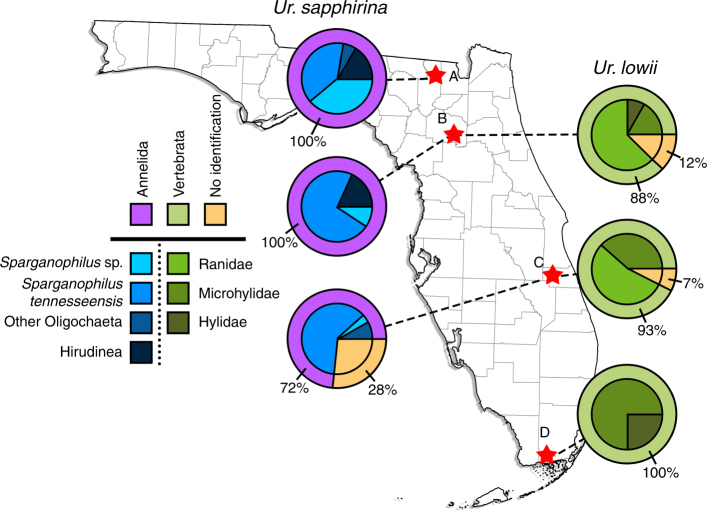
Fig. 1
Fig. 1
Host use patterns of Ur. sapphirina and Ur. Lowii. Mosquitoes were collected in four counties (A–D) along the Florida Peninsula, USA, and host use patterns were determined by diagnostic PCR screening of blood meals for annelid and vertebrate DNA. Results of PCR screens for vertebrate and annelid DNA in the blood meals of 88 Ur. sapphirina (left) and 44 Ur. lowii (right), collected from Columbia Co. (A) Alachua Co. (B), Indian River Co. (C), or Miami-Dade Co. (D). Pink shading of outer rings indicates the proportion of blood meals that screened positive for annelid DNA and were confirmed by Sanger sequencing. Green shading on outer rings indicates the proportion of blood meals that screened positive for vertebrate DNA and were confirmed by Sanger sequencing. Orange shading on outer rings and inner circles indicates the proportion of blood meals that either did not produce an amplicon or resulted in ambiguous sequences that could not be attributed to a host taxon. Blue shading of inner circles represents the proportion of blood meals derived from various annelid taxa, as determined by DNA sequences. Green shading of inner circles represents the proportion of blood meals derived from various vertebrate taxa, as determined by DNA sequences. Excluding unidentified blood meals (orange shading), the proportion of annelid and vertebrate hosts overall was significantly different between Ur. sapphirina and Ur. lowii (two-sided Fisher’s Exact Test; P< 0.001). Map created using data obtained from the Florida Geographic Data Library
Fig. 2
Fig. 2
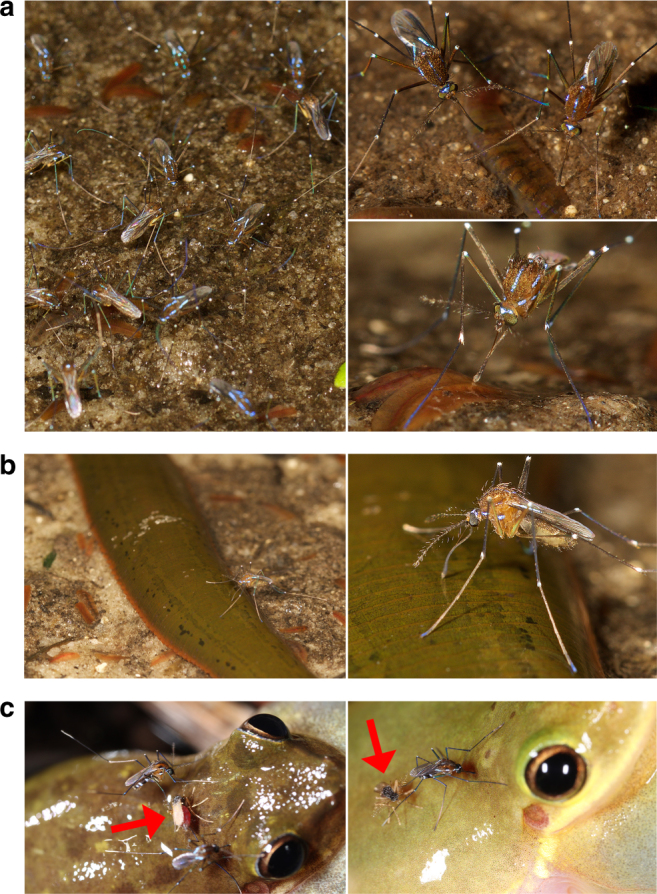
Interactions between Uranotaenia, Corethrella, and hosts. a, b Female Uranotaenia sapphirina were observed, photographed, and filmed at River Styx, Alachua Co., Florida, USA. a Congregations of female mosquitoes were observed questing among and feeding from partially submerged Sparganophilus earthworms. b Female Uranotaenia sapphirina feeding from the leech Macrobdella ditetra; note reflexed labium and exposed stylets. c Females of Uranotaenia lowii and frog-biting midges (Corethrellidae; indicated by red arrows) feeding from Hyla squirella, Miami-Dade Co., Florida, USA
Fig. 3
Fig. 3
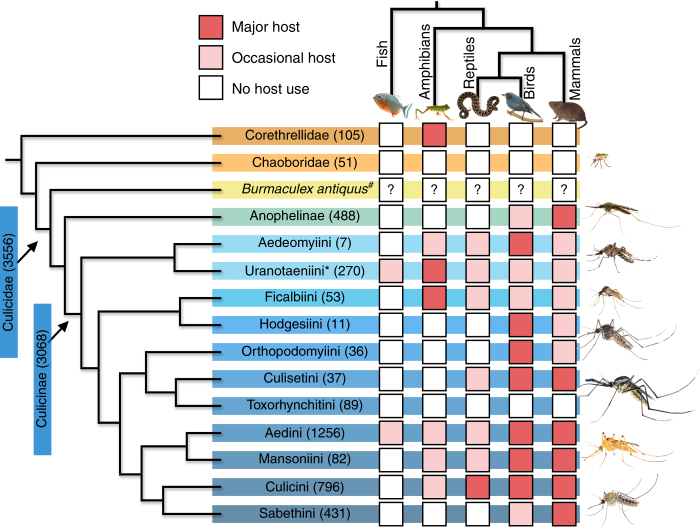
Patterns of blood-feeding on vertebrate host classes for Culicidae and related lineages (Corethrellidae and Chaoboridae). Composite image adapted using phylogeny from Harbach and Kitching and Borkent and Grimaldi. Numbers in parentheses following mosquito taxa indicate number of species within each taxon, , . Shading of squares indicates the degree to which mosquito or related lineages interact with vertebrate classes, , , , , , , , , , , , –. Uranotaenia sapphirina is contained within tribe Uranotaeniini*. All mosquito lineages are extant except Burmaculex antiquus#, the oldest known fossil mosquito, from the middle Cretaceous (110 mya). Burmaculex antiquus is presumed to have been a blood feeder, but had a moderately elongate proboscis and lacked the palpal sensillae that function as CO2 receptors for host location in modern mosquitoes

References

    1. Finlay C. The mosquito hypothetically considered as an agent in the transmission of yellow fever poison. New Orleans Med. Surg. J. 1881;9:601–616. - PMC - PubMed
    1. Cupp EW, Klingler K, Hassan HK, Viguers LM, Unnasch TR. Transmission of Eastern equine encephalomyelitis virus in central Alabama. Am. J. Trop. Med. Hyg. 2003;68:495–500. - PMC - PubMed
    1. Andreadis TG, Anderson JF, Vossbrinck CR, Main AJ. Epidemiology of West Nile virus in Connecticut: a five-year analysis of mosquito data 1999-2003. Vector Borne Zoonotic Dis. 2004;4:360–378. doi: 10.1089/vbz.2004.4.360. - DOI - PubMed
    1. Armstrong PM, Andreadis TG. Eastern equine encephalitis virus in mosquitoes and their role as bridge vectors. Emerg. Infect. Dis. 2010;16:1869–1874. doi: 10.3201/eid1612.100640. - DOI - PMC - PubMed
    1. Wilkerson RC, et al. Making mosquito taxonomy useful: a stable classification of tribe Aedini that balances utility with current knowledge of evolutionary relationships. PLoS ONE. 2015;10:e0133602. doi: 10.1371/journal.pone.0133602. - DOI - PMC - PubMed

LinkOut - more resources