. 2018 Dec;40(6):3213-3222.
doi: 10.3892/or.2018.6723. Epub 2018 Sep 21.

Xanthohumol, a prenylated flavonoid from Hops, exerts anticancer effects against gastric cancer in vitro

Affiliations

Xanthohumol, a prenylated flavonoid from Hops, exerts anticancer effects against gastric cancer in vitro

Shanshan Wei et al. Oncol Rep. 2018 Dec.

Abstract

Xanthohumol (Xn), a prenylated flavonoid isolated from Hops (Humulus lupulus L.), has demonstrated potent anticancer activity in multiple types of cancer. However, the effect of Xn on gastric cancer (GC) remains unknown. The aim of the present study was to investigate the effect of Xn on GC cell proliferation, apoptosis and metastasis. It was observed that Xn decreased the viability of GC cells, with very low or no toxicity to normal gastric epithelial cells GES‑1 at a concentration of 1‑100 µM. The proliferation of AGS cells was inhibited by Xn, as indicated by the decreased number of EdU‑positive cells. Xn treatment increased the number of apoptotic cells, downregulated the expression of Bcl‑2 and upregulated the expression of Bax, suggesting induction of apoptosis. The results from the wound healing and Transwell assays indicated that Xn suppressed AGS cell metastasis. Moreover, Xn induced reactive oxygen species (ROS) overproduction and inhibited nuclear factor (NF)‑κB signaling in AGS cells, which was reversed by the ROS inhibitor N‑acetylcysteine (NAC). NAC suppressed the effect of Xn on the proliferation, apoptosis and metastasis of AGS cells. Taken together, these results suggest that Xn exerts anticancer effects against GC via induction of ROS production and subsequent inhibition of NF‑κB signaling. Therefore, Xn may be a promising candidate treatment against GC progression.


Figures
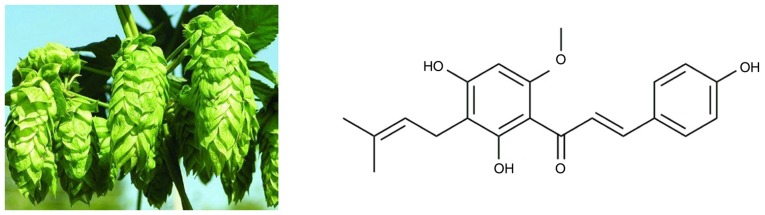
Figure 1.
Figure 1.
Hops (Humulus lupulus L.) and structure of xanthohumol.
Figure 2.
Figure 2.
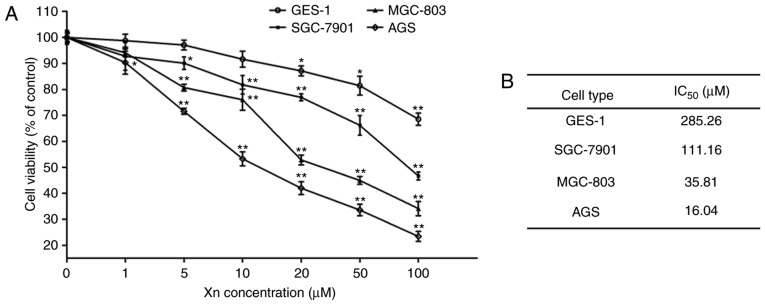
Cytotoxicity of xanthohumol (Xn) on GC cells and normal gastric epithelial cells. (A) GC cells (MGC-803, SGC-7901 and AGS) and normal gastric epithelial cells (GES-1) were treated with Xn at concentrations of 0–100 µM for 24 h. (B) The IC50 for each cancer cell line was calculated according to the data in (A). Cell viability was determined by the MTS assay. Treatment with 0 µM Xn was used as control. Data are expressed as mean ± standard error of the mean. n=3. *P<0.05, **P<0.01 vs. control (0 µM Xn).
Figure 3.
Figure 3.
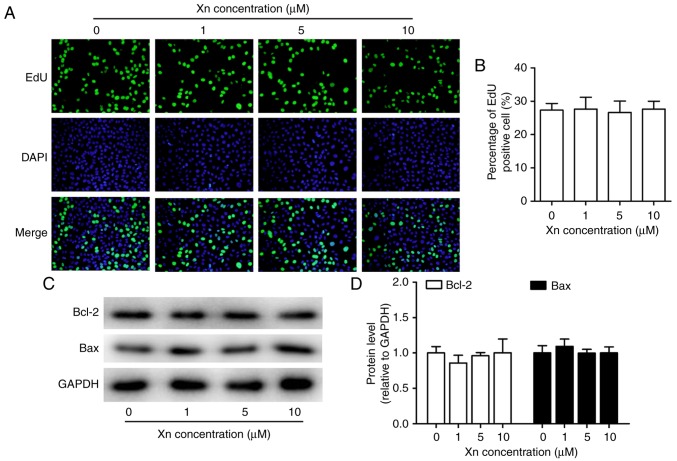
Effect of xanthohumol (Xn) on the proliferation and apoptosis of GES-1 cells. Cells were treated with different concentrations of Xn (0–10 µM) for 24 h. After treatment, (A) EdU incorporation assay was used to assess the proliferative ability; representative images are shown. (B) Percentage of EdU-positive cells. (C and D) The expression of apoptosis-related proteins, including pro-apoptosis protein Bax and anti-apoptosis protein Bcl-2, was measured through western blotting. Data are expressed as mean ± standard error of the mean. n=3.
Figure 4.
Figure 4.
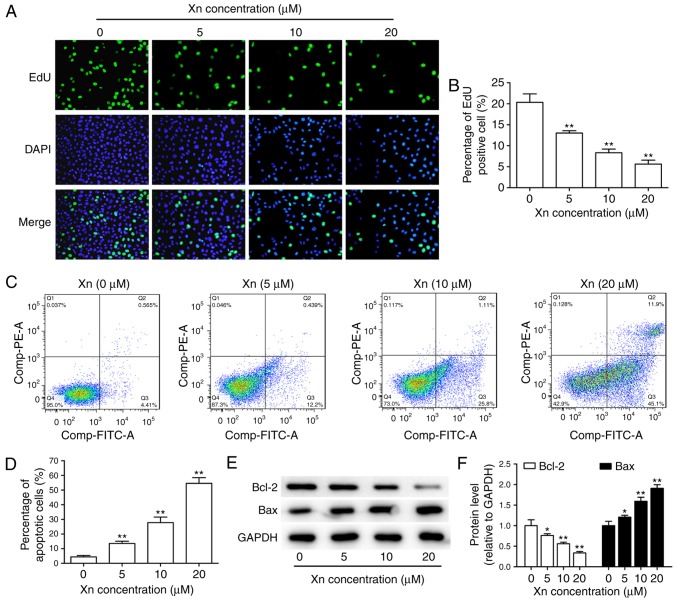
Effect of xanthohumol (Xn) on the proliferation and apoptosis of AGS cells. Cells were treated with different concentrations of Xn (0–20 µM) for 24 h. After treatment, (A) EdU incorporation assay was used to assess cell proliferative ability; representative images are shown. (B) Percentage of EdU-positive cells. (C and D) The number of apoptotic cells was determined by flow cytometry. (E and F) The expression of apoptosis-related proteins, including pro-apoptotic protein Bax and anti-apoptotic protein Bcl-2, was measured through western blotting. Data are expressed as mean ± standard error of the mean. n=3. *P<0.05, **P<0.01 vs. control (0 µM Xn).
Figure 5.
Figure 5.
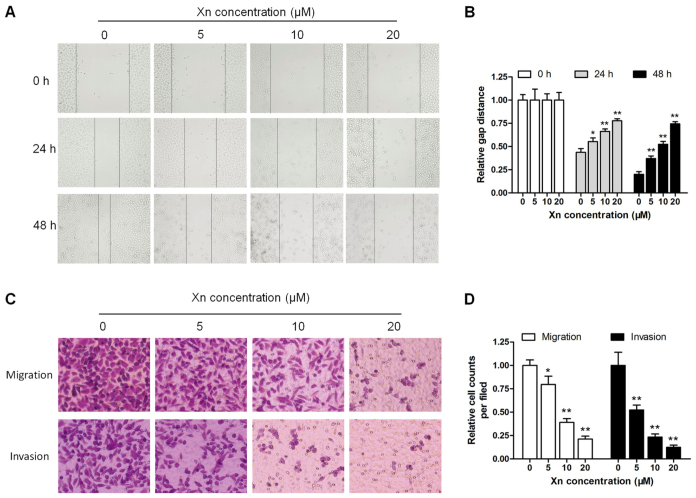
Effect of xanthohumol (Xn) on wound healing, migration and invasion of AGS cells. (A and B) Cells were treated with different concentrations of Xn (0–20 µM) for 0, 24 and 48 h, followed by measurement of the relative wound width. (C and D) The Transwell assay was performed to evaluate cell migration and invasion ability; cells were treated with Xn as mentioned above in culture wells for 24 h, and the migrating and invading cells were stained by crystal violet solution. Data are expressed as mean ± standard error of the mean. n=3. *P<0.05, **P<0.01 vs. control (0 µM Xn).
Figure 6.
Figure 6.
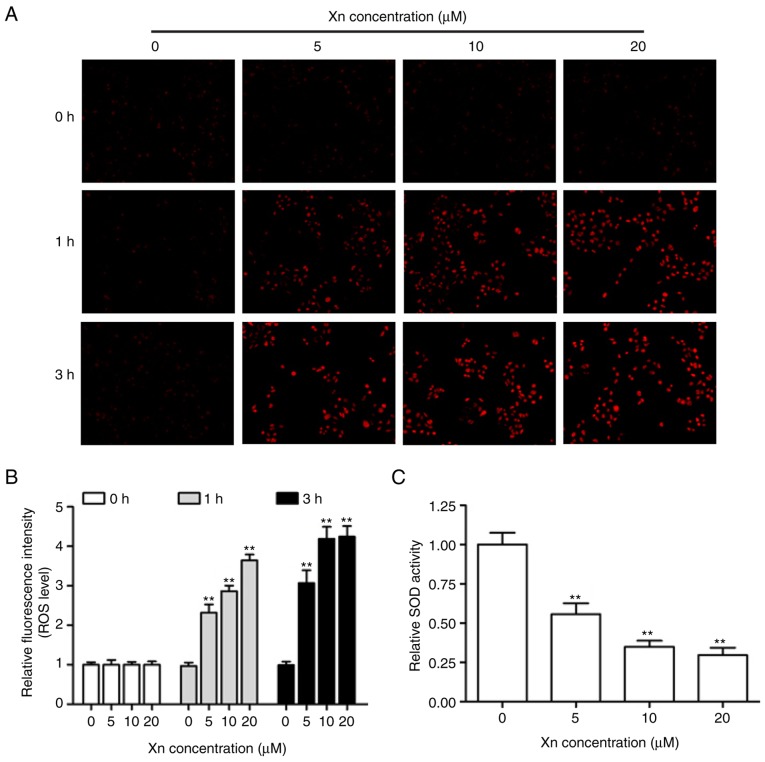
Effect of xanthohumol (Xn) on reactive oxygen species (ROS) production and superoxide dismutase (SOD) activity in AGS cells. (A and B) Cells were treated with different concentrations of Xn (0–20 µM) for 0, 1 and 3 h, followed by measurement of ROS levels. Representative fluorescence images were captured, and red fluorescence intensity reflected the ROS level. (C) SOD activity was determined after the cells were treated with Xn as mentioned above for 3 h. Data are expressed as mean ± standard error of the mean. n=3. **P<0.01 vs. control (0 µM Xn).
Figure 7.
Figure 7.
Effect of the reactive oxygen species (ROS) inhibitor N-acetylcysteine (NAC) on the anticancer activity of xanthohumol (Xn) against GC. Cells were pretreated with the ROS inhibitor NAC (5 mM) for 1 h, and then treated with Xn (20 µM) for 3 h, followed by measurement of ROS level. (A and B) Representative fluorescence images were captured, and red fluorescence intensity reflected the ROS level. Cells were pretreated with NAC (5 mM) for 1 h, and then treated with Xn (20 µM) for 24 h. (C) The EdU incorporation assay was used to assess cell proliferation ability; representative images are shown. (D) Percentage of EdU-positive cells. (E and F) The expression of apoptosis-related proteins, including the pro-apoptotic protein Bax and the anti-apoptotic protein Bcl-2, was measured through western blotting. (G and H) The relative wound width was measured following treatment with Xn for 0 and 48 h. Con, control. Data are expressed as mean ± standard error of the mean. n=3. **P<0.01 vs. control (0 µM Xn); ##P<0.01 vs. Xn (20 µM Xn).
Figure 8.
Figure 8.
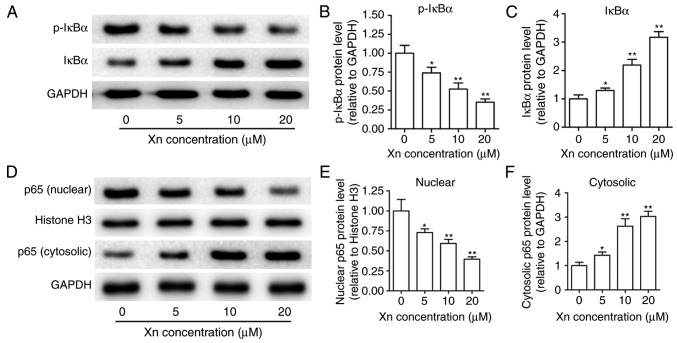
Effect of xanthohumol (Xn) on the nuclear factor (NF)-κB signaling pathway in AGS cells. Cells were treated with different concentrations of Xn (0–20 µM) for 24 h, then harvested and lysed to measure NF-κB signaling proteins through western blotting. (A-C) Effects of Xn on IκBα and p-IκBα expression. (D-F) Effect of Xn on nuclear and cytosolic p65 expression. Histone H3 served as the nuclear loading control and GAPDH served as the cytosolic loading control. Data are expressed as mean ± standard error of the mean. n=3. *P<0.05, **P<0.01 vs. control (0 µM Xn).
Figure 9.
Figure 9.
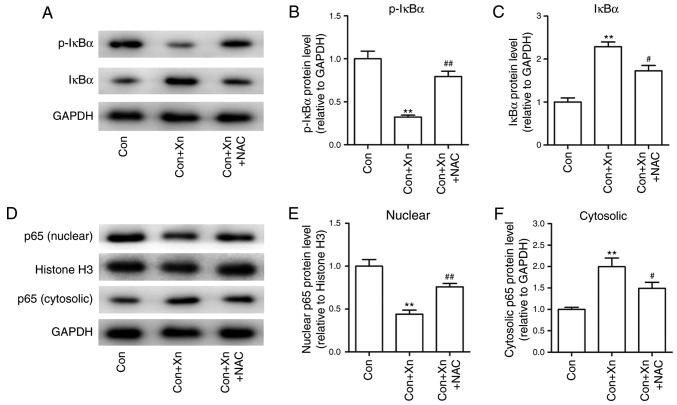
Effect of the reactive oxygen species (ROS) inhibitor N-acetylcysteine (NAC) on the nuclear factor (NF)-κB signaling pathway in xanthohumol (Xn)-treated AGS cells. Cells were pre-treated with the ROS inhibitor NAC (5 mM) for 1 h, and then treated with Xn (20 µM) for 24 h; they were then harvested and lysed to measure NF-κB signaling proteins through western blotting. (A-C) Expression of IκBα and p-IκBα protein; (D-F) Expression of nuclear and cytosolic p65 protein. Histone H3 served as the nuclear loading control, GAPDH served as the cytosolic loading control. Data are expressed as mean ± standard error of the mean. n=3. **P<0.01 vs. control (0 µM Xn); #P<0.05, ##P<0.01 vs. Xn (20 µM Xn).

References

    1. Ajani JA, Bentrem DJ, Besh S, D'Amico TA, Das P, Denlinger C, Fakih MG, Fuchs CS, Gerdes H, Glasgow RE, et al. Gastric cancer, version 2.2013: Featured updates to the NCCN Guidelines. J Natl Compr Cancer Netw. 2013;11:531–546. doi: 10.6004/jnccn.2013.0070. - DOI - PubMed
    1. Gong J, Cao J, Liu G, Huo JR. Function and mechanism of F-box proteins in gastric cancer (Review) Int J Oncol. 2015;47:43–50. doi: 10.3892/ijo.2015.2983. - DOI - PubMed
    1. Singh S, Sharma B, Kanwar SS, Kumar A. Lead phytochemicals for anticancer drug development. Front Plant Sci. 2016;7:1667. doi: 10.3389/fpls.2016.01667. - DOI - PMC - PubMed
    1. Hosseini A, Ghorbani A. Cancer therapy with phytochemicals: Evidence from clinical studies. Avicenna J Phytomed. 2015;5:84–97. - PMC - PubMed
    1. Chen QH, Fu ML, Chen MM, Liu J, Liu XJ, He GQ, Pu SC. Preparative isolation and purification of xanthohumol from hops (Humulus lupulus L.) by high-speed counter-current chromatography. Food Chem. 2012;132:619–623. doi: 10.1016/j.foodchem.2011.10.098. - DOI - PubMed

MeSH terms