. 2019 Feb:100:32-40.
doi: 10.1016/j.psyneuen.2018.09.024. Epub 2018 Sep 22.

Amygdalar activity predicts future incident diabetes independently of adiposity

Affiliations

Amygdalar activity predicts future incident diabetes independently of adiposity

Michael T Osborne et al. Psychoneuroendocrinology. 2019 Feb.

Abstract

While it is established that psychosocial stress increases the risk of developing diabetes mellitus (DM), two key knowledge gaps remain: 1) the neurobiological mechanisms that are involved in mediating that risk, and 2) the role, if any, that adiposity plays in that mechanism. We tested the hypotheses that: 1) metabolic activity in the amygdala (AmygA), a key center involved in the neurobiological response to stress, associates with subsequent DM risk, and 2) this association is independent of adiposity. AmygA and adipose tissue volumes were measured, and serial blood assessments for DM were obtained in 232 subjects who underwent combined 18F-fluorodeoxyglucose positron emission tomography/computed tomography (18F-FDG-PET/CT) imaging. Higher baseline AmygA predicted subsequent, new-onset DM, independently of adiposity and other DM risk factors. Furthermore, higher adiposity only increased DM risk in the presence of higher AmygA. In a separate cross-sectional cohort, higher AmygA associated with higher insulin resistance. Accordingly, the current study shows, for the first time, that activity in a stress-responsive neural region predicts the onset of DM. Further, we observed that this neurobiological activity acts independently of, but also synergistically with adiposity to increase DM risk. These findings suggest novel therapeutic targets to help manage and possibly prevent DM.

Keywords: Amygdala; Diabetes mellitus; Positron emission tomography/computed tomography; Visceral adiposity.


Figures

Figure 1.
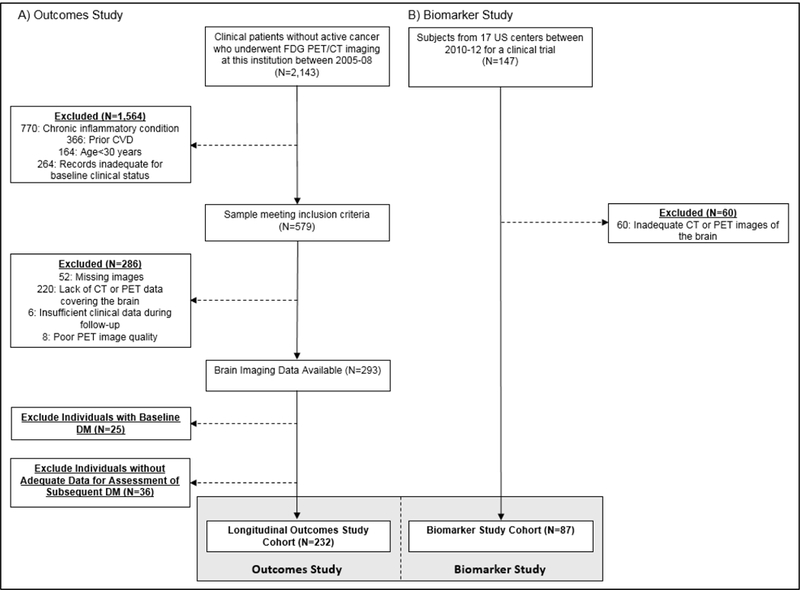
Figure 1.. (A) Outcomes study subject selection. (B) Biomarker study subject selection
Abbreviations: CVD: cardiovascular disease, CT: computed tomography, DM: diabetes mellitus, FDG: fluorodeoxyglucose, LDL: low density lipoprotein, PET: positron emission tomography.
Figure 2.
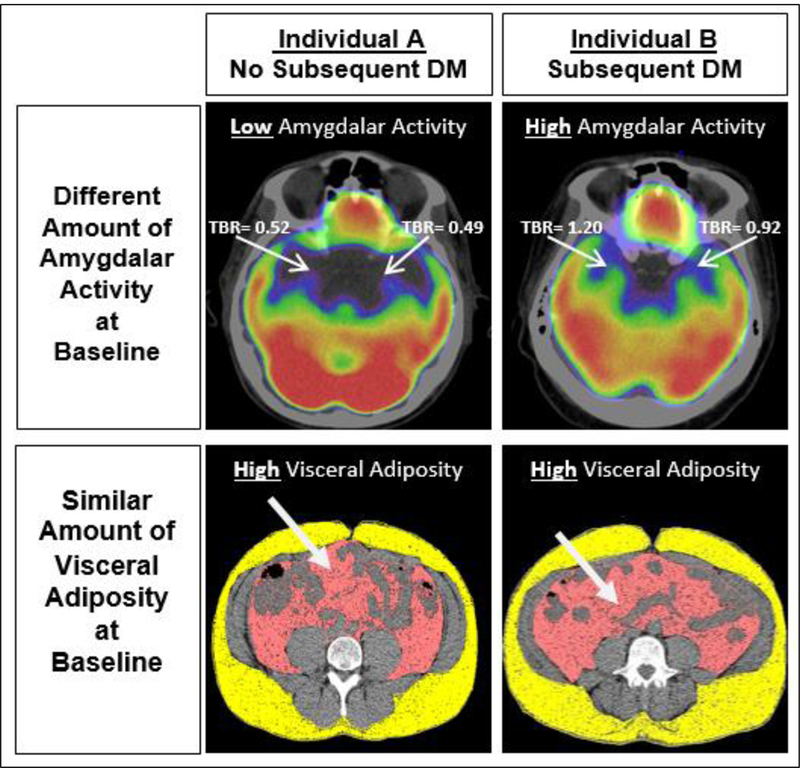
Figure 2.. Imaging of amygdalar activity and adiposity in individuals with vs. without subsequent type 2 diabetes.
Axial views of amygdala (upper right and left 18F-FDG-PET/CT images) and adipose tissues are shown (lower right and left CT images) from two individuals. Both individuals were obese and had similar amounts of visceral adipose tissue. However, AmygA was increased in the individual who developed DM (right) compared to the individual who did not (left). Abbreviations: DM: diabetes mellitus, TBR: target-to-background ratio.
Figure 3.
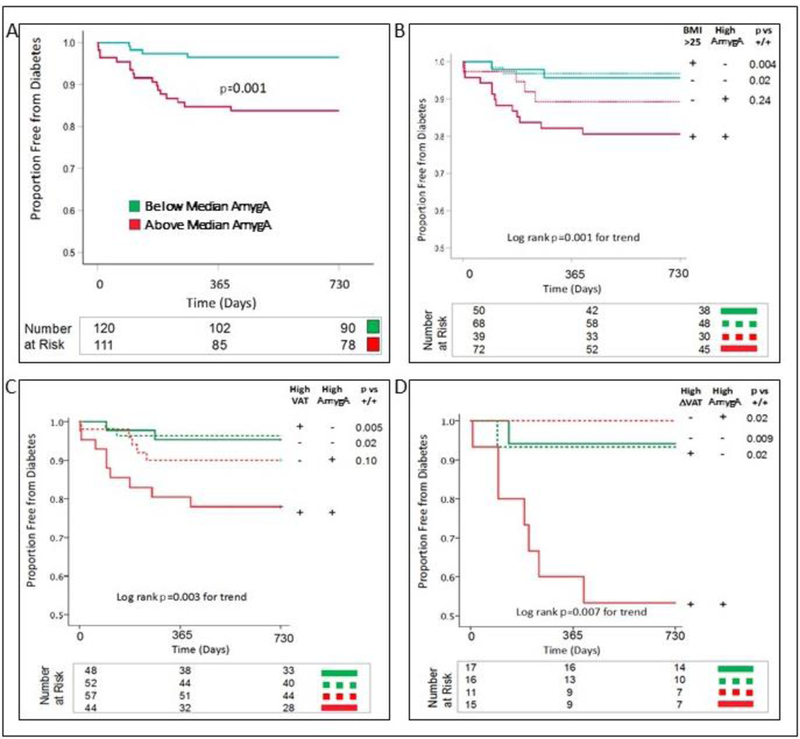
Figure 3.. Kaplan-Meier curves showing type 2 diabetes-free survival as a function of amygdalar activity alone (A) and as a function of both amygdalar activity and (B) body mass index, (C) visceral adipose tissue, and (D) subsequent change in visceral adipose tissue.
A. Subjects were categorized by baseline AmygA [< (green) or ≥ (red) sample median]. Those with high AmygA had substantially higher incidence of DM. The total number of subjects assessed is 231, as one individual did not provide cerebral background data to calculate the pre-specified AmygA endpoint. B. Subjects were categorized by baseline AmygA [< (green) or ≥ (red) sample median] and baseline BMI [< (dashed) or ≥ (solid) 25 kg/m2]. Those with high AmygA and BMI had substantially higher incidence of DM. The total number of subjects assessed is 229, as one individual did not provide cerebral background data to calculate the pre-specified AmygA endpoint, and two subjects did not provide height data to calculate BMI. C. Subjects were categorized by baseline AmygA [< (green) or ≥ (red) sample median] and baseline VAT [< (dashed) or ≥ (solid) sample median]. Those with high AmygA and VAT had substantially higher incidence of DM. The total number of subjects assessed is 201, as one individual did not provide cerebral background data to calculate the pre-specified AmygA endpoint, and 30 individuals did not provide data for measurement of VAT. D.Subjects were categorized by baseline AmygA [< (green) or ≥ (red) sample median] and subsequent change in VAT [< (dashed) or ≥ (solid) sample median]. Those with high AmygA and change in VAT had substantially higher incidence of DM. Serial VAT measurements were available in 59 individuals. Abbreviations: AmygA: amygdalar activity, BMI: body mass index, DM: diabetes mellitus, VAT: visceral adipose tissue.

References

    1. Adam TC, Epel ES, 2007. Stress, eating and the reward system. Physiology & Behavior 91, 449–458. - PubMed
    1. American Diabetes Association, 2016. 2. Classification and Diagnosis of Diabetes. Diabetes Care 39, S13–22. - PubMed
    1. Bartolomucci A, Cabassi A, Govoni P, Ceresini G, Cero C, Berra D, Dadomo H, Franceschini P, Dell’Omo G, Parmigiani S, Palanza P, 2009. Metabolic consequences and vulnerability to diet- induced obesity in male mice under chronic social stress. PLoS One 4, e4331. - PMC - PubMed
    1. Bremner JD, Vermetten E, Schmahl C, Vaccarino V, Vythilingam M, Afzal N, Grillon C, Charney DS, 2005. Positron emission tomographic imaging of neural correlates of a fear acquisition and extinction paradigm in women with childhood sexual-abuse-related post-traumatic stress disorder. Psychological Medicine 35, 791–806. - PMC - PubMed
    1. Britz-Cunningham SH, Millstine JW, Gerbaudo VH, 2008. Improved discrimination of benign and malignant lesions on FDG PET/CT, using comparative activity ratios to brain, basal ganglia, or cerebellum. Clinical Nuclear Medicine 33, 681–687. - PubMed

Publication types

MeSH terms