


Role of Hydrogen Sulfide in NRF2- and Sirtuin-Dependent Maintenance of Cellular Redox Balance
- PMID: 30274149
- PMCID: PMC6210431
- DOI: 10.3390/antiox7100129
Role of Hydrogen Sulfide in NRF2- and Sirtuin-Dependent Maintenance of Cellular Redox Balance
Abstract
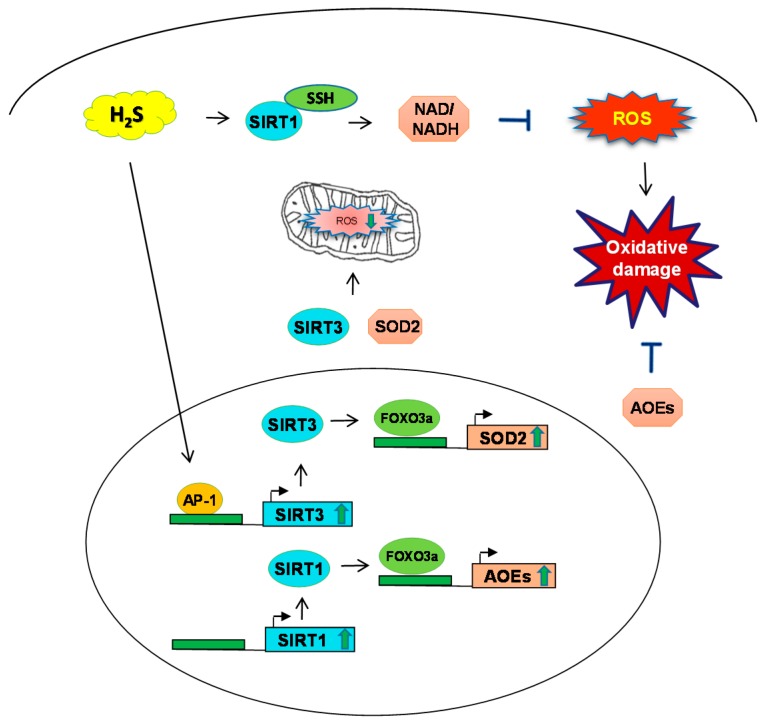
Hydrogen sulfide (H₂S) has arisen as a critical gasotransmitter signaling molecule modulating cellular biological events related to health and diseases in heart, brain, liver, vascular systems and immune response. Three enzymes mediate the endogenous production of H₂S: cystathione β-synthase (CBS), cystathione γ-lyase (CSE) and 3-mercaptopyruvate sulfurtransferase (3-MST). CBS and CSE localizations are organ-specific. 3-MST is a mitochondrial and cytosolic enzyme. The generation of H₂S is firmly regulated by these enzymes under normal physiological conditions. Recent studies have highlighted the role of H₂S in cellular redox homeostasis, as it displays significant antioxidant properties. H₂S exerts antioxidant effects through several mechanisms, such as quenching reactive oxygen species (ROS) and reactive nitrogen species (RNS), by modulating cellular levels of glutathione (GSH) and thioredoxin (Trx-1) or increasing expression of antioxidant enzymes (AOE), by activating the transcription factor nuclear factor (erythroid-derived 2)-like 2 (NRF2). H₂S also influences the activity of the histone deacetylase protein family of sirtuins, which plays an important role in inhibiting oxidative stress in cardiomyocytes and during the aging process by modulating AOE gene expression. This review focuses on the role of H₂S in NRF2 and sirtuin signaling pathways as they are related to cellular redox homeostasis.
Keywords: NRF2; hydrogen sulfide; oxidative stress; redox; sirtuin.
Conflict of interest statement
The authors declare no conflict of interest.
Figures


References
-
- Perna A.F., Luciano M.G., Ingrosso D., Raiola I., Pulzella P., Sepe I., Lanza D., Violetti E., Capasso R., Lombardi C., et al. Hydrogen sulfide, the third gaseous signaling molecule with cardiovascular properties, is decreased in hemodialysis patients. J. Ren. Nutr. 2010;20:S11–S14. doi: 10.1053/j.jrn.2010.05.004. - DOI - PubMed
Publication types
Grants and funding
LinkOut - more resources
Full Text Sources
