


A Review of Scrub Typhus (Orientia tsutsugamushi and Related Organisms): Then, Now, and Tomorrow
- PMID: 30274407
- PMCID: PMC6136631
- DOI: 10.3390/tropicalmed3010008
A Review of Scrub Typhus (Orientia tsutsugamushi and Related Organisms): Then, Now, and Tomorrow
Abstract
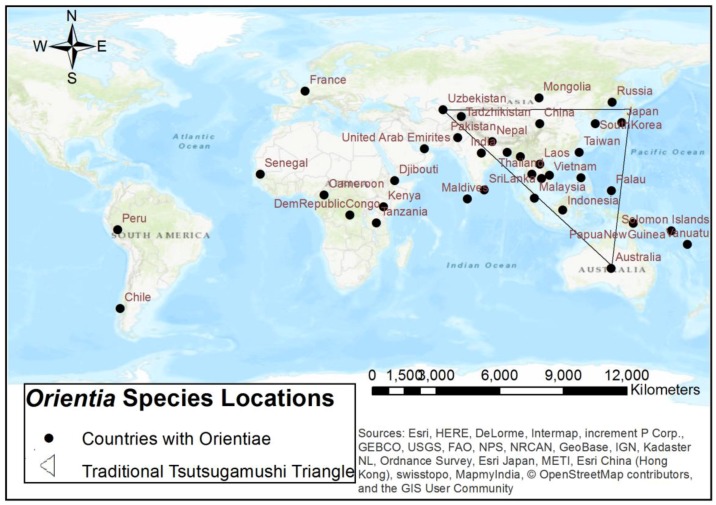
Scrub typhus and the rickettsial diseases represent some of the oldest recognized vector-transmitted diseases, fraught with a rich historical aspect, particularly as applied to military/wartime situations. The vectors of Orientia tsutsugamushi were once thought to be confined to an area designated as the Tsutsugamushi Triangle. However, recent reports of scrub typhus caused by Orientia species other than O. tsutsugamushi well beyond the limits of the Tsutsugamushi Triangle have triggered concerns about the worldwide presence of scrub typhus. It is not known whether the vectors of O. tsutsugamushi will be the same for the new Orientia species, and this should be a consideration during outbreak/surveillance investigations. Additionally, concerns surrounding the antibiotic resistance of O. tsutsugamushi have led to considerations for the amendment of treatment protocols, and the need for enhanced public health awareness in both the civilian and medical professional communities. In this review, we discuss the history, outbreaks, antibiotic resistance, and burgeoning genomic advances associated with one of the world's oldest recognized vector-borne pathogens, O. tsutsugamushi.
Keywords: Orientia; Orientia tsutsugamushi; chiggers; mites; rickettsia; scrub typhus.
Conflict of interest statement
The opinions and assertions contained in this paper are the private views of the authors and are not to be construed as official or as reflecting the views of the Department of the Army, the Department of the Navy, the Department of Defense and the United States Government. The authors have no conflict of interests concerning this work.
Figures
References
-
- World Health Organization . WHO Recommended Surveillance Standards. World Health Organization; Geneva, Switzerland: 1999.
-
- Izzard L., Fuller A., Blacksell S.D., Paris D.H., Richards A.L., Aukkanit N., Nguyen C., Jiang J., Fenwick S., Day N.P., et al. Isolation of a novel Orientia species (O. chuto sp. nov.) from a patient infected in Dubai. J. Clin. Microbiol. 2010;48:4404–4409. doi: 10.1128/JCM.01526-10. - DOI - PMC - PubMed
-
- Dumler J.S., Barbet A.F., Bekker C., Dasch G.A., Palmer G.H., Ray S.C., Rikihisa Y., Rurangirwa F.R. Reorganization of genera in the families Rickettsiaceae and Anaplasmataceae in the order Rickettsiales: Unification of some species of Ehrlichia with Anaplasma, Cowdria with Ehrlichia and Ehrlichia with Neorickettsia, descriptions of six new species combinations and designation of Ehrlichia equi and ‘HGE agent’ as subjective synonyms of Ehrlichia phagocytophila. Int. J. Syst. Evol. Microbiol. 2001;51:2145–2165. - PubMed
-
- Odhiambo A.M., Maina A.N., Taylor M.L., Jiang J., Richards A.L. Development and validation of a quantitative real-time polymerase chain reaction assay specific for the detection of Rickettsia felis and not Rickettsia felis-like organisms. Vector-Borne Zoonotic Dis. 2014;14:476–481. doi: 10.1089/vbz.2013.1518. - DOI - PubMed
Publication types
Grants and funding
LinkOut - more resources
Full Text Sources
