Review
. 2018 Jan 25;3(1):11.
doi: 10.3390/tropicalmed3010011.

Scrub Typhus: No Longer Restricted to the Tsutsugamushi Triangle

Affiliations
Review

Scrub Typhus: No Longer Restricted to the Tsutsugamushi Triangle

Ju Jiang et al. Trop Med Infect Dis. .

Abstract

Scrub typhus is the most important rickettsial disease in the world. Its previous endemic region was considered to be in Asia, Australia and islands in the Indian and Pacific Oceans; this area was referred to as the Tsutsugamushi Triangle. Accumulation of serological, molecular, genetic, and culture data have shown that not only is scrub typhus not limited to the Tsutsugamushi Triangle, but can be caused by orientiae other than Orientia tsutsugamushi. This review describes evidence currently available that will be instrumental to researchers, healthcare providers and medical leaders in developing new research projects, performing diagnosis, and preventing scrub typhus in locations not previously thought to be endemic.

Keywords: Orientia tsutsugamushi; Tsutsugamushi Triangle; endemic region; scrub typhus.


Conflict of interest statement

The authors declare no conflict of interest. The funding sponsors had no role in the design of the study; in the collection, analyses, or interpretation of data; in the writing of the manuscript, and in the decision to publish the results.

Figures
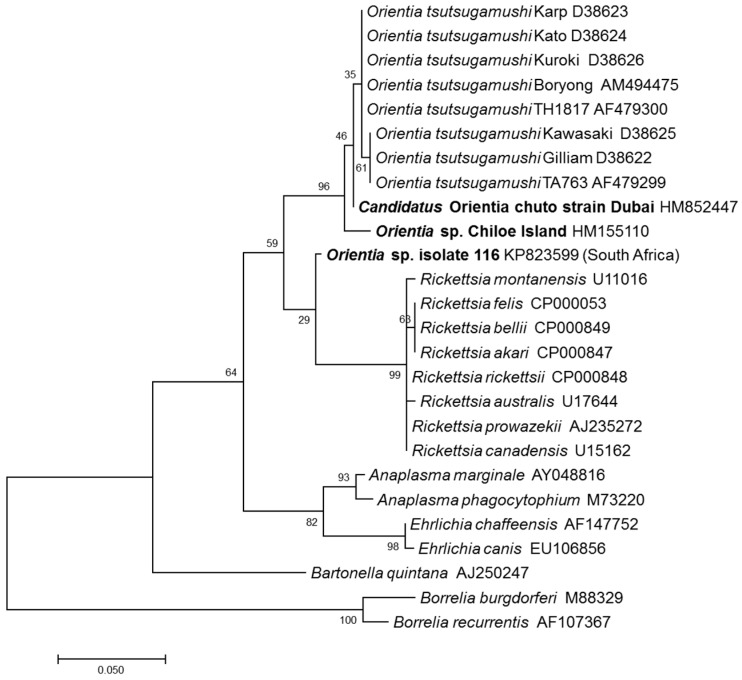
Figure 1
Figure 1
Evolutionary relationships of Orientia species (in bold) detected outside of the Tsutsugamushi Triangle compared with Orientia tsutsugamushi strains and Rickettsia species (GenBank accession numbers are shown next to each agent). The tree was based on 256 bp rrs gene fragments and constructed using the Maximum Likelihood method based on the Tamura-Nei model. Evolutionary analyses were conducted in MEGA7 and the values for the bootstrap test (1000 replicates) are shown next to the branches. The tree is drawn to scale, with branch lengths measured by the number of substitutions per site.
Figure 2
Figure 2
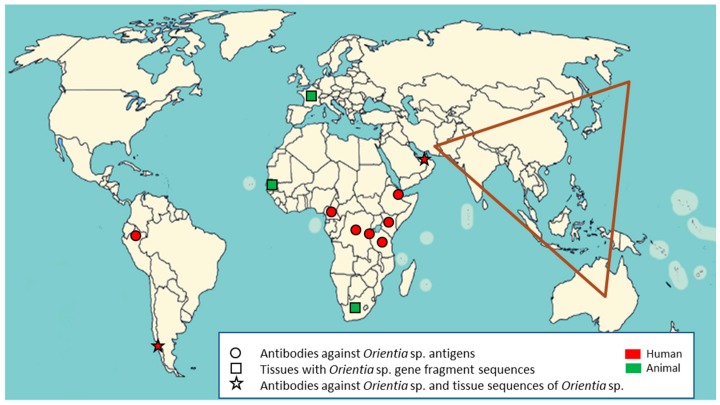
Human and animal serological and molecular evidence of Orientia spp. infections in new endemic regions of scrub typhus outside of the Tsutsugamushi Triangle (shown in brown).

References

    1. Watt G., Parola P. Scrub typhus and tropical rickettsioses. Curr. Opin. Infect. Dis. 2003;16:429–436. doi: 10.1097/00001432-200310000-00009. - DOI - PubMed
    1. Paris D.H., Shelite T.R., Day N.P., Walker D.H. Review article: Unresolved problems related to scrub typhus: A seriously neglected life-threatening disease. Am. J. Trop. Med. Hyg. 2013;89:301–307. doi: 10.4269/ajtmh.13-0064. - DOI - PMC - PubMed
    1. Kelly D.J., Richards A.L., Temenak J.J., Strickman D., Dasch G.A. The past and present threat of rickettsial diseases to military medicine and international public health. Clin. Infect. Dis. 2002;34(Suppl. s4):145–169. doi: 10.1086/339908. - DOI - PubMed
    1. Kelly D.J., Fuerst P.A., Ching W.M., Richards A.L. Scrub typhus: The geographical distribution of phenotypic and genotypic variants of Orientia tsutsugamushi. Clin. Infect. Dis. 2009;48:S203–S230. doi: 10.1086/596576. - DOI - PubMed
    1. Bonell A., Lubell Y., Newton P.N., Crump J.A., Paris D.H. Estimating the burden of scrub typhus: A systematic review. PLoS Negl. Trop. Dis. 2017;11:e0005838. doi: 10.1371/journal.pntd.0005838. - DOI - PMC - PubMed

LinkOut - more resources