


The Unique Life Cycle of Strongyloides stercoralis and Implications for Public Health Action
- PMID: 30274449
- PMCID: PMC6073624
- DOI: 10.3390/tropicalmed3020053
The Unique Life Cycle of Strongyloides stercoralis and Implications for Public Health Action
Abstract
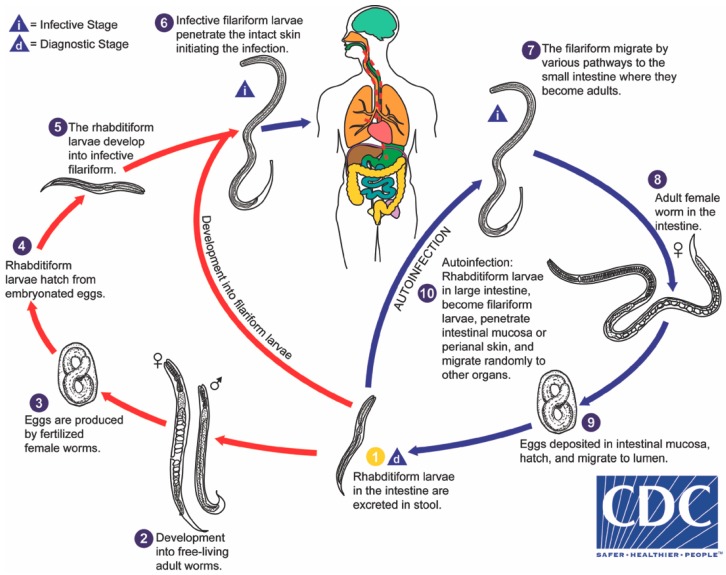
Strongyloides stercoralis has one of the most complex life cycles of the human-infecting nematodes. A common misconception in medical and public health professions is that S. stercoralis in its biology is akin to other intestinal nematodes, such as the hookworms. Despite original evidence provided by medical and veterinary research about this unique helminth, many assumptions have entered the scientific literature. This helminth is set apart from others that commonly affect humans by (a) the internal autoinfective cycle with autoinfective larvae randomly migrating through tissue, parthenogenesis, and the potential for lifelong infection in the host, the profound pathology occurring in hyperinfection and systemic manifestations of strongyloidiasis, and (b) a limited external cycle with a single generation of free-living adults. This paper aims to review and discuss original research on the unique life cycle of S. stercoralis that distinguishes it from other helminths and highlight areas where increased understanding of the parasite's biology might lead to improved public health prevention and control strategies.
Keywords: Strongyloides stercoralis; biology; control; life cycle; public health; strongyloidiasis.
Conflict of interest statement
The authors declare no conflict of interest.
Figures
References
-
- Buonfrate D., Mena M.A., Angheben A., Requena-Mendez A., Munoz J., Gobbi F., Albonico M., Gotuzzo E., Bisoffi Z., The COHEMI Project Study Group Prevalence of strongyloidiasis in Latin America: A systematic review of the literature. Epidemiol. Infect. 2015;143:452–460. doi: 10.1017/S0950268814001563. - DOI - PMC - PubMed
-
- Amor A., Rodriguez E., Saugar J.M., Arroyo A., Lopez-Quintana B., Abera B., Yimer M., Yizengaw E., Zewdie D., Ayehubizu Z., et al. High prevalence of Strongyloides stercoralis in school-aged children in a rural highland of north-western Ethiopia: The role of intensive diagnostic work-up. Parasites Vectors. 2016;9:617. doi: 10.1186/s13071-016-1912-8. - DOI - PMC - PubMed
Publication types
LinkOut - more resources
Full Text Sources
