


"A Learned Soul to Guide Me": The Voices of Those Living with Kidney Disease Inform Physical Activity Programming
- PMID: 30275654
- PMCID: PMC6158575
- DOI: 10.3138/ptc.2017-01.ep
"A Learned Soul to Guide Me": The Voices of Those Living with Kidney Disease Inform Physical Activity Programming
Abstract
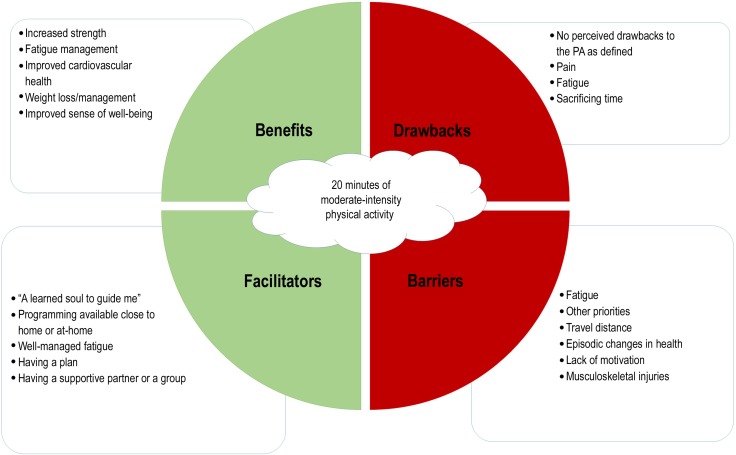
Purpose: The purpose of this study was to (a) confirm the barriers to and facilitators of physical activity (PA) among persons living with chronic kidney disease (CKD) in Ontario and (b) inform the design of a Kidney Foundation of Canada Active Living for Life programme for persons living with CKD. Method: Adults living with CKD in Ontario were invited to participate in a cross-sectional survey investigating opinions about and needs for PA programming. The 32-item survey contained four sections: programme delivery preferences, current PA behaviour, determinants of PA, and demographics. Data were summarized using descriptive statistics and thematic coding. Results: A total of 63 respondents participated. They had a mean age of 56 (SD 16) years, were 50% female, and were 54% Caucasian; 66% had some post-secondary education. The most commonly reported total weekly PA was 90 minutes (range 0-1,050 minutes). Most respondents (84%) did not regularly perform strength training, and 73% reported having an interest in participating in a PA programme. Conclusion: Individuals living with CKD require resources to support and maintain a physically active lifestyle. We identified a diversity of needs, and they require a flexible and individualized inter-professional strategy that is responsive to the episodic changes in health status common in this population.
Objectif : la présente étude visait à a) confirmer les obstacles et les incitatifs à l'activité physique (AP) chez les personnes atteintes d'une néphropathie chronique (NPC) en Ontario et b) étayer la conception du programme Une vie active pour la vie de la Fondation canadienne du rein pour les personnes atteintes d'une NPC. Méthodologie : des adultes de l'Ontario atteints d'une NPC ont été invités à participer à un sondage transversal sur leurs avis et leurs besoins liés aux programmes d'AP. Le sondage de 32 questions était divisé en quatre parties : préférences quant à la prestation du programme, comportements actuels en matière d'AP, déterminants de l'AP et démographie. Les chercheurs ont résumé les données à l'aide de statistiques descriptives et de codes thématiques. Résultats : au total, 63 répondants ont participé. Ils avaient un âge moyen de 56 ans (ÉT de 16 ans), 50 % étaient des femmes, 54 % étaient blancs et 66 % avaient une certaine éducation postsecondaire. L'AP physique hebdomadaire totale la plus déclarée était de 90 minutes (plage de 0 à 1 050 minutes). La plupart des répondants (84 %) ne faisaient pas d'entraînement musculaire régulier, et 73 % se sont dit intéressés à participer à un programme d'AP. Conclusion : les personnes atteintes d'une NPC ont besoin de ressources pour maintenir un mode de vie actif. Les chercheurs ont repéré une diversité de besoins et la nécessité d'une stratégie interprofessionnelle personnalisée qui tient compte des changements épisodiques de l'état de santé, courants dans cette population.
Keywords: community surveys; exercise; kidney diseases.
Figures
Similar articles
-
Promoting Physical Activity and Exercise in Daily Practice: Current Practices, Barriers, and Training Needs of Physiotherapists in Eastern Nigeria.Physiother Can. 2016;68(1):37-45. doi: 10.3138/ptc.2014-74. Physiother Can. 2016. PMID: 27504046 Free PMC article.
-
Motivators, barriers, and beliefs regarding physical activity in an older adult population.J Geriatr Phys Ther. 2011 Jul-Sep;34(3):138-47. doi: 10.1519/JPT.0b013e31820e0e71. J Geriatr Phys Ther. 2011. PMID: 21937904
-
An exploration of factors influencing physical activity levels amongst a cohort of people living in the community after stroke in the south of England.Disabil Rehabil. 2018 Feb;40(4):414-424. doi: 10.1080/09638288.2016.1258437. Epub 2016 Dec 28. Disabil Rehabil. 2018. PMID: 28029070
-
An exploration of physical activity and wellbeing in university employees.Perspect Public Health. 2016 May;136(3):152-60. doi: 10.1177/1757913915593103. Epub 2015 Jul 20. Perspect Public Health. 2016. PMID: 26194136 Review.
-
Physical activity and the 'pediatric inactivity triad' in children living with chronic kidney disease: a narrative review.Ther Adv Chronic Dis. 2022 Jul 16;13:20406223221109971. doi: 10.1177/20406223221109971. eCollection 2022. Ther Adv Chronic Dis. 2022. PMID: 35860687 Free PMC article. Review.
Cited by
-
Exercise training in chronic kidney disease-effects, expectations and adherence.Clin Kidney J. 2021 May 6;14(Suppl 2):ii3-ii14. doi: 10.1093/ckj/sfab012. eCollection 2021 Apr. Clin Kidney J. 2021. PMID: 33981415 Free PMC article. Review.
-
Physical Exercise in People with Chronic Kidney Disease-Practices and Perception of the Knowledge of Health Professionals and Physical Activity and Sport Science Professionals about Their Prescription.Int J Environ Res Public Health. 2022 Jan 7;19(2):656. doi: 10.3390/ijerph19020656. Int J Environ Res Public Health. 2022. PMID: 35055478 Free PMC article.
-
High-resistance inspiratory muscle strength training: a promising strategy for improving vascular health in chronic kidney disease.Front Physiol. 2025 Apr 25;16:1582777. doi: 10.3389/fphys.2025.1582777. eCollection 2025. Front Physiol. 2025. PMID: 40352145 Free PMC article.
-
Clinician's Commentary on Parsons et al.1.Physiother Can. 2018 Summer;70(3):296-297. doi: 10.3138/ptc.2017-01-cc. Physiother Can. 2018. PMID: 30311920 Free PMC article. No abstract available.
-
The Moderating Role of Health Variables on the Association between Physical Exercise and Quality of Life in Patients with End-Stage Renal Disease.Healthcare (Basel). 2023 Jul 27;11(15):2148. doi: 10.3390/healthcare11152148. Healthcare (Basel). 2023. PMID: 37570388 Free PMC article.
References
-
- Kittiskulnam P, Sheshadri A, Johansen KL.. Consequences of CKD on functioning. Semin Nephrol. 2016;36(4):305–18. 10.1016/j.semnephrol.2016.05.007. Medline:27475661 - DOI - PMC - PubMed
-
- Fraser SD, Taal MW.. Multimorbidity in people with chronic kidney disease: implications for outcomes and treatment. Curr Opin Nephrol Hypertens. 2016;25(6):465–72. 10.1097/MNH.0000000000000270. Medline:27490909 - DOI - PubMed
-
- Heiwe S, Jacobson SH.. Exercise training for adults with chronic kidney disease. Cochrane Database Syst Rev. 2011;(10):CD003236 10.1002/14651858.CD003236.pub2. Medline:21975737 - DOI - PMC - PubMed
-
- Parsons TL, King-Vanvlack CE.. Exercise and end-stage kidney disease: functional exercise capacity and cardiovascular outcomes. Adv Chronic Kidney Dis. 2009;16(6):459–81. 10.1053/j.ackd.2009.08.009. Medline:19801136 - DOI - PubMed
-
- Koufaki P, Greenwood SA, Macdougall IC, et al. . Exercise therapy in individuals with chronic kidney disease: a systematic review and synthesis of the research evidence. Annu Rev Nurs Res. 2013;31(1):235–75. 10.1891/0739-6686.31.235. Medline:24894142 - DOI - PubMed
LinkOut - more resources
Full Text Sources