Review
. 2018 Sep 26:22:24.
doi: 10.1186/s40824-018-0133-y. eCollection 2018.

New opportunities for nanoparticles in cancer immunotherapy

Affiliations
Review

New opportunities for nanoparticles in cancer immunotherapy

Wooram Park et al. Biomater Res. .

Abstract

Background: Recently, cancer immunotherapy has become standard for cancer treatment. Immunotherapy not only treats primary tumors, but also prevents metastasis and recurrence, representing a major advantage over conventional cancer treatments. However, existing cancer immunotherapies have limited clinical benefits because cancer antigens are often not effectively delivered to immune cells. Furthermore, unlike lymphoma, solid tumors evade anti-cancer immunity by forming an immune-suppressive tumor microenvironment (TME). One approach for overcoming these limitations of cancer immunotherapy involves nanoparticles based on biomaterials.

Main body: Here, we review in detail recent trends in the use of nanoparticles in cancer immunotherapy. First, to illustrate the unmet needs for nanoparticles in this field, we describe the mechanisms underlying cancer immunotherapy. We then explain the role of nanoparticles in the delivery of cancer antigens and adjuvants. Next, we discuss how nanoparticles can be helpful within the immune-suppressive TME. Finally, we summarize current and future uses of nanoparticles with image-guided interventional techniques in cancer immunotherapy.

Conclusion: Recently developed approaches for using nanoparticles in cancer immunotherapy have enormous potential for improving cancer treatment. Cancer immunotherapy based on nanoparticles is anticipated not only to overcome the limitations of existing immunotherapy, but also to generate synergistic effects via cooperation between nanoparticles and immune cells.

Keywords: Biomaterials; Cancer antigens; Cancer immunotherapy; Nanoparticle; Tumor microenvironment (TME).


Conflict of interest statement

Not applicableNot applicableThe authors declare that they have no competing interests.Springer Nature remains neutral with regard to jurisdictional claims in published maps and institutional affiliations.

Figures
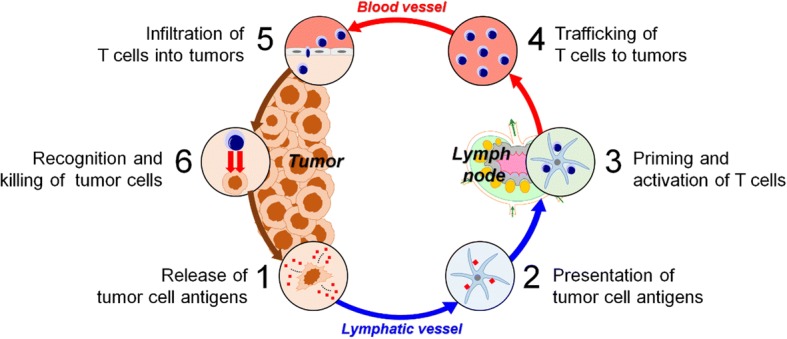
Fig. 1
Fig. 1
Cancer–immunity cycle. Tumor antigens released from tumor cells are recognized by antigen-presenting cells (APCs). Matured APCs migrate to the lymph nodes, leading to priming and proliferation of T cells. T cells activated by APCs are transferred to tumor tissues, where they kill tumor cells. Finally, tumor antigens from killed cancer cells induce another round of the immune response, leading to a cancer–immunity cycle
Fig. 2
Fig. 2
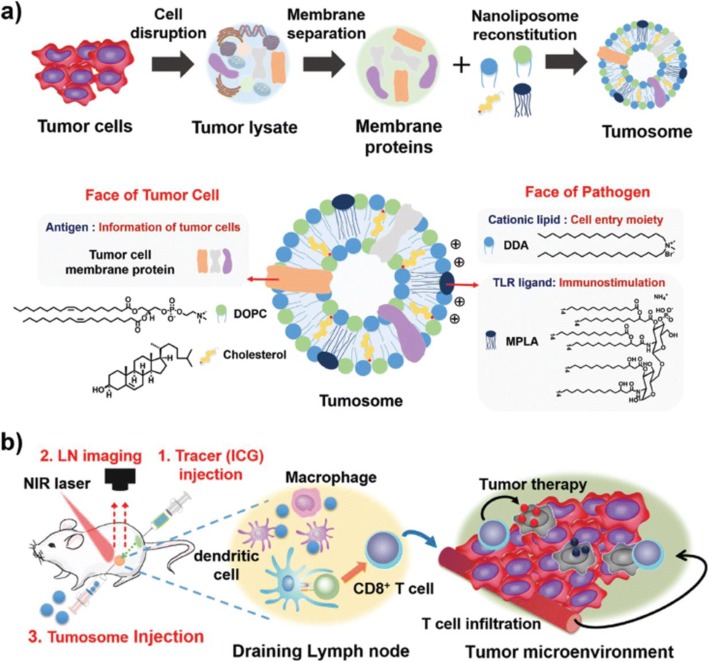
Schematic illustration of multifaceted immunomodulatory nanoliposome (tumosome)-based cancer immunotherapy. a Multifaceted tumosomes consist of tumor cell membrane proteins, as tumor-associated antigens; two immunostimulatory adjuvants (3-O-desacyl-4′-monophosphoryl lipid A [MPLA] and dimethyldioctadecylammonium bromide [DDA]), as pathogen characters; and helper lipids (1,2-dioleoyl-sn-glycero-3-phosphocholine [DOPC] and cholesterol). b Image-guided cancer immunotherapy. First, to determine the exact position of tumor-draining lymph nodes, near infrared (NIR) tracer (indocyanine green, ICG) is injected, Second, tumor-draining lymph nodes are identified using NIR optical imaging. Third, tumosomes are injected into the lymph node with the guidance of NIR imaging (reprinted with permission from Ref [54]; © 2017 Wiley-VCH)
Fig. 3
Fig. 3
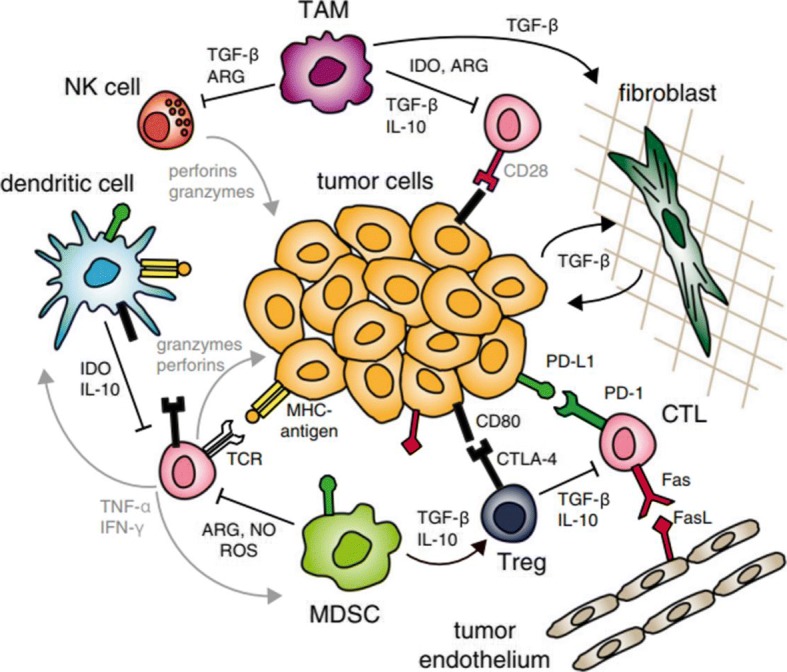
Immune-suppressive tumor microenvironment (TME). Cancer immunity mediated by CTLs is suppressed by compounds secreted by immune cells recruited to the tumor. Cancer cells also express surface molecules that contribute to anergy and exhaustion of anti-cancer immune cells (reprinted with permission from Ref [55]; © 2015 National Academy of Sciences)
Fig. 4
Fig. 4
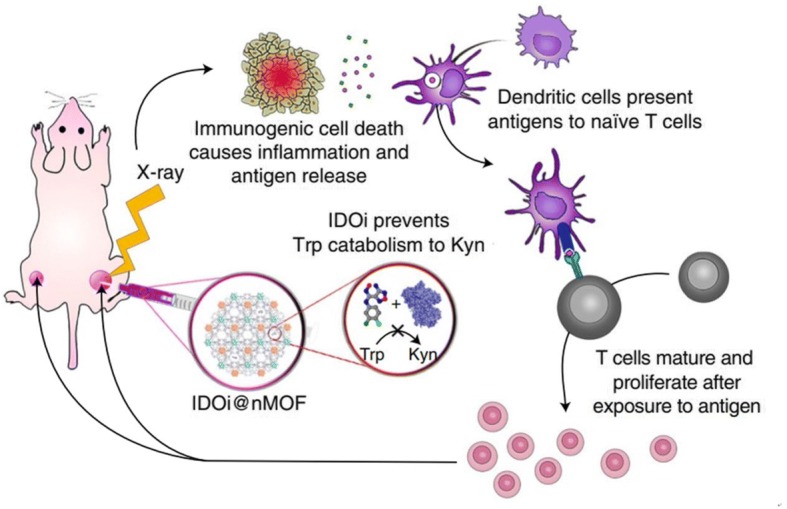
Nanoscale metal–organic framework (nMOFs) enable synergistic radiotherapy–radiodynamic therapy (RT–RDT) and immunotherapy using extremely low doses of X-rays. Indoleamine 2,3-dioxygenase inhibitor nMOF (IDOi@nMOF) was intratumorally injected into the right-side tumors of mice bearing bilateral subcutaneous tumors. Upon low-dose X-ray irradiation, IDOi@nMOF eradicated the right (irradiated) tumors in two ways: via synergistic RT–RDT, which caused both apoptosis and necrosis of cancer cells, and via immunotherapy by IDOi released from the nMOF, which overcame the suppressive tumor microenvironment by preventing catabolism of tryptophan (Trp) to kynurenine (Kyn) and subsequent T-cell anergy. Importantly, systemic IDOi activity combined with local RT–RDT induced immunogenic cell death, and antigen release led to the effective expansion and tumor infiltration of functional CD8+ T cells, which effectively suppressed or eradicated the left-side (untreated) tumors (reprinted with permission from Ref [58]; © 2018 Nature Publishing Group)
Fig. 5
Fig. 5
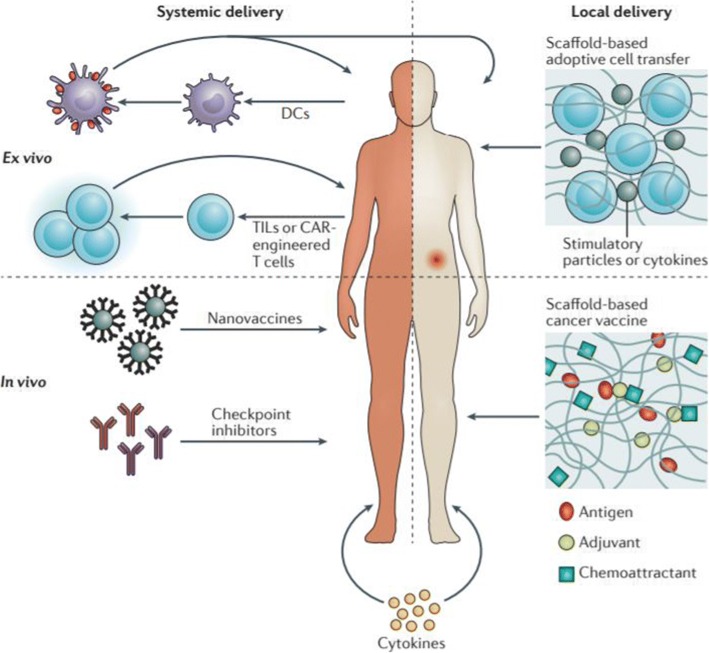
Synthetic immune niches act locally to control the anti-cancer immune response. Current immunotherapeutic strategies are often delivered intravenously, resulting in systemic exposure to immunostimulatory agents and treatment-associated toxicity. These strategies include cellular immunotherapies that deliver either ex vivo–expanded immune cell (such as dendritic cells [DCs]) vaccination; adoptive T-cell therapy using tumor-infiltrating lymphocytes (TILs) or chimeric antigen receptor (CAR)-engineered T cells (upper left); or in vivo–acting nanovaccines, immune checkpoint inhibitors, and cytokines (lower left). By contrast, local administration of immunostimulatory agents may result in more effective treatment at lower doses while simultaneously preventing systemic toxicity. Applying synthetic immune niches for scaffold-based adoptive cell transfer (upper right) or scaffold-based cancer vaccination (lower right) not only enables local immunomodulation, but also may overcome other limitations of current immunotherapeutic interventions that are related to cell delivery and sustained availability of immunostimulatory agents (reprinted with permission from Ref [78]; © 2018 Nature Publishing Group)

References

    1. Siegel RL, Miller KD, Jemal A. Cancer statistics, 2018. CA Cancer J Clin. 2018;68(1):7–30. doi: 10.3322/caac.21442. - DOI - PubMed
    1. Postow MA, Callahan MK, Wolchok JD. Immune checkpoint blockade in cancer therapy. J Clin Oncol. 2015;33(17):1974–1982. doi: 10.1200/JCO.2014.59.4358. - DOI - PMC - PubMed
    1. Phan GQ, et al. Cancer regression and autoimmunity induced by cytotoxic T lymphocyte-associated antigen 4 blockade in patients with metastatic melanoma. Proc Natl Acad Sci. 2003;100(14):8372–8377. doi: 10.1073/pnas.1533209100. - DOI - PMC - PubMed
    1. Hodi FS, et al. Improved survival with ipilimumab in patients with metastatic melanoma. N Engl J Med. 2010;363(8):711–723. doi: 10.1056/NEJMoa1003466. - DOI - PMC - PubMed
    1. Kroemer G, Zitvogel L. Cancer immunotherapy in 2017: the breakthrough of the microbiota. Nat Rev Immunol. 2018;18(2):87–88. doi: 10.1038/nri.2018.4. - DOI - PubMed