Impact of Various Types of Comorbidities on the Outcomes of Laparoscopic Total Gastrectomy in Patients with Gastric Carcinoma
- PMID: 30276002
- PMCID: PMC6160524
- DOI: 10.5230/jgc.2018.18.e27
Impact of Various Types of Comorbidities on the Outcomes of Laparoscopic Total Gastrectomy in Patients with Gastric Carcinoma
Abstract
Purpose: With increasing life expectancy, the presence of comorbidities has become a major concern in elderly patients who require surgery. However, little is known about the impact of different comorbidities on the outcomes of laparoscopic total gastrectomy (LTG). In this study, we investigated the impact of comorbidities on postoperative complications in patients undergoing LTG for gastric carcinoma.
Materials and methods: We retrospectively reviewed the cases of 303 consecutive patients who underwent LTG for gastric carcinoma between 2005 and 2016. The associations between each comorbidity and postoperative complications were assessed using univariate and multivariate analyses.
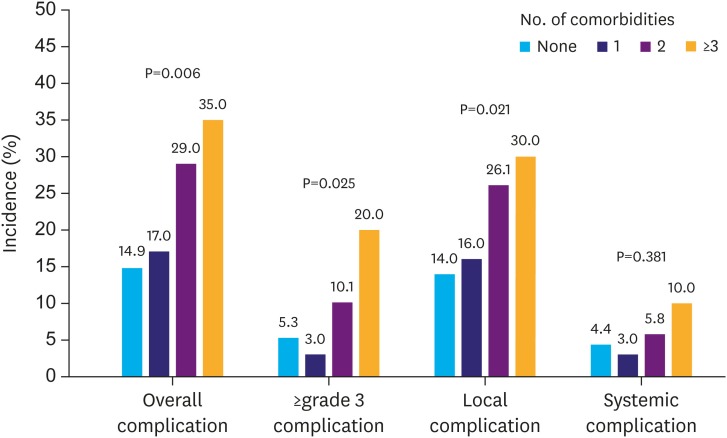
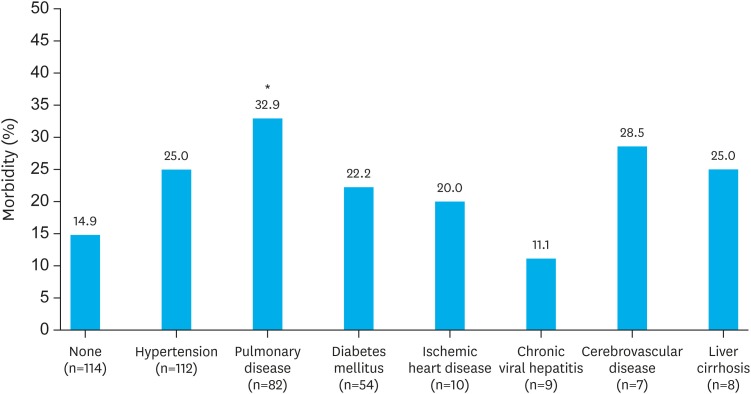
Results: A total of 189 patients (62.4%) had one or more comorbidities. Hypertension was the most common comorbidity (37.0%), followed by diabetes mellitus (17.8%), chronic viral hepatitis (2.6%), liver cirrhosis (2.6%), and pulmonary (27.1%), ischemic heart (3.3%), and cerebrovascular diseases (2.3%). The overall postoperative morbidity and mortality rates were 20.1% and 1.0%, respectively. Patients with pulmonary disease significantly showed higher complication rates than those without comorbidities (32.9% vs. 14.9%, respectively, P=0.003); patient with other comorbidities showed no significant difference in the incidence of LTG-related complications. During univariate and multivariate analyses, pulmonary disease was found to be an independent predictive factor for postoperative complications (odds ratio, 2.14; 95% confidence interval, 1.03-4.64), along with old age and intraoperative bleeding.
Conclusions: Among the various comorbidities investigated, patients with pulmonary disease had a significantly higher risk of postoperative complications after LTG. Proper perioperative care for optimizing pulmonary function may be required for patients with pulmonary disease.
Keywords: Comorbidity; Gastrectomy; Laparoscopy; Postoperative complications; Stomach neoplasms.
Conflict of interest statement
Conflict of Interest: No potential conflict of interest relevant to this article was reported.
Figures
References
-
- Viñuela EF, Gonen M, Brennan MF, Coit DG, Strong VE. Laparoscopic versus open distal gastrectomy for gastric cancer: a meta-analysis of randomized controlled trials and high-quality nonrandomized studies. Ann Surg. 2012;255:446–456. - PubMed
-
- Kim YW, Baik YH, Yun YH, Nam BH, Kim DH, Choi IJ, et al. Improved quality of life outcomes after laparoscopy-assisted distal gastrectomy for early gastric cancer: results of a prospective randomized clinical trial. Ann Surg. 2008;248:721–727. - PubMed
-
- Etoh T, Shiraishi N, Kitano S. Current trends of laparoscopic gastrectomy for gastric cancer in Japan. Asian J Endosc Surg. 2009;2:18–23.
-
- Yu J, Hu J, Huang C, Ying M, Peng X, Wei H, et al. The impact of age and comorbidity on postoperative complications in patients with advanced gastric cancer after laparoscopic D2 gastrectomy: results from the Chinese laparoscropic gastrointestinal surgery study (CLASS) group. Eur J Surg Oncol. 2013;39:1144–1149. - PubMed
LinkOut - more resources
Full Text Sources