Review
. 2018 Sep 26;4(9):1102-1112.
doi: 10.1021/acscentsci.8b00504. Epub 2018 Aug 29.

Bioinspired Designs of Superhydrophobic and Superhydrophilic Materials

Affiliations
Review

Bioinspired Designs of Superhydrophobic and Superhydrophilic Materials

Yifan Si et al. ACS Cent Sci. .

Abstract

Bioinspired designs of superhydrophobic and superhydrophilic materials have been an important and fascinating area of research in recent years for their extensive potential application prospects from industry to our daily life. Despite extensive progress, existing research achievements are far from real applications. From biomimetic performance to service life, the related research has faced serious problems at present. A timely outlook is therefore necessary to summarize the existing research, to discuss the challenges faced, and to propose constructive advice for the ongoing scientific trend. Here, we comb the process of development of bioinspired superhydrophobic and superhydrophilic materials at first. Then, we also describe how to design artificial superhydrophobic and superhydrophilic materials. Furthermore, current challenges faced by bioinspired designs of superhydrophobic and superhydrophilic materials are pointed out, separately, and the possible solutions are discussed. Emerging applications in this field are also briefly considered. Finally, the development trend within this field is highlighted to lead future research.


Conflict of interest statement

The authors declare no competing financial interest.

Figures
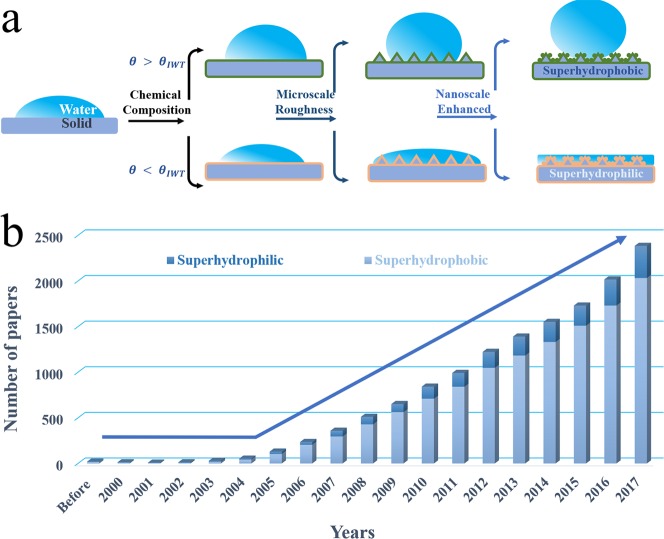
Figure 1
Figure 1
(a) Intrinsic wetting threshold (θIWT) of water, which is regarded as the limit between hydrophilicity and hydrophobicity. When the intrinsic WCA (θ) on a flat solid surface is larger than θIWT, superhydrophobic surfaces can be obtained by increasing the surface roughness. Conversely, when the intrinsic WCA (θ) on a flat solid surface is smaller than θIWT, superhydrophilic surfaces can be obtained. (b) Rapid increase of research interest (number of papers) on the topic of “superhydrophobic” and “superhydrophilic” materials.
Figure 2
Figure 2
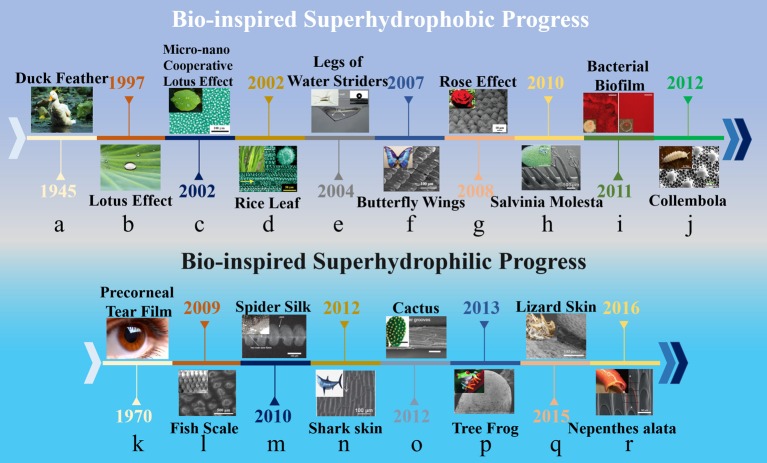
Time-line of bioinspired superhydrophobic and superhydrophilic process of development. (a) Duck feather. (b) Lotus effect. (c) Micro–nano cooperative lotus effect. (d) Rice leaf. (e) Legs of water striders. (f) Butterfly wings. (g) Rose effect. (h) Salvinia molesta. (i) Bacterial biofilm. (j) Collembola. (k) Precorneal tear film. (l) Fish scale. (m) Spider Silk. (n) Shark skin. (o) Cactus. (p) Tree frog. (q) Lizard skin. (r) Nepenthes alata. Copyright 2002, 2009, 2010, 2013 Wiley; 2004, 2010, 2012, 2016 Nature publishing group; 2007, 2012 Royal Society of Chemistry; 2008 American Chemical Society; 2015 Royal Society; 2011 PNAS; and 2012 Springer.
Figure 3
Figure 3
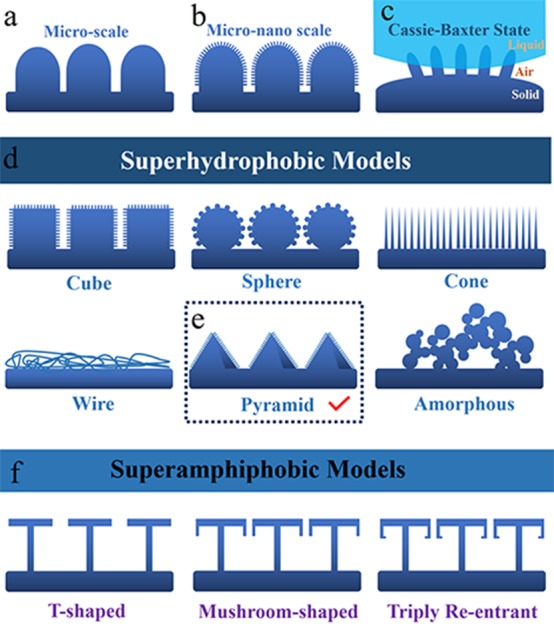
Models of the evolution from superhydrophobicity to superamphiphobicity. (a) Microscale synapse model. (b) Micro-/nanoscale synapse model. (c) Cassie–Baxter state model. (d) Various developed artificial micro-/nanoscale models. (e) Pyramid micro-/nanoscale model shows optimal comprehensive performance. (f) Classical superamphiphobic models from T-shaped to mushroom-shaped to triply reentrant structure.
Figure 4
Figure 4
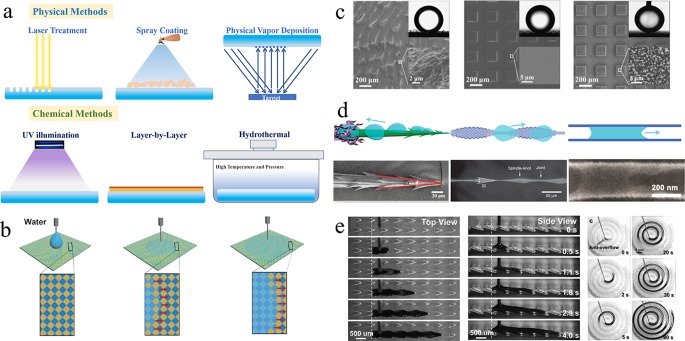
(a) Common superhydrophilic surface fabrication physical and chemical methods. (b) Water spreading process on superhydrophilic interfaces with the help of 2D capillary forces. (c) Fish-scale-inspired artificial superhydrophilic/underwater superoleophobic surfaces. (d) Conical spine structure of cactus spine, spindle-knot fiber structure of spider silk, and in situ observation of water transport in carbon nanotubes. (e) Through continual liquid deposition, dyed water could unidirectionally spread in one single direction and pin in all the others on superhydrophilic peristome-mimetic surfaces. Deposited liquid also could flow downward along the spiral. Copyright 2016, 2017 Wiley; 2010, 2012 Nature publishing group; and 2004 American Chemical Society.
Figure 5
Figure 5
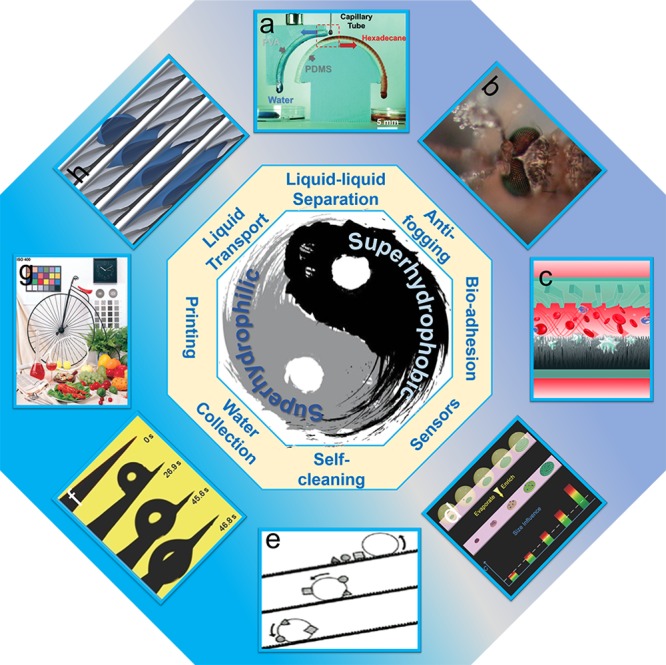
Emerging applications of superhydrophobic and superhydrophilic surfaces in various fields. (a) Liquid–liquid separation. (b) Antifogging. (c) Bioadhesion. (d) Sensors. (e) Self-cleaning. (f) Water collection. (g) Printing. (h) Liquid transport. Copyright 2007, 2011, 2013, 2015, 2017 Wiley; 2016 Nature publishing group; 1997 Springer; and 2013 Royal Society of Chemistry.

References

    1. Su B.; Tian Y.; Jiang L. Bioinspired Interfaces with Superwettability: From Materials to Chemistry. J. Am. Chem. Soc. 2016, 138, 1727–1748. 10.1021/jacs.5b12728. - DOI - PubMed
    1. Wang S.; Liu K.; Yao X.; Jiang L. Bioinspired Surfaces with Superwettability: New Insight on Theory, Design, and Applications. Chem. Rev. 2015, 115, 8230–8293. 10.1021/cr400083y. - DOI - PubMed
    1. Barthlott W.; Mail M.; Neinhuis C. Superhydrophobic Hierarchically Structured Surfaces in Biology: Evolution, Structural Principles and Biomimetic Applications. Philos. Trans. R. Soc., A 2016, 374, 20160191–20160231. 10.1098/rsta.2016.0191. - DOI - PMC - PubMed
    1. Zhu Z.; Zheng S.; Peng S.; Zhao Y.; Tian Y. Superlyophilic Interfaces and Their Applications. Adv. Mater. 2017, 29, 1703120–1703132. 10.1002/adma.201703120. - DOI - PubMed
    1. Yao X.; Song Y.; Jiang L. Applications of Bio-Inspired Special Wettable Surfaces. Adv. Mater. 2011, 23, 719–734. 10.1002/adma.201002689. - DOI - PubMed