Growth and feeding of deep-sea coral Lophelia pertusa from the California margin under simulated ocean acidification conditions
- PMID: 30280039
- PMCID: PMC6164558
- DOI: 10.7717/peerj.5671
Growth and feeding of deep-sea coral Lophelia pertusa from the California margin under simulated ocean acidification conditions
Abstract
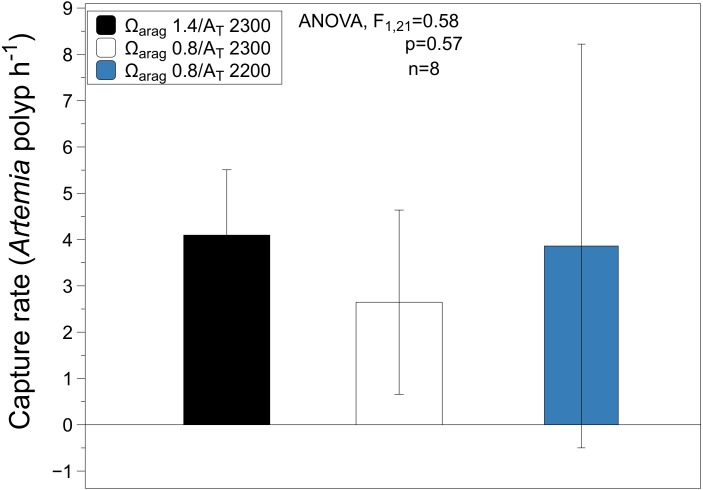
The global decrease in seawater pH known as ocean acidification has important ecological consequences and is an imminent threat for numerous marine organisms. Even though the deep sea is generally considered to be a stable environment, it can be dynamic and vulnerable to anthropogenic disturbances including increasing temperature, deoxygenation, ocean acidification and pollution. Lophelia pertusa is among the better-studied cold-water corals but was only recently documented along the US West Coast, growing in acidified conditions. In the present study, coral fragments were collected at ∼300 m depth along the southern California margin and kept in recirculating tanks simulating conditions normally found in the natural environment for this species. At the collection site, waters exhibited persistently low pH and aragonite saturation states (Ωarag) with average values for pH of 7.66 ± 0.01 and Ωarag of 0.81 ± 0.07. In the laboratory, fragments were grown for three weeks in "favorable" pH/Ωarag of 7.9/1.47 (aragonite saturated) and "unfavorable" pH/Ωarag of 7.6/0.84 (aragonite undersaturated) conditions. There was a highly significant treatment effect (P < 0.001) with an average% net calcification for favorable conditions of 0.023 ± 0.009% d-1 and net dissolution of -0.010 ± 0.014% d-1 for unfavorable conditions. We did not find any treatment effect on feeding rates, which suggests that corals did not depress feeding in low pH/ Ωarag in an attempt to conserve energy. However, these results suggest that the suboptimal conditions for L. pertusa from the California margin could potentially threaten the persistence of this cold-water coral with negative consequences for the future stability of this already fragile ecosystem.
Keywords: Carbonate saturation; Climate change; Deep-sea; Ocean acidification.
Conflict of interest statement
Erik Cordes is an Academic Editor for PeerJ. Leslie Wickes was employed by JHT, Inc. at the time of the sample collection, and now is the owner and sole operator of Thrive Blue LLC.
Figures


References
-
- Alin SR, Feely RA, Dickson AG, Hernández-Ayón JM, Juranek LW, Ohman MD, Goericke R. Robust empirical relationships for estimating the carbonate system in the southern California Current System and application to CalCOFI hydrographic cruise data (2005–2011) Journal of Geophysical Research Ocean. 2012;117:C05033. doi: 10.1029/2011JC007511. - DOI
-
- Bakun A, Black BA, Bograd SJ, García-Reyes M, Miller AJ, Rykaczewski RR, Sydeman WJ. Anticipated effects of climate change on coastal upwelling ecosystems. Current Climate Change Reports. 2015;1:85–93. doi: 10.1007/s40641-015-0008-4. - DOI
-
- Barton A, Waldbusser GG, Feely RA, Weisberg SB, Newton JA, Hales B, Cudd B, Eudeline B, Langdon CJ, Jefferds I, King T, Suhrbier A, McLaughlin K. Impacts of coastal acidification on the Pacific Northwest shellfish industry and adaptation strategies implemented in response. Oceanography. 2015;28:146–159. doi: 10.5670/oceanog.2015.38. - DOI
-
- Bograd SJ, Checkley DA, Wooster WS. CalCOFI: a half century of physical, chemical, and biological research in the California current system. Deep-Sea Research, Part II (Topical Studies in Oceanography) 2003;50:2349–2353. doi: 10.1016/S0967-0645(03)00122-X. - DOI
LinkOut - more resources
Full Text Sources