. 2019 Jun;38(6):1629-1635.
doi: 10.1002/jum.14835. Epub 2018 Oct 2.

Percutaneous Ultrasonic Tenotomy Reduces Insertional Achilles Tendinopathy Pain With High Patient Satisfaction and a Low Complication Rate

Affiliations

Percutaneous Ultrasonic Tenotomy Reduces Insertional Achilles Tendinopathy Pain With High Patient Satisfaction and a Low Complication Rate

Ruth L Chimenti et al. J Ultrasound Med. 2019 Jun.

Abstract

Due to the novelty of percutaneous ultrasonic tenotomy, the risks and benefits of this minimally invasive procedure for insertional Achilles tendinopathy pain have only been examined in case studies and retrospective chart reviews for other diagnoses. This retrospective chart review over a 3.5-year period identified 34 patients with insertional Achilles tendinopathy who had percutaneous ultrasonic tenotomy (mean age ± SD, 52.2 ± 11.6 years; mean body mass index, 32.9 ± 7.5 kg/m2 ; 62% female). This procedure reduced the rate of moderate/severe pain from 68% at baseline to 15% at the long-term follow-up and had a satisfaction rate of 70%. There was 1 minor complication out of 40 procedures in 34 patients.

Keywords: Achilles tendon; enthesopathy; minimally invasive procedure; musculoskeletal; percutaneous ultrasonic tenotomy; tendinopathy; tendonitis.


Figures

FIGURE 1.
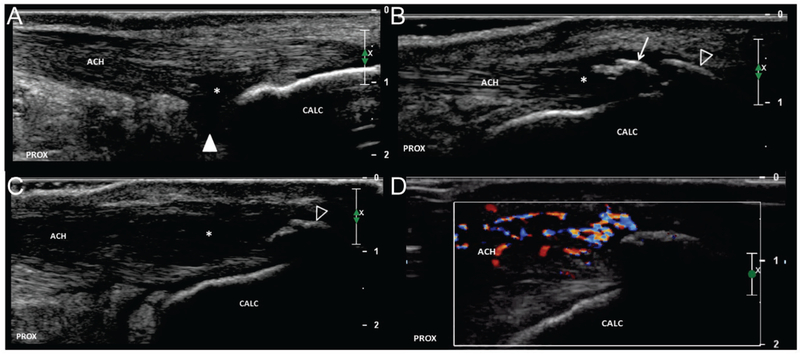
FIGURE 1.. Variations in insertional Achilles tendon pathology
Long axis images of Achilles tendon insertion demonstrating variability in location and extent of pathologic findings. a.) Hypoechoic changes (asterisks) are demonstrated adjacent to the posterosuperior calcaneus (arrow). The boundary with the retro-calcaneal bursa (arrowhead) is ill-defined. Note the relatively normal appearance of the superficial/posterior portion of the tendon. b.) The deep/anterior portion of the tendon is relatively normal; however, changes of tendinosis (asterisks) are appreciated adjacent to an intra-tendinous calcification (arrow). There is minimal posterior acoustic shadowing suggesting “soft” calcification which is amendable to percutaneous debridement. An enthesophyte (open arrowhead) demonstrates dense posterior acoustic shadowing consistent with cortical bone. c.) Hypoechoic changes of tendinosis (asterisks) are more extensive and pronounce. An enthesophyte is present (open arrowhead), but no intra-tendinous calcification is appreciated. d.) Corresponding Color Doppler imaging of figure 1c. There is hyperemia within the superficial/posterior tendon as well as paratenon. ACH = Achilles tendon, CALC = calcaneus, PROX = proximal.
FIGURE 2.
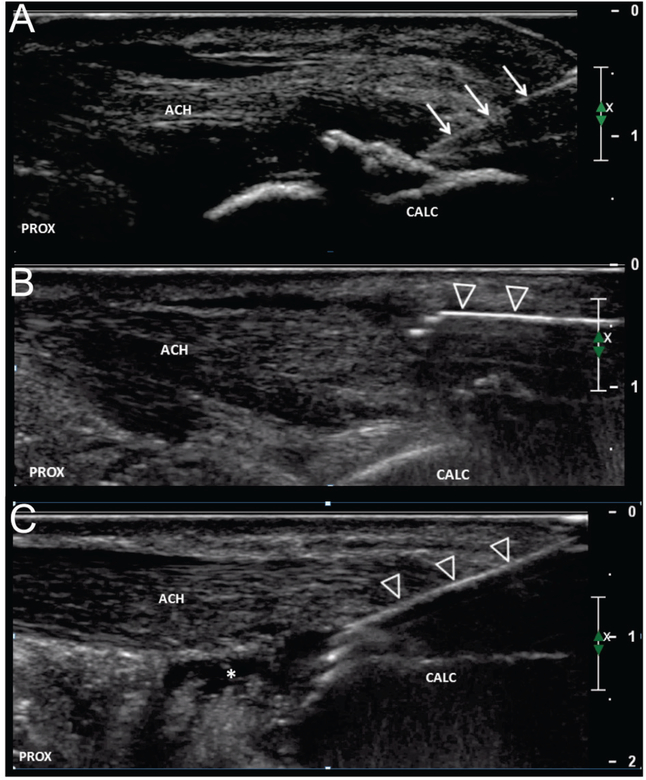
FIGURE 2.. Procedural technique
Long axis image of Achilles tendon demonstrating procedural technique. a.) After obtaining local anesthesia, a #11 blade (arrows) is used to make an incision down to the tendon. b.) The TX device (open arrowheads) is then introduced superficial/posterior to the tendon and the hypertrophied paratenon and connective tissue are debrided from the tendon. c.) The device is then guided into the tendon and the regions of tendinosis are debrided. In this example, there was concomitant retro-calcaneal bursitis (asterisks) and a limited bursectomy was performed. ACH = Achilles tendon, CALC = calcaneus, PROX = proximal.
FIGURE 3.
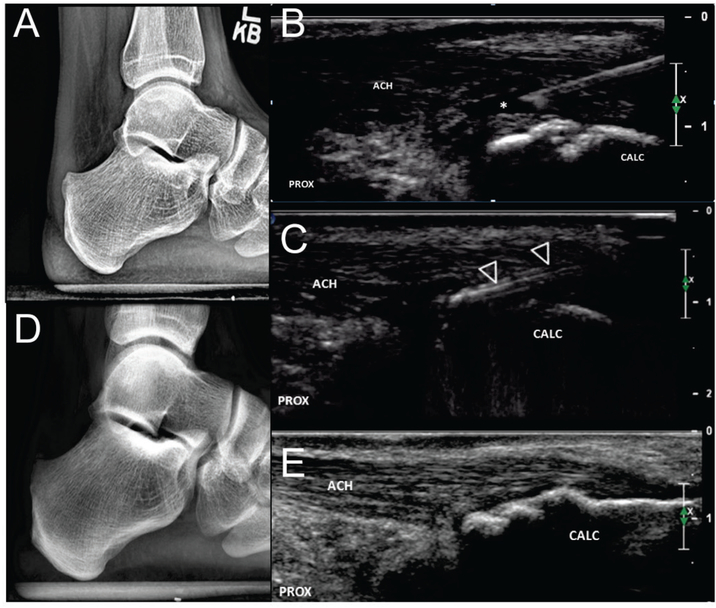
FIGURE 3.. Haglund bony debridement
a.) Pre-procedural X-ray demonstrates a posteriorly projecting bony protuberance at the posterosuperior calcaneus which correlated with location of patient’s maximal pain. b.) Procedural long axis ultrasound image during local anesthesia demonstrates partial thickness tear (asterisks) adjacent to the region of cortical irregularity at the posterosuperior calcaneus (arrowhead). c.) The TX device (open arrowheads) is used to shave down the posteriorly projecting bony protuberance using a layer by layer technique working from superficial to deep. Follow up radiograph at 6 weeks (d.) demonstrates decreased prominence of the previously noted bony protuberance while follow up ultrasound at 3 years (e) is consistent with bony remodeling and complete healing of the debrided partial tendon tear. Patient reports no pain or functional limitation at 3 year follow up. ACH = Achilles tendon, CALC = calcaneus, PROX = proximal.

References

    1. Chimenti RL, Cychosz CC, Hall MM, Phisitkul P. Current Concepts Review Update: Insertional Achilles Tendinopathy. Foot Ankle Int. October 2017;38(10):1160–1169. - PMC - PubMed
    1. Seng C, Mohan PC, Koh SB, et al. Ultrasonic Percutaneous Tenotomy for Recalcitrant Lateral Elbow Tendinopathy: Sustainability and Sonographic Progression at 3 Years. Am. J. Sports Med February 2016;44(2):504–510. - PubMed
    1. Williams RC, Pourcho AM. Percutaneous Ultrasonic Tenotomy for Refractory Common Extensor Tendinopathy After Failed Open Surgical Release: A Report of Two Cases. PM R. March 2018;10(3):313–316. - PubMed
    1. Barnes DE, Beckley JM, Smith J. Percutaneous ultrasonic tenotomy for chronic elbow tendinosis: a prospective study. J. Shoulder Elbow Surg. January 2015;24(1):67–73. - PubMed
    1. Battista CT, Dorweiler MA, Fisher ML, Morrey BF, Noyes MP. Ultrasonic Percutaneous Tenotomy of Common Extensor Tendons for Recalcitrant Lateral Epicondylitis. Tech. Hand Up. Extrem. Surg March 2018;22(1):15–18. - PubMed