Review
. 2018 Nov;33(11):1688-1699.
doi: 10.1002/mds.102. Epub 2018 Oct 2.

Imaging of Motor Cortex Physiology in Parkinson's Disease

Affiliations
Review

Imaging of Motor Cortex Physiology in Parkinson's Disease

Roxana G Burciu et al. Mov Disord. 2018 Nov.

Abstract

There is abundant evidence that the pathophysiology of Parkinson's disease (PD) is not confined to the nigrostriatal dopaminergic pathway but propagates along the cortico-basal ganglia-thalamo-cortical neural network. A critical node in this functional circuit impacted by PD is the primary motor cortex (M1), which plays a key role in generating neural impulses that regulate movements. The past several decades have lay witness to numerous in vivo neuroimaging techniques that provide a window into the function and structure of M1. A consistent observation from numerous studies is that during voluntary movement, but also at rest, the functional activity of M1 is altered in PD relative to healthy individuals, and it relates to many of the motor signs. Although this abnormal functional activity can be partially restored with acute dopaminergic medication, it continues to deteriorate with disease progression and may predate structural degeneration of M1. The current review discusses the evidence that M1 is fundamental to the pathophysiology of PD, as measured by neuroimaging techniques such as positron emission tomography, single-photon emission computed tomography, electroencephalography, magnetoencephalography, and functional and structural MRI. Although novel treatments that target the cortex will not cure PD, they could significantly slow down and alter the progressive course of the disease and thus improve clinical care for this degenerative disease. © 2018 The Authors. Movement Disorders published by Wiley Periodicals, Inc. on behalf of International Parkinson and Movement Disorder Society.

Keywords: Parkinson's disease; electrophysiology; functional imaging; primary motor cortex; structural imaging.


Figures

Figure 1
Figure 1
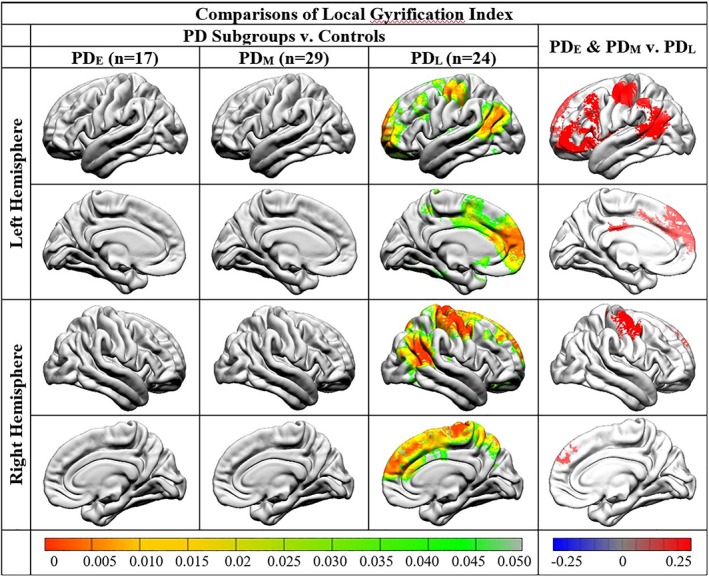
Comparison of local gyrification index between Parkinson disease (PD) subgroups and controls (left) and among PD subgroups (right) at baseline. In this study, PD patients were grouped based on the number of years since diagnosis into PD‐early (PEE; < 1 year, baseline UPDRS‐III on medication of 11.4 ± 8.2, baseline Hoehn and Yahr stage 1.4 ± 0.6), PD‐middle (PEM; 1‐5 years, baseline UPDRS‐III on medication of 19.8 ± 10.4, baseline Hoehn and Yahr stage 1.4 ± 0.6), and PD‐late (PEL; > 5 years, baseline UPDRS‐III on medication of 20.4 ± 11.9, baseline Hoehn and Yahr stage 2.2 ± 0.6). PD with a long disease duration had reduced gyrification bilaterally in several cortical areas including M1 compared to controls at baseline (left). These patients also had reduced gyrification in several neocortical areas when compared with PD with short and medium disease duration at baseline (right). Figure reprinted with permission from Sterling NW, Wang M, Zhang L, et al. Stage‐dependent loss of cortical gyrification as Parkinson disease “unfolds”. Neurology 2016;86(12):1143‐1151.109
Figure 2
Figure 2
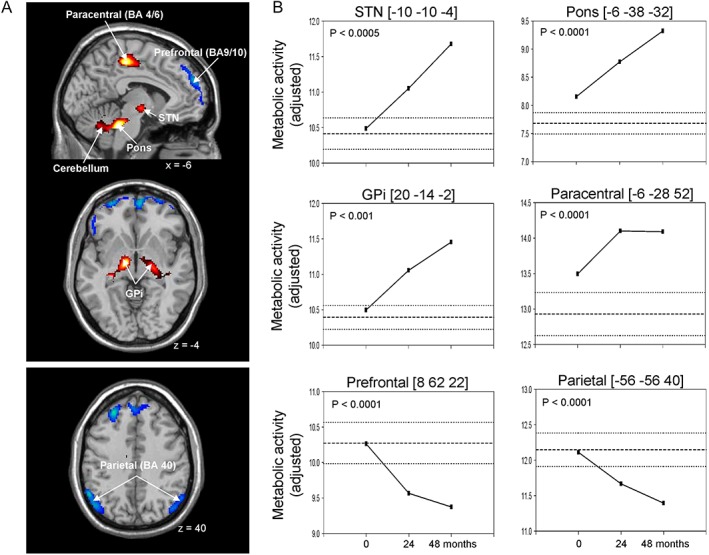
(A) Voxel‐based analysis of longitudinal changes in regional metabolic activity. Metabolic increases with disease progression are displayed using a warm colors. Progressive metabolic declines are displayed using a cold colors. (B) metabolic data at each timepoint. The coordinates refer to the Montreal Neurological Institute (MNI) standard space. GPi, internal globus pallidus; STN, subthalamic nucleus; BA, Brodmann area. Figure reprinted with permission from Huang C, Tang C, Feigin A, et al. Changes in network activity with the progression of Parkinson's disease. Brain 2007;130(7):1834‐1846.120
Figure 3
Figure 3
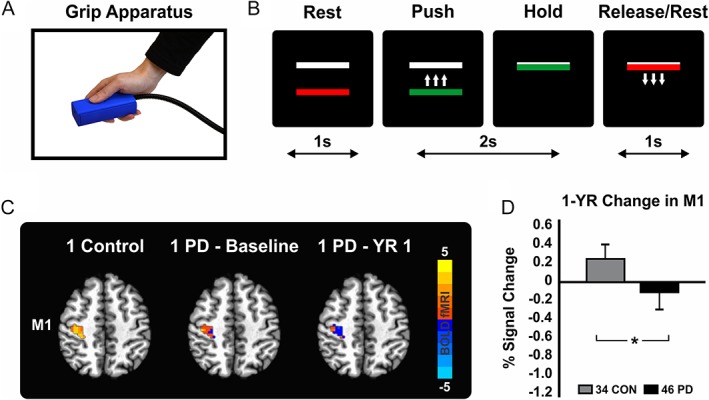
(A) Grip apparatus used to produce force. PD patients performed the task with the more affected hand. (B) Task consisting of a series of 2 seconds of force production and 1 second of rest. Force target was set at 15% of maximum voluntary contraction. (C) Functional MRI signal during grip force production in the contralateral M1 in 1 healthy control along with task‐based fMRI signal at baseline and 1 year later in one PD patient. (C) Group statistics showing a reduction in force‐related fMRI activity in M1 in PD during the course of 1 year. Data represent the 1‐year difference adjusted for the following variables at baseline: age, sex, Montreal Cognitive Assessment Test, and percent signal change in M1. CON, controls; M1, primary motor cortex; PD, Parkinson's disease; YR, year. Figure adapted from Burciu RG, Chung JW, Shukla P, et al. Functional MRI of disease progression in Parkinson disease and atypical parkinsonian syndromes. Neurology 2016;87(7):709‐717.122

References

    1. Fearnley JM, Lees AJ. Ageing and Parkinson's disease: substantia nigra regional selectivity. Brain 1991;114(Pt 5):2283‐2301. - PubMed
    1. Kordower JH, Olanow CW, Dodiya HB, et al. Disease duration and the integrity of the nigrostriatal system in Parkinson's disease. Brain 2013;136(Pt 8):2419‐2431. - PMC - PubMed
    1. Jankovic J. Parkinson's disease: clinical features and diagnosis. J Neurol Neurosurg Psychiatry 2008;79(4):368‐376. - PubMed
    1. Mazzoni P, Shabbott B, Cortes JC. Motor control abnormalities in Parkinson's disease. Cold Spring Harb Perspect Med 2012;2(6):a009282. - PMC - PubMed
    1. Blandini F, Nappi G, Tassorelli C, Martignoni E. Functional changes of the basal ganglia circuitry in Parkinson's disease. Prog Neurobiol 2000;62(1):63‐88. - PubMed

Publication types