


Mouse mast cells and mast cell proteases do not play a significant role in acute tissue injury pain induced by formalin
- PMID: 30280636
- PMCID: PMC6247485
- DOI: 10.1177/1744806918808161
Mouse mast cells and mast cell proteases do not play a significant role in acute tissue injury pain induced by formalin
Abstract
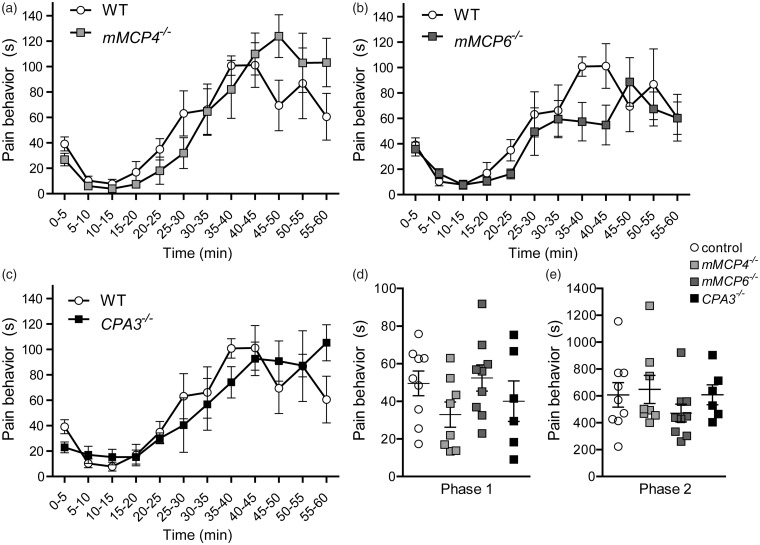
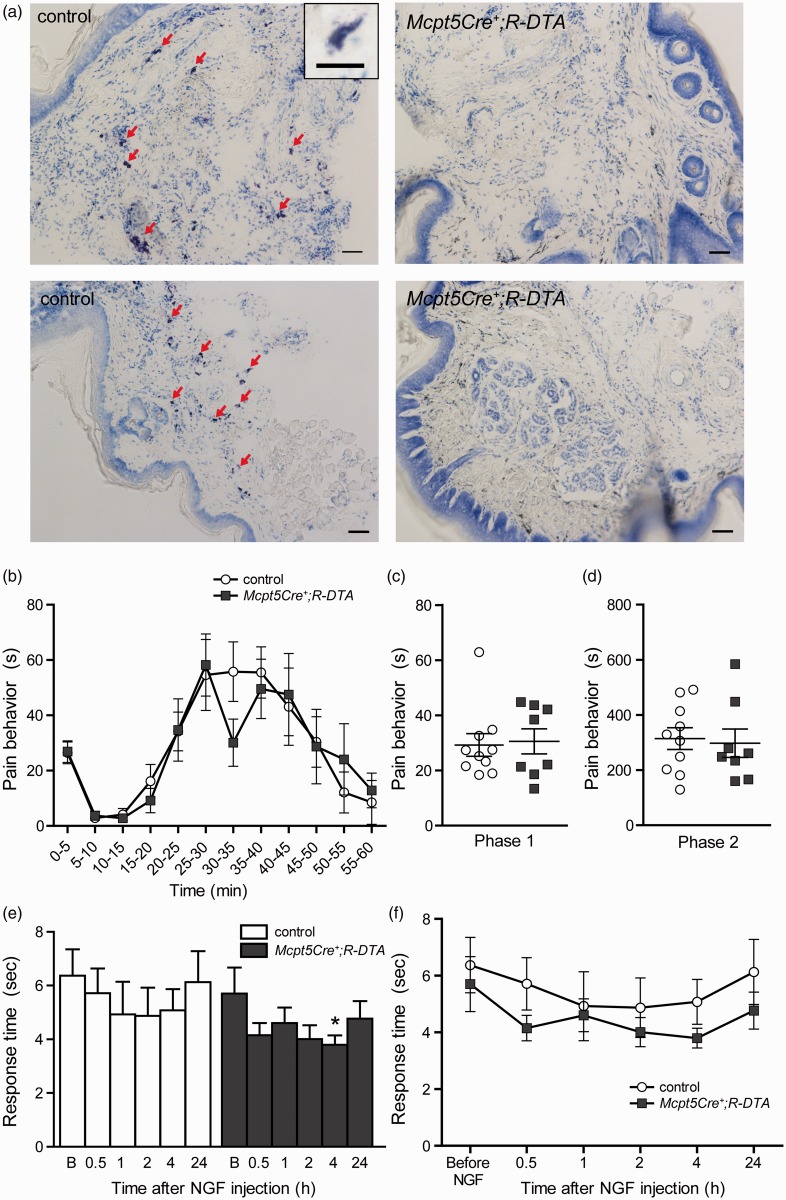
Subcutaneous formalin injections are used as a model for tissue injury-induced pain where formalin induces pain and inflammation indirectly by crosslinking proteins and directly through activation of the transient receptor potential A1 receptor on primary afferents. Activation of primary afferents leads to both central and peripheral release of neurotransmitters. Mast cells are found in close proximity to peripheral sensory nerve endings and express receptors for neurotransmitters released by the primary afferents, contributing to the neuro/immune interface. Mast cell proteases are found in large quantities within mast cell granules and are released continuously in small amounts and upon mast cell activation. They have a wide repertoire of proposed substrates, including Substance P and calcitonin gene-related peptide, but knowledge of their in vivo function is limited. We evaluated the role of mouse mast cell proteases (mMCPs) in tissue injury pain responses induced by formalin, using transgenic mice lacking either mMCP4, mMCP6, or carboxypeptidase A3 (CPA3), or mast cells in their entirety. Further, we investigated the role of mast cells in heat hypersensitivity following a nerve growth factor injection. No statistical difference was observed between the respective mast cell protease knockout lines and wild-type controls in the formalin test. Mast cell deficiency did not have an effect on formalin-induced nociceptive responses nor nerve growth factor-induced heat hypersensitivity. Our data thus show that mMCP4, mMCP6, and CPA3 as well as mast cells as a whole, do not play a significant role in the pain responses associated with acute tissue injury and inflammation in the formalin test. Our data also indicate that mast cells are not essential to heat hypersensitivity induced by nerve growth factor.
Keywords: Pain formalin; mast cell; protease; transgenic.
Figures
References
-
- Cox ML, Schray CL, Luster CN, Stewart ZS, Korytko PJ, M Khan KN, Paulauskis JD, Dunstan RW. Assessment of fixatives, fixation, and tissue processing on morphology and RNA integrity. Exp Mol Pathol 2006; 80: 183–191. - PubMed
-
- Story GM, Peier AM, Reeve AJ, Eid SR, Mosbacher J, Hricik TR, Earley TJ, Hergarden AC, Andersson DA, Hwang SW, McIntyre P, Jegla T, Bevan S, Patapoutian A. ANKTM1, a TRP-like channel expressed in nociceptive neurons, is activated by cold temperatures. Cell 2003; 112: 819–829. - PubMed
-
- Siebenhaar F, Magerl M, Peters EMJ, Hendrix S, Metz M, Maurer M. Mast cell–driven skin inflammation is impaired in the absence of sensory nerves. J Allergy Clin Immunol 2008; 121: 955–961. - PubMed
Publication types
MeSH terms
Substances
LinkOut - more resources
Full Text Sources
Miscellaneous
