. 2018 Oct 31;30(43):435101.
doi: 10.1088/1361-648X/aae000. Epub 2018 Oct 3.

Protein refractive index increment is determined by conformation as well as composition

Affiliations

Protein refractive index increment is determined by conformation as well as composition

Domarin Khago et al. J Phys Condens Matter. .

Abstract

The refractive index gradient of the eye lens is controlled by the concentration and distribution of its component crystallin proteins, which are highly enriched in polarizable amino acids. The current understanding of the refractive index increment ([Formula: see text]) of proteins is described using an additive model wherein the refractivity and specific volume of each amino acid type contributes according to abundance in the primary sequence. Here we present experimental measurements of [Formula: see text] for crystallins from the human lens and those of aquatic animals under uniform solvent conditions. In all cases, the measured values are much higher than those predicted from primary sequence alone, suggesting that structural factors also contribute to protein refractive index.


Figures
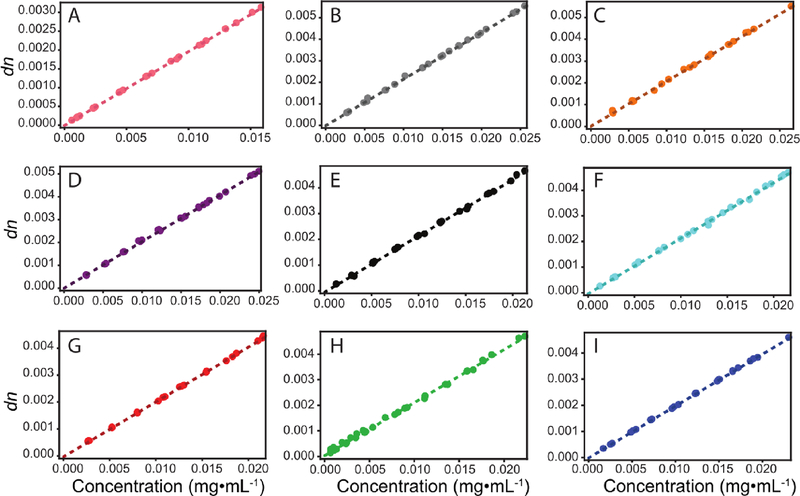
Figure 1.
Figure 1.
Experimentally determined dn/dc values for lens proteins from different organisms. A. HEWL (control), B. γM8b-crystallin, C. γM8c-crystallin, D. γM8dcrystallin, E. γS1-crystallin, F. γS2-crystallin, G. J2-crystallin, H. human γS-crystallin, I. tunicate βγ-crystallin. Hen egg white lysozyme was measured as a control protein that has not been selected for high refractivity.
Figure 2.
Figure 2.
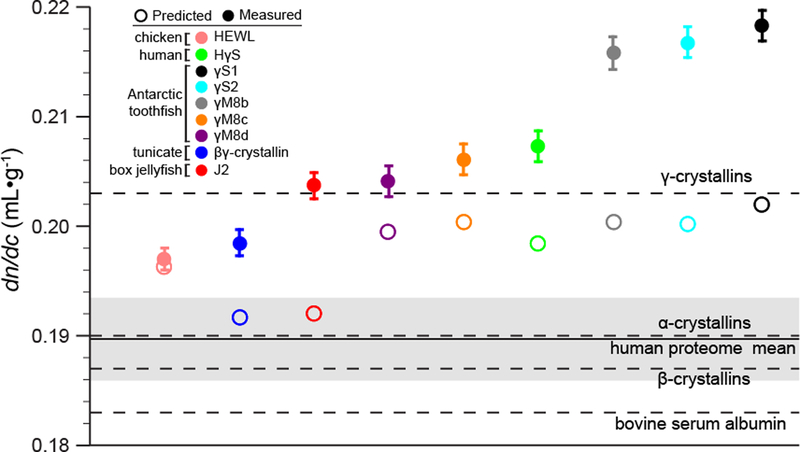
Measured dn/dc values compared to predicted. The dn/dc of HEWL, human γS-crystallin, toothfish γS1-, γS2-, γM8b-, γM8c-, and γM8d-crystallins, box jelly J2-crystallin and tunicate βγ-crystallin were measured and compared to their predicted values, represented by filled and open circles respectively. The solid line represents the mean dn/dc of the human proteome, with the shaded region representing one standard deviation from the mean. The dashed lines indicate the literature dn/dc values for bovine serum albumin [39], and α-, β, and γ-crystallin fractions from bovine eye lens [19].
Figure 3.
Figure 3.
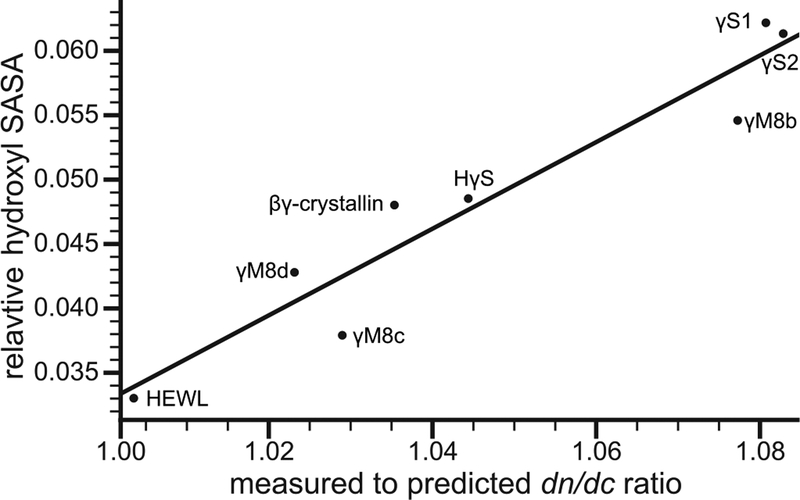
Relative hydroxyl SASA correlates with the measured to predicted dn/dc ratio. The relationship was fit to a linear regression that follows the form Shyd = 0.336x − 0.304 with an R2 of 0.906, in which Shyd and x are the fraction of hydroxyl SASA and measured to predicted dn/dc ratio respectively.
Figure 4.
Figure 4.
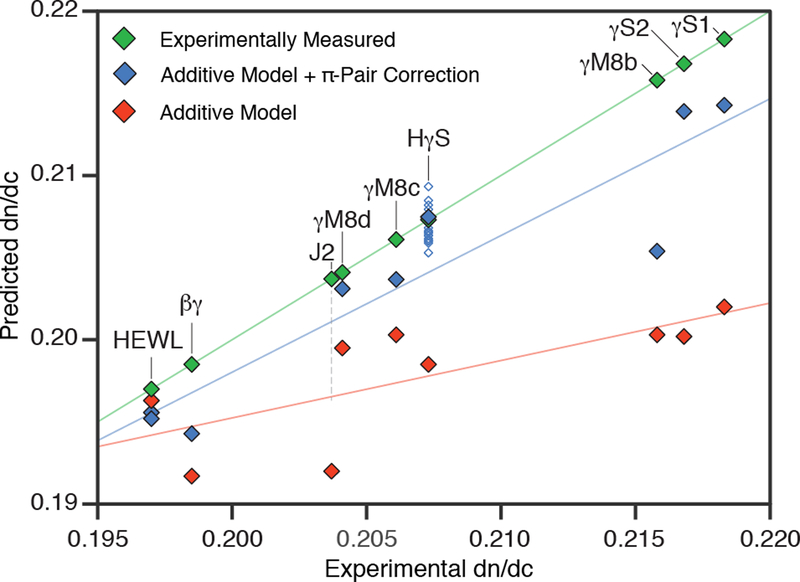
Experimental dn/dc values (green), values predicted from the additive model of Zhao et al (red) and additive model values plus the π-pair correction (blue) are plotted as a function of the experimental dn/dc. Corrected predictions are shown as filled diamonds for the lowest energy structure and empty diamonds for alternate confirmations where they are available. Two filled diamonds are shown representing the two lysozyme crystal structures, while no predictions are shown for J2-crystallin, as no previously solved structures were sufficiently similar for confident structural modeling. Additional unfilled diamonds are shown for human γS-crystallin to represent alternate low energy NMR conformations. Regression lines are shown as visual guides for model comparison.

References

    1. Slingsby Christine, Wistow Graeme J., and Clark Alice R.. Evolution of crystallins for a role in the vertebrate eye lens. Protein Science, 22(4):367–380, 2013. - PMC - PubMed
    1. Wistow Graeme J. and Piatigorsky Joram. Lens crystallins: The evolution and expression of proteins for a highly specialized tissue. Annual Review of Biochemistry, 57:479–504, 1988. - PubMed

    1. Zhao H, Brown PH, and Schuck P. On the distribution of protein refractive index increments. Biophysical Journal, 100:2309–2317, 2011. - PMC - PubMed
    1. Zhao Huaying, Chen Yingwei, Rezabkova Lenka, Wu Zhengrong, Wistow Graeme, and Schuck Peter. Solution properties of γ-crystallins: Hydration of fish and mammal γ-crystallins. Protein Science, 23(1):88–99, 2014. - PMC - PubMed
    1. Horwitz J. Alpha-crystallin can function as a molecular chaperone. Proceedings of the National Academy of Sciences of the United States of America, 89(21):10449–10453, November 1992. - PMC - PubMed

Publication types