


Genome-wide meta-analysis identifies BARX1 and EML4-MTA3 as new loci associated with infantile hypertrophic pyloric stenosis
- PMID: 30281099
- PMCID: PMC6322072
- DOI: 10.1093/hmg/ddy347
Genome-wide meta-analysis identifies BARX1 and EML4-MTA3 as new loci associated with infantile hypertrophic pyloric stenosis
Abstract
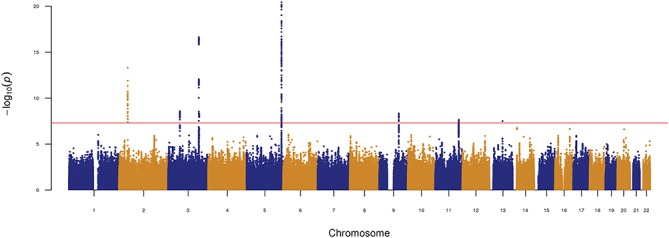
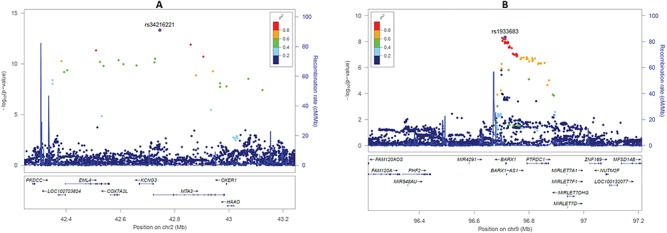
Infantile hypertrophic pyloric stenosis (IHPS) is a disorder of young infants with a population incidence of ∼2/1000 live births, caused by hypertrophy of the pyloric sphincter smooth muscle. Reported genetic loci associated with IHPS explain only a minor proportion of IHPS risk. To identify new risk loci, we carried out a genome-wide meta-analysis on 1395 surgery-confirmed cases and 4438 controls, with replication in a set of 2427 cases and 2524 controls. We identified and replicated six independent genomic loci associated with IHPS risk at genome wide significance (P < 5 × 10⁻⁸), including novel associations with two single nucleotide polymorphisms (SNPs). One of these SNPs, rs6736913 [odds ratio (OR) = 2.32; P = 3.0 × 10⁻¹⁵], is a low frequency missense variant in EML4 at 2p21. The second SNP, rs1933683 (OR = 1.34; P = 3.1 × 10⁻⁹) is 1 kb downstream of BARX1 at 9q22.32, an essential gene for stomach formation in embryogenesis. Using the genome-wide complex trait analysis method, we estimated the IHPS SNP heritability to be 30%, and using the linkage disequilibrium score regression method, we found support for a previously reported genetic correlation of IHPS with lipid metabolism. By combining the largest collection of IHPS cases to date (3822 cases), with results generalized across populations of different ancestry, we elucidate novel mechanistic avenues of IHPS disease architecture.
Figures
References
-
- Hirschsprung H. (1888) Fälle von angeborener Pylorusstenose, beobachtet bei Säuglingen. Jahrb der Kinderh., 28, 61–68.
-
- Ramstedt C. (1912) Zur Operation der angeborenen Pylorusstenose. Med. Klin., 8, 1702–1705.
-
- MacMahon B. (2006) The continuing enigma of pyloric stenosis of infancy: a review. Epidemiology, 17, 195–201. - PubMed
-
- Zhu J., Zhu T., Lin Z., Qu Y. and Mu D. (2017) Perinatal risk factors for infantile hypertrophic pyloric stenosis: a meta-analysis. J. Pediatr. Surg., 52, 1389–1397. - PubMed
Publication types
MeSH terms
Substances
Grants and funding
LinkOut - more resources
Full Text Sources
Molecular Biology Databases
