


Daily Drinking Is Associated with Increased Mortality
- PMID: 30281161
- PMCID: PMC6214719
- DOI: 10.1111/acer.13886
Daily Drinking Is Associated with Increased Mortality
Abstract
Background: There is evidence that low-level alcohol use, drinking 1 to 2 drinks on occasion, is protective for cardiovascular disease, but increases the risk of cancer. Synthesizing the overall impact of low-level alcohol use on health is therefore complex. The objective of this paper was to examine the association between frequency of low-level drinking and mortality.
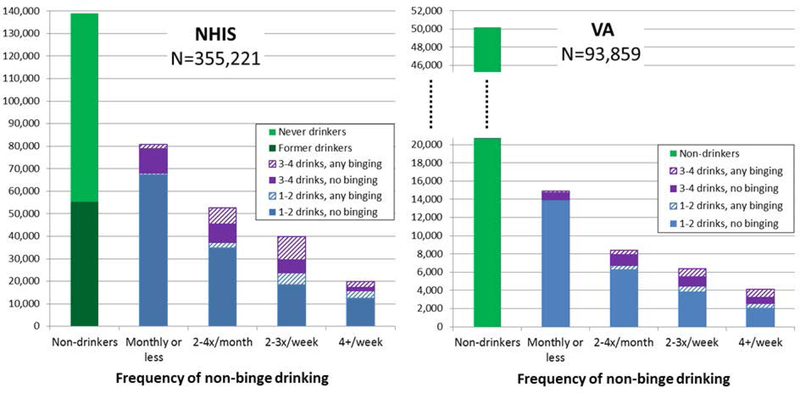
Methods: Two data sets with self-reported alcohol use and mortality follow-up were analyzed: 340,668 individuals from the National Health Interview Survey (NHIS) and 93,653 individuals from the Veterans Health Administration (VA) outpatient medical records. Survival analyses were conducted to evaluate the association between low-level drinking frequency and mortality.
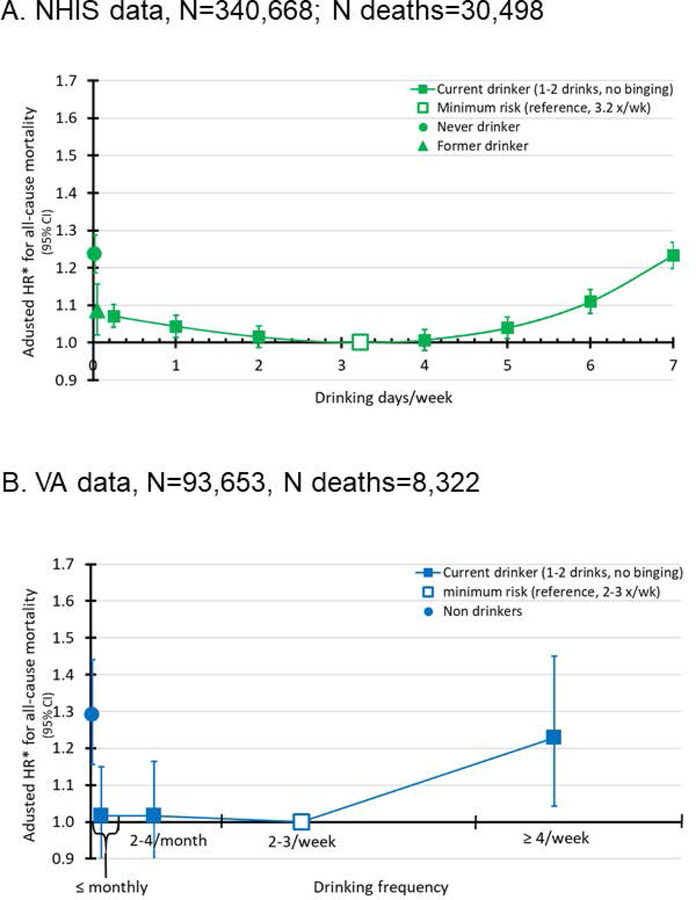
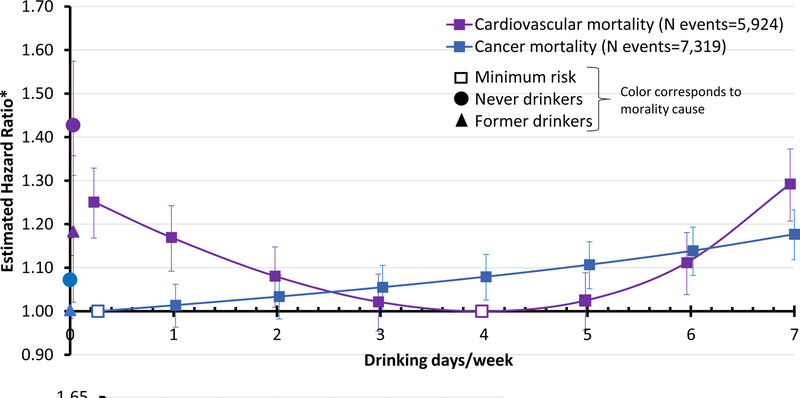
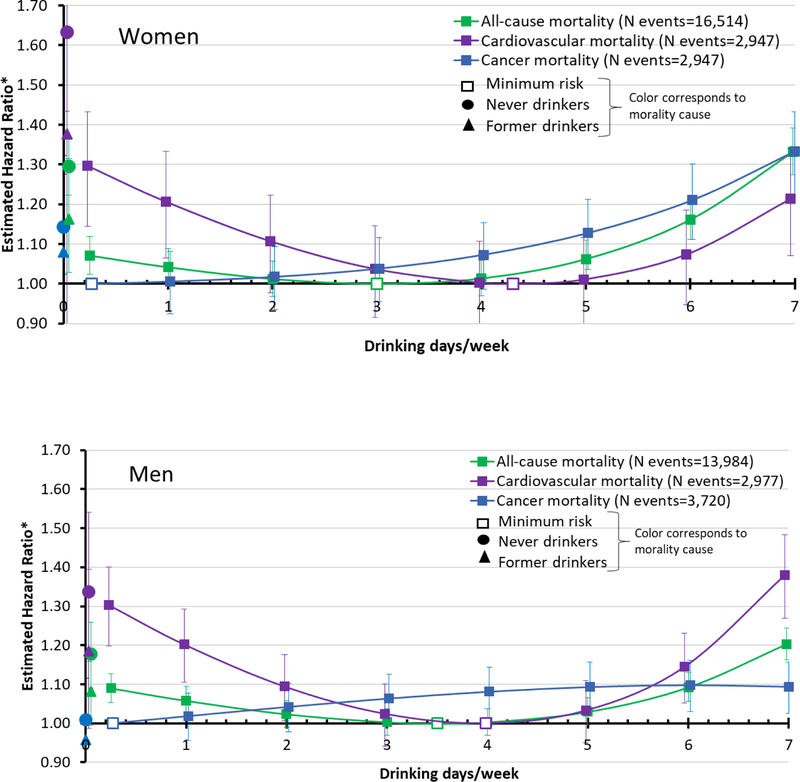
Results: The minimum risk drinking frequency among those who drink 1 to 2 drinks per occasion was found to be 3.2 times weekly in the NHIS data, based on a continuous measure of drinking frequency, and 2 to 3 times weekly in the VA data. Relative to these individuals with minimum risk, individuals who drink 7 times weekly had an adjusted hazard ratio (HR) of all-cause mortality of 1.23 (p < 0.0001) in the NHIS data, and individuals who drink 4 to 7 times weekly in the VA data also had an adjusted HR of 1.23 (p = 0.01). Secondary analyses in the NHIS data showed that the minimum risk was drinking 4 times weekly for cardiovascular mortality, and drinking monthly or less for cancer mortality. The associations were consistent in stratified analyses of men, women, and never smokers.
Conclusions: The minimum risk of low-level drinking frequency for all-cause mortality appears to be approximately 3 occasions weekly. The robustness of this finding is highlighted in 2 distinctly different data sets: a large epidemiological data set and a data set of veterans sampled from an outpatient clinic. Daily drinking, even at low levels, is detrimental to one's health.
Keywords: Alcohol Use; Cancer Mortality; Cardiovascular Mortality; Mortality.
© 2018 by the Research Society on Alcoholism.
Conflict of interest statement
CONFLICTS OF INTEREST
Dr. Bierut is listed as an inventor on Issued U.S. Patent 8,080,371, “Markers for Addiction” covering the use of certain SNPs in determining the diagnosis, prognosis, and treatment of addiction.
Figures
References
-
- Anstie FE (1870). On the use of wines in health and disease New York, J. S. Redfield.
-
- Bradley KA, Bush KR, et al. (2003). “Two brief alcohol-screening tests From the Alcohol Use Disorders Identification Test (AUDIT): validation in a female Veterans Affairs patient population.” Arch Intern Med 163(7): 821–829. - PubMed
-
- Bradley KA, DeBenedetti AF, et al. (2007). “AUDIT-C as a brief screen for alcohol misuse in primary care.” Alcohol Clin Exp Res 31(7): 1208–1217. - PubMed
-
- Britton A and Bell S (2017). “The protective effects of moderate drinking: lies, damned lies, and… selection biases?” Addiction 112(2): 218–219. - PubMed
-
- Britton A and Marmot M (2004). “Different measures of alcohol consumption and risk of coronary heart disease and all-cause mortality: 11-year follow-up of the Whitehall II Cohort Study.” Addiction 99(1): 109–116. - PubMed
Publication types
MeSH terms
Grants and funding
- R21 DA033827/DA/NIDA NIH HHS/United States
- R21 DA044744/DA/NIDA NIH HHS/United States
- 2015215/DDCF/Doris Duke Charitable Foundation/United States
- R21 AA024888/AA/NIAAA NIH HHS/United States
- R01 DA036583/DA/NIDA NIH HHS/United States
- R01DA042195/NH/NIH HHS/United States
- UL1 TR002345/TR/NCATS NIH HHS/United States
- R21 AA025689/AA/NIAAA NIH HHS/United States
- UL1 RR024992/RR/NCRR NIH HHS/United States
- R01 DA042195/DA/NIDA NIH HHS/United States
- K08 DA032680/DA/NIDA NIH HHS/United States
- U10 AA008401/AA/NIAAA NIH HHS/United States
- R01DA036583/NH/NIH HHS/United States
LinkOut - more resources
Full Text Sources
Other Literature Sources
Medical
