. 2018 Oct 3;8(1):14771.
doi: 10.1038/s41598-018-32866-5.

The use of natural media amendments to produce kale enhanced with functional lipids in controlled environment production system

Affiliations

The use of natural media amendments to produce kale enhanced with functional lipids in controlled environment production system

Natalia P Vidal et al. Sci Rep. .

Abstract

Diets high in vegetable consumption is highly correlated with reduced risk of developing common lifestyle related diseases. We investigated the effects of three natural growth media amendments [potassium humate, dry vermicast, volcanic minerals or Promix alone (Control)] in enhancing the accumulation of functional lipids in greenhouse grown kale. Functional lipids (n9, n6, n3 fatty acids, diglycerides, galactolipids and phytosterols) were assessed using either gas chromatography/mass spectrometry (GC/MS) or ultra-high performance liquid chromatography-high resolution tandem mass spectrometry (UHPLC-HRMS/MS). The results showed volcanic minerals and dry vermicast were the most successful in enhancing the accumulation of functional lipids in kale. For example, dry vermicast enhanced the accumulation of total C18:1n9 and C16:3n3 fatty acids, while total C18:2n6 fatty acid accumulation was enhanced by volcanic minerals. In conclusion, natural growing medium amendments are remarkably effective in modulating the accumulation of functional lipids in kale grown under controlled-environment conditions. This could be a useful strategy for functional foods production in control environment production systems. Increase access to kale with enhanced functional lipids could aid in increase consumption of these health promotive compounds in the diet with potential implications in population health.


Conflict of interest statement

The authors declare no competing interests.

Figures
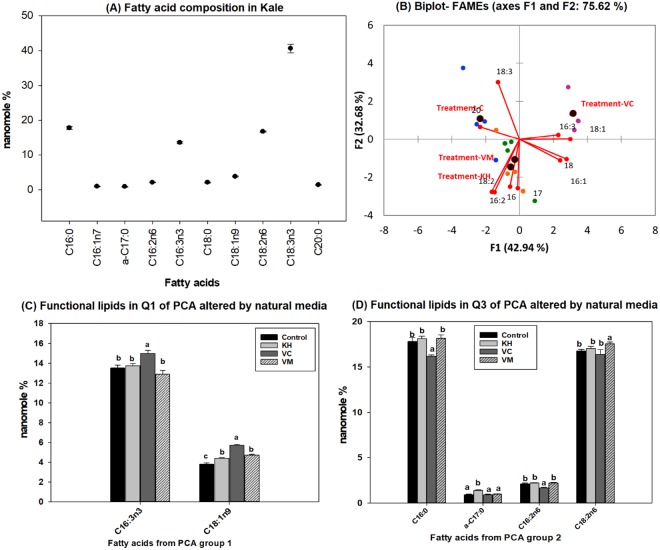
Figure 1
Figure 1
(AD). Natural amended media alter the total fatty acid composition of Kale cultivated under control environmental (greenhouse) conditions. (A) Observed kale fatty acids, (B) Biplot showing relationships between observed kale fatty acid levels and media amendments used for growth. One-way ANOVA showing altered Kale functional lipids segregated in (C) quadrant 1 (Q1) and (D) Q3 of correlation circle or biplot following principal component analysis. Values in bar chart (nanomole percent by weight composition) represent means ± standard errors. Means in the same row accompanied by different superscripts are significantly different at LSD α = 0.05, n = 4 per experimental replicate. Control = no media amendment added, KH = potassium humate, VC = dry vermicast, VM = volcanic minerals amendments added to the control media. Please note Fig. A in graphs of kale lipids reported in this paper represent the composition observed in the control plants.
Figure 2
Figure 2
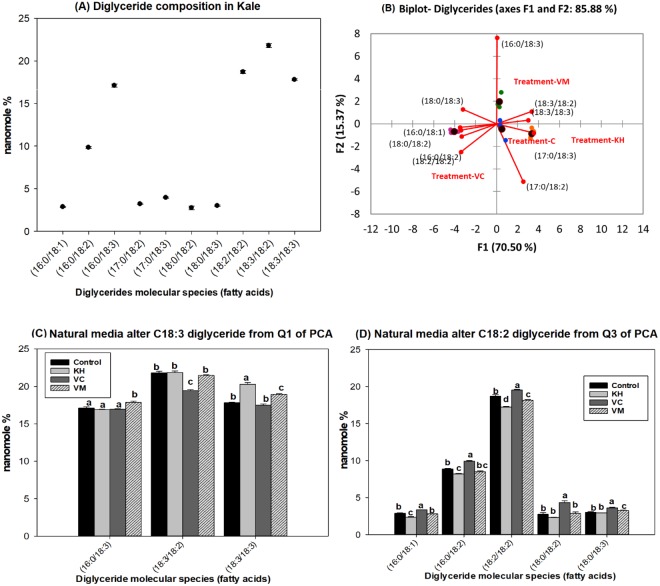
(AD). Natural amended media alter the diglycerides (DG) composition of Kale cultivated under control environmental (greenhouse) conditions. (A) Observed kale DG, (B) Biplot showing relationships between observed kale diglyceride levels and media amendments used for growth. One-way ANOVA showing altered Kale functional lipids segregated in (C) quadrant 1 (Q1) and (D) Q3 of the correlation circle or biplot following principal component analysis. Values in bar chart (nanomole percent by weight composition) represent means ± standard errors. Means in the same row accompanied by different superscripts are significantly different at LSD α = 0.05, n = 4 per experimental replicate. Control = no media amendment added, KH = potassium humate, VC = dry vermicast, VM = volcanic minerals amendments added to the control media. HESI-MS = heated electrospray ionization mass spectrometry. Ammonium adducts [M + NH4]+ of DG molecular species were identified using neutral loss of 35 Da in HESI-MS positive mode following lipid class separation using C30 reverse phase chromatography.
Figure 3
Figure 3
Abbreviated plant biosynthesis glycolipids metabolism. The most abundant molecular species enhanced in the DG and galactolipid classes in kale plants grown in potassium humate (orange) vermicast (green) and volcanic mineral (blue) media amendments are shown. Abbreviations: ATS, LPA acyltransferase; DG, diglyceride; DGD, DGDG synthase; G3P, glycerol-3-phosphate; GLA, glycerolypase; GPAT, glycerol-3-phosphate acyl transferase; LPA, lysophosphatidic acid; MGD, MGDG synthase; PA, phosphatidic acid; PAP, phosphatidate phosphatase; SQDG, SQDG synthase; ER, endoplasmic reticulum.
Figure 4
Figure 4
(AD). Natural amended media alter the monogalactosylmonoacylglycerides (MGMG) composition of Kale cultivated under control environmental (greenhouse) conditions. (A) Observed kale MGMG, (B) Biplot showing relationships between observed kale monogalactosylmonoacylglycerides levels and media amendments used for growth. One-way ANOVA showing altered Kale functional lipids segregated in (C) quadrants 1 & 2 (Q1 & Q2) and (D) Q3 of correlation circle or biplot following principal component analysis. Values in bar chart (nanomole percent by weight composition) represent means ± standard errors. Means in the same row accompanied by different superscripts are significantly different at LSD α = 0.05, n = 4 per experimental replicate. Control = no media amendment added, KH = potassium humate, VC = dry vermicast, VM = volcanic minerals amendments added to the control media.
Figure 5
Figure 5
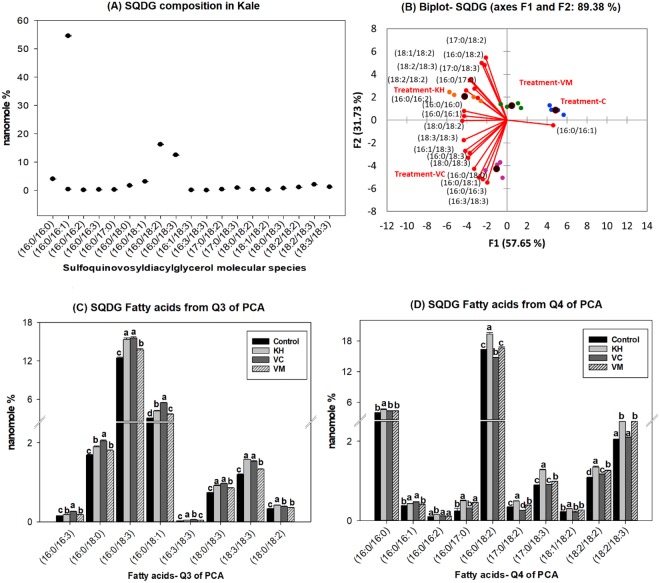
(AD). Natural amended media alter the sulfoquinovosyldiacylglycerides (SQDG) composition of Kale cultivated under control environmental (greenhouse) conditions. (A) Observed kale SQDG, (B) Biplot showing relationships between observed kale sulfoquinovosyldiacylglycerides levels and media amendments used for growth. One-way ANOVA showing altered Kale functional lipids segregated in (C) quadrants 3 (Q3) and (D) Q4 of correlation circle or biplot following principal component analysis. Values in bar chart (nanomole percent by weight composition) represent means ± standard errors. Means in the same row accompanied by different superscripts are significantly different at LSD α = 0.05, n = 4 per experimental replicate. Control = no media amendment added, KH = potassium humate, VC = dry vermicast, VM = volcanic minerals amendments added to the control media. HESI-MS = heated electrospray ionization mass spectrometry. Deprotonated [M-H]- of SQDG molecular species were identified using a precursor ion scan of m/z 225 in HESI-MS negative mode following lipid class separation using C30 reverse phase chromatography.
Figure 6
Figure 6
(AD). Natural amended media alter the monogalactosyldiacylglycerides composition of Kale cultivated under control environmental (greenhouse) conditions. (A) Observed kale monogalactosyldiacylglycerides, (B) Biplot showing relationships between observed kale monogalactosyldiacylglycerides levels and media amendments used for growth. One-way ANOVA showing altered Kale functional lipids segregated in (C) quadrants 1 (Q1) and (D) Q3 & Q4 of correlation circle or biplot following principal component analysis. Values in bar chart (nanomole percent by weight composition) represent means ± standard errors. Means in the same row accompanied by different superscripts are significantly different at LSD α = 0.05, n = 4 per experimental replicate. Control = no media amendment added, KH = potassium humate, VC = dry vermicast, VM = volcanic minerals amendments added to the control media. MGDG = monogalactosyldiacylglycerides. HESI-MS = heated electrospray ionization mass spectrometry.
Figure 7
Figure 7
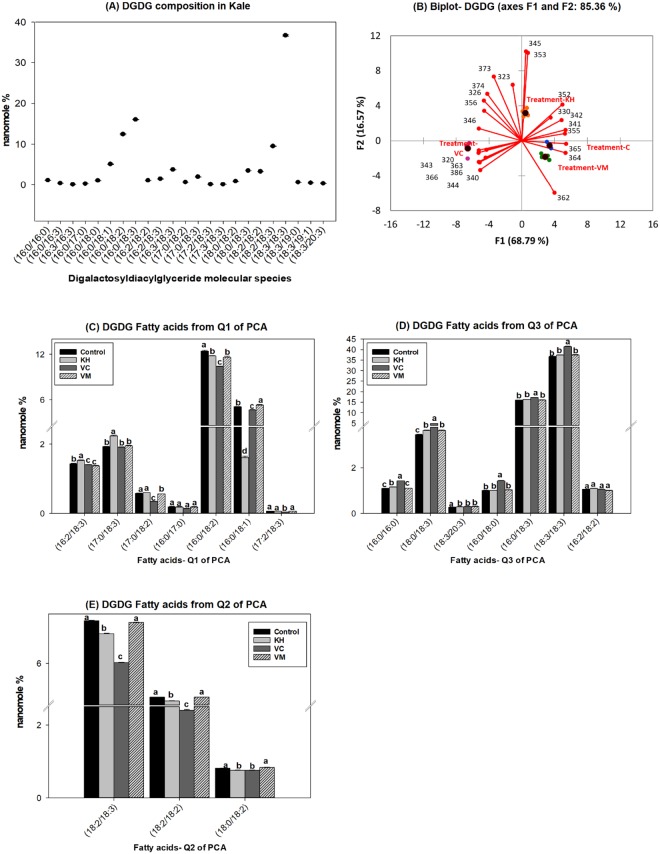
(AE). Natural amended media alter the digalactosyldiacylglycerides composition of Kale cultivated under control environmental (greenhouse) conditions. (A) Observed kale digalactosyldiacylglycerides, (B) Biplot showing relationships between observed kale digalactosyldiacylglycerides levels and media amendments used for growth. One-way ANOVA showing altered Kale functional lipids segregated in (C) quadrants (Q1), (D) Q3 (E) Q2 of correlation circle or biplot following principal component analysis. Values in bar chart (nanomole percent by weight composition) represent means ± standard errors. Means in the same row accompanied by different superscripts are significantly different at LSD α = 0.05, n = 4 per experimental replicate. Control = no media amendment added, KH = potassium humate, VC = dry vermicast, VM = volcanic minerals amendments added to the control media. DGDG = digalactosyldiacylglycerides. HESI-MS = heated electrospray ionization mass spectrometry. Formic acid adducts [M + HCOO]− of DGDG molecular species were identified using a precursor ion scan of m/z 397, 415 in HESI-MS negative mode following lipid class separation using C30 reverse phase chromatography. Diacyl species were used for the correlation circle, scope and biplot plots because use of the molecular species as in previous figures would make these figures unreadable. Please see bar chart for the corresponding figures as separated per quadrant in the score, biplots and correlation circle. DGDG molecular were identified using a characteristic fragment ion of m/z 397, 415 in HESI-MS negative mode following lipid class separation using C30 reverse phase chromatography.

References

    1. Viuda-Martos M, Ruiz-Navajas Y, Fernández-López J, Pérez-Álvarez JA. Spices as Functional Foods. Critical Reviews in Food Science and Nutrition. 2010;51:13–28. doi: 10.1080/10408390903044271. - DOI - PubMed
    1. Betoret E, Betoret N, Vidal D, Fito P. Functional foods development: Trends and technologies. Trends in Food Science & Technology. 2011;22:498–508. doi: 10.1016/j.tifs.2011.05.004. - DOI
    1. Trichopoulou, et al. Vegetable and fruit: the evidence in their favour and the public health perspective. International Journal for Vitamin and Nutrition Research. 2003;73:63–69. doi: 10.1024/0300-9831.73.2.63. - DOI - PubMed
    1. Stuchlík M, Zak S. Vegetable lipids as components of functional foods. Biomedical Papers-Palacky University Olomouc. 2002;146:3–10. doi: 10.5507/bp.2002.001. - DOI - PubMed
    1. Schreiner M, Huyskens-Keil S. Phytochemicals in fruit and vegetables: health promotion and postharvest elicitors. Critical reviews in plant sciences. 2006;25:267–278. doi: 10.1080/07352680600671661. - DOI

Publication types