. 2018 Oct 3;8(1):14752.
doi: 10.1038/s41598-018-33018-5.

Gut Colonization with Methanogenic Archaea Lowers Plasma Trimethylamine N-oxide Concentrations in Apolipoprotein e-/- Mice

Affiliations

Gut Colonization with Methanogenic Archaea Lowers Plasma Trimethylamine N-oxide Concentrations in Apolipoprotein e-/- Mice

Ali Ramezani et al. Sci Rep. .

Abstract

A mechanistic link between trimethylamine N-oxide (TMAO) and atherogenesis has been reported. TMAO is generated enzymatically in the liver by the oxidation of trimethylamine (TMA), which is produced from dietary choline, carnitine and betaine by gut bacteria. It is known that certain members of methanogenic archaea (MA) could use methylated amines such as trimethylamine as growth substrates in culture. Therefore, we investigated the efficacy of gut colonization with MA on lowering plasma TMAO concentrations. Initially, we screened for the colonization potential and TMAO lowering efficacy of five MA species in C57BL/6 mice fed with high choline/TMA supplemented diet, and found out that all five species could colonize and lover plasma TMAO levels, although with different efficacies. The top performing MA, Methanobrevibacter smithii, Methanosarcina mazei, and Methanomicrococcus blatticola, were transplanted into Apoe-/- mice fed with high choline/TMA supplemented diet. Similar to C57BL/6 mice, following initial provision of the MA, there was progressive attrition of MA within fecal microbial communities post-transplantation during the initial 3 weeks of the study. In general, plasma TMAO concentrations decreased significantly in proportion to the level of MA colonization. In a subsequent experiment, use of antibiotics and repeated transplantation of Apoe-/- mice with M. smithii, led to high engraftment levels during the 9 weeks of the study, resulting in a sustained and significantly lower average plasma TMAO concentrations (18.2 ± 19.6 μM) compared to that in mock-transplanted control mice (120.8 ± 13.0 μM, p < 0.001). Compared to control Apoe-/- mice, M. smithii-colonized mice also had a 44% decrease in aortic plaque area (8,570 μm [95% CI 19587-151821] vs. 15,369 μm [95% CI [70058-237321], p = 0.34), and 52% reduction in the fat content in the atherosclerotic plaques (14,283 μm [95% CI 4,957-23,608] vs. 29,870 μm [95% CI 18,074-41,666], p = 0.10), although these differences did not reach significance. Gut colonization with M. smithii leads to a significant reduction in plasma TMAO levels, with a tendency for attenuation of atherosclerosis burden in Apoe-/- mice. The anti-atherogenic potential of MA should be further tested in adequately powered experiments.


Conflict of interest statement

The authors declare no competing interests.

Figures
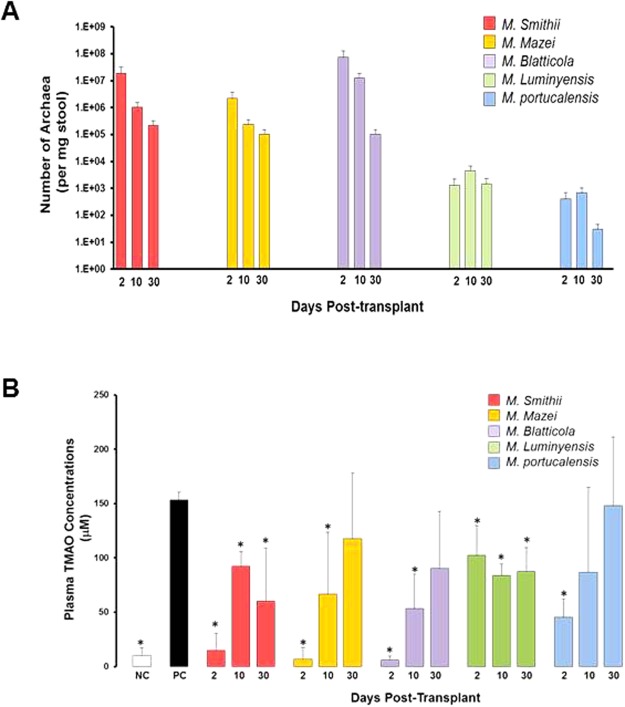
Figure 1
Figure 1
MA can colonize normal C57BL/6 mice guts and lower their plasma TMAO concentrations. (A) Q-PCR analysis of fecal samples from C57BL/6 mice transplanted with one of five different representative gut- and non-gut MA, namely: M. smithii, M. mazei, M. blatticola, M. luminyensis, and M. portucalensis. Stool samples were collected at days 2, 10, and 30 post-transplantation. (B) Plasma TMAO concentrations in mock- and MA-transplanted C57BL/6 J mice collected at days 2, 10 and 30 post-transplantation. Mock-transplanted negative control mice (NC) only received regular water, whereas mock-transplanted positive control mice (PC) received high choline/TMA water, similar to MA-transplanted mice.
Figure 2
Figure 2
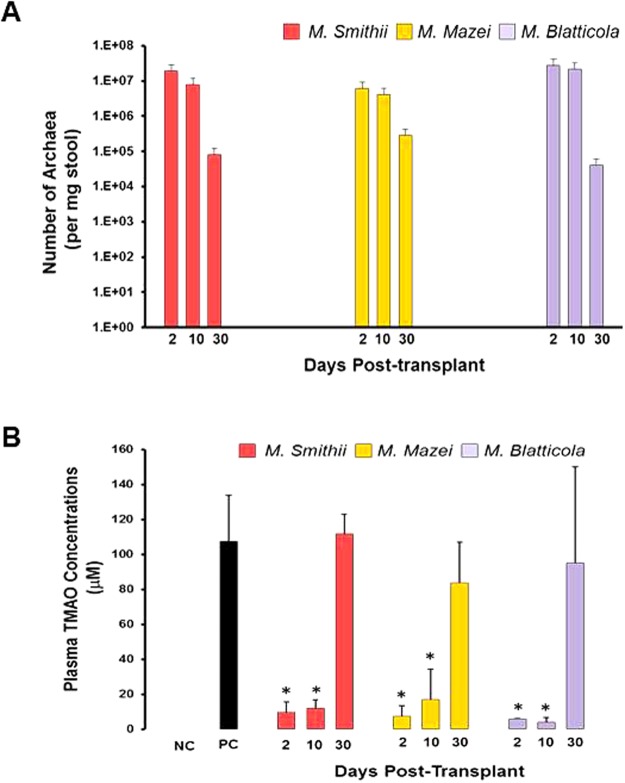
MA can colonize Apoe−/− mice guts and lower their plasma TMAO concentrations. (A) Q-PCR analysis of fecal samples from Apoe−/− mice transplanted with one of the 3 different MA, namely: M. smithii, M. mazei, and M. blatticola. Stool samples were collected at days 2, 10, and 30 post-transplantation. (B) Plasma TMAO concentrations in mock- and MA-transplanted Apoe−/− mice collected at days 2, 10 and 30 post-transplantation. Mock-transplanted negative control mice (NC) only received regular water, whereas mock-transplanted positive control mice (PC) received high choline/TMA water, similar to MA-transplanted mice.
Figure 3
Figure 3
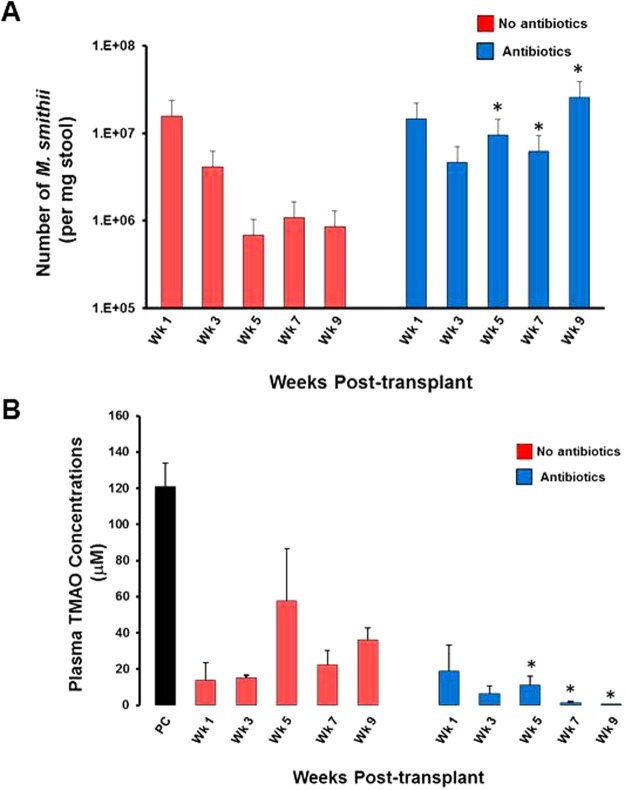
Repeated transplantation of Apoe−/− mice with M. smithii in presence of antibiotics leads to stable and high level gut colonization and diminishes the plasma TMAO concentrations. (A) To maintain a high level of gut colonization with the MA, M. smithii, transplantation was repeated every 3 weeks for the duration of the study. A second group of mice (+Antibiotics) was also maintained on vancomycin and ampicillin, in addition to receiving repeated transplantations. Weekly blood and stool samples were collected from the mice for 9 weeks. Stool samples were analyzed by q-PCR for MA engraftment levels. (B) Plasma TMAO concentrations in mock- and M. smithii-transplanted Apoe−/− mice (±antibiotics) collected weekly for 9 weeks post-transplantation. Mock-transplanted positive control mice (PC) received high choline/TMA water, similar to M. smithii-transplanted mice, but not antibiotics.
Figure 4
Figure 4
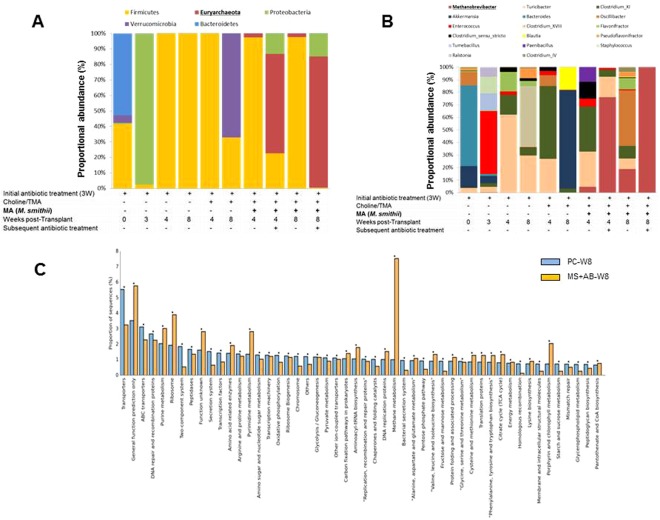
Antibiotic depletion of Firmicutes enhances gut colonization by M. smithii. Apoe−/− mouse gut microbiome characterization based on 16 S rRNA gene sequencing. Shown is the histogram of proportional changes in gut microbiota OTU abundance at the (A) phylum and (B) genus levels as measured for the different groups (NC, PC, No-antibiotics, antibiotic). (C) Metabolic potential of M. smithii-colonized mice compared to un-transplanted mice.
Figure 5
Figure 5
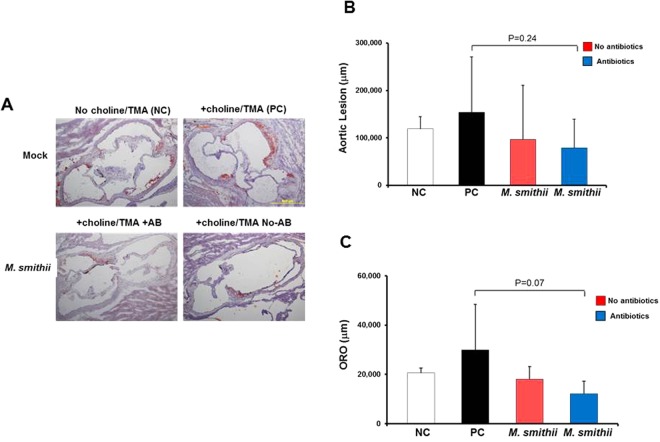
Stable M. smithii gut colonization trends towards attenuation of choline/TMA-enhanced atherosclerosis. (A) Representative Oil-Red-O (ORO)/hematoxylin staining of aortic root sections from 19-week-old female Apoe−/− mice that were fed chemically defined chow (0.07% total choline), in the presence versus absence of choline/TMA (1.0% total choline; 1.2% TMA) provided in the drinking water, and either mock- or M. smithii-transplanted, as described in the Experimental Procedures. Scale bars, 500 μm. The AB-POS group was maintained on antibiotics in their drinking water for the duration of the experiment following transplantation. (B) Aortic root lesion plaque area and (C) ORO staining in the plaque area were quantified in 19-week-old female Apoe−/− mice from the indicated diet and M. smithii transplanted groups. Data are presented as mean ± SE.

References

    1. Benjamin EJ, et al. Heart Disease and Stroke Statistics-2017 Update: A Report From the American Heart Association. Circulation. 2017;135:e146–e603. doi: 10.1161/CIR.0000000000000485. - DOI - PMC - PubMed
    1. Jie Z, et al. The gut microbiome in atherosclerotic cardiovascular disease. Nat. Commun. 2017;8:845–857. doi: 10.1038/s41467-017-00900-1. - DOI - PMC - PubMed
    1. Slingerland AE, Schwabkey Z, Wiesnoski DH, Jenq RR. Clinical Evidence for the Microbiome in Inflammatory Diseases. Front Immunol. 2017;8:400–415. doi: 10.3389/fimmu.2017.00400. - DOI - PMC - PubMed
    1. Koeth RA, et al. Intestinal microbiota metabolism of L-carnitine, a nutrient in red meat, promotes atherosclerosis. Nat. Med. 2013;19:576–585. doi: 10.1038/nm.3145. - DOI - PMC - PubMed
    1. Tang WH, et al. Intestinal microbial metabolism of phosphatidylcholine and cardiovascular risk. N. Engl. J. Med. 2013;368:1575–1584. doi: 10.1056/NEJMoa1109400. - DOI - PMC - PubMed

Publication types

MeSH terms

LinkOut - more resources