Review
. 2018 Sep 19:9:553.
doi: 10.3389/fendo.2018.00553. eCollection 2018.

The Gut-Kidney Axis: Putative Interconnections Between Gastrointestinal and Renal Disorders

Affiliations
Review

The Gut-Kidney Axis: Putative Interconnections Between Gastrointestinal and Renal Disorders

Markku Lehto et al. Front Endocrinol (Lausanne). .

Abstract

Diabetic kidney disease (DKD) is a devastating condition associated with increased morbidity and premature mortality. The etiology of DKD is still largely unknown. However, the risk of DKD development and progression is most likely modulated by a combination of genetic and environmental factors. Patients with autoimmune diseases, like type 1 diabetes, inflammatory bowel disease, and celiac disease, share some genetic background. Furthermore, gastrointestinal disorders are associated with an increased risk of kidney disease, although the true mechanisms have still to be elucidated. Therefore, the principal aim of this review is to evaluate the impact of disturbances in the gastrointestinal tract on the development of renal disorders.

Keywords: chronic kidney disease; contact activation; diabetic nephropathy; gastrointestinal inflammation; gut permeability; inflammatory bowel disease; intestinal alkaline phosphatase; type 1 diabetes.


Figures
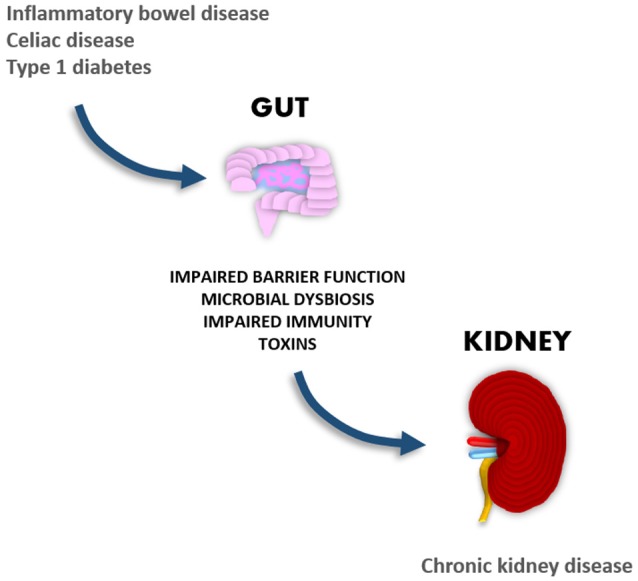
Figure 1
Figure 1
Gastrointestinal manifestations in autoimmune-mediated diseases are associated with the development of chronic kidney disease.
Figure 2
Figure 2
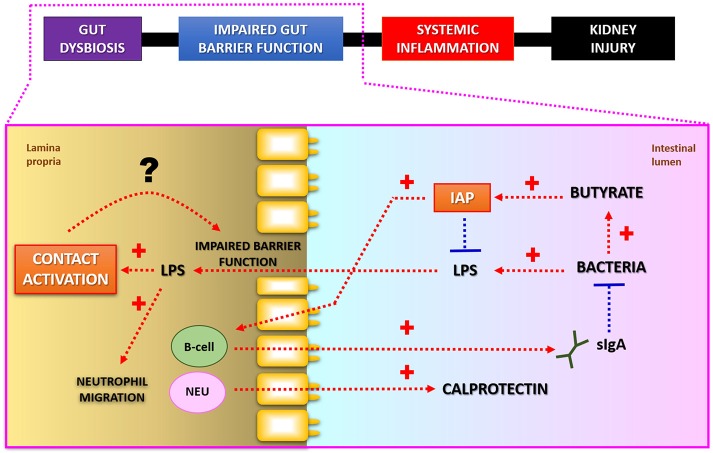
Putative interconnections between LPS-detoxification and intestinal barrier function. Intestinal alkaline phosphatase (IAP) detoxifies bacterial lipopolysaccharides (LPS; endotoxins) by dephosphorylation. Butyrate, a short-chain fatty acid produced as a result of bacterial fermentation, stimulates IAP gene expression. IAP may also modulate composition of microbial community via regulation of secretory IgA release. Fecal calprotectin is a commonly used marker for increased neutrophil (NEU) migration and local inflammation in patients with gastrointestinal diseases. Lower luminal IAP-activity may lead to increased production of toxic LPS-molecules, which in turn may stimulate Factor XII regulated contact activation pathway in the gut. Subsequent activation of kallikrein-kinin system by endotoxins may potentiate leakiness of the intestinal wall. Modified from Lassenius et al. (103).

References

    1. Lithovius R, Harjutsalo V, Saraheimo M, Forsblom C, Groop PH; FinnDiane Study Group. Longitudinal trends in use and costs of prescription medication in patients with type 1 diabetes: the impact of renal disease. Ann Med. (2013) 45:112–9. 10.3109/07853890.2012.671535 - DOI - PubMed
    1. Tuttle KR, Bakris GL, Bilous RW, Chiang JL, de Boer IH, Goldstein-Fuchs J, et al. Diabetic kidney disease: a report from an ADA Consensus Conference. Am J Kidney Dis. (2014) 64:510–33. 10.1053/j.ajkd.2014.08.001 - DOI - PubMed
    1. Rossing P, Hougaard P, Borch-Johnsen K, Parving HH. Predictors of mortality in insulin dependent diabetes: 10 year observational follow up study. BMJ (1996) 313:779–84. 10.1136/bmj.313.7060.779 - DOI - PMC - PubMed
    1. Groop PH, Thomas MC, Moran JL, Wadèn J, Thorn LM, Mäkinen VP, et al. The presence and severity of chronic kidney disease predicts all-cause mortality in type 1 diabetes. Diabetes (2009) 58:1651–8. 10.2337/db08-1543 - DOI - PMC - PubMed
    1. Groop PH, Thomas M, Feodoroff M, Forsblom C, Harjutsalo V. FinnDiane Study Group. Excess mortality in patients with type 1 diabetes without albuminuria-separating the contribution of early and late risks. Diabetes Care (2018) 41:748–54. 10.2337/dc17-1618 - DOI - PubMed

LinkOut - more resources