


Telehealth Interventions Designed for Women: an Evidence Map
- PMID: 30284173
- PMCID: PMC6258612
- DOI: 10.1007/s11606-018-4655-8
Telehealth Interventions Designed for Women: an Evidence Map
Abstract
Background: Telehealth employs technology to connect patients to the right healthcare resources at the right time. Women are high utilizers of healthcare with gender-specific health issues that may benefit from the convenience and personalization of telehealth. Thus, we produced an evidence map describing the quantity, distribution, and characteristics of evidence assessing the effectiveness of telehealth services designed for women.
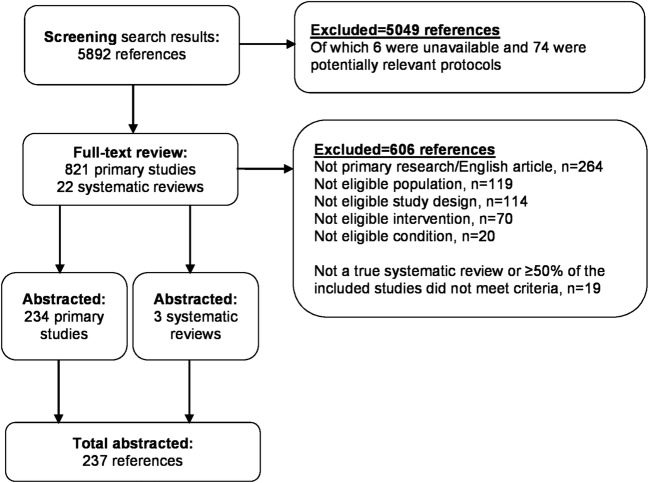
Methods: We searched MEDLINE® (via PubMed®) and Embase® from inception through March 20, 2018. We screened systematic reviews (SRs), randomized trials, and quasi-experimental studies using predetermined eligibility criteria. Articles meeting inclusion criteria were identified for data abstraction. To assess emerging trends, we also conducted a targeted search of ClinicalTrials.gov .
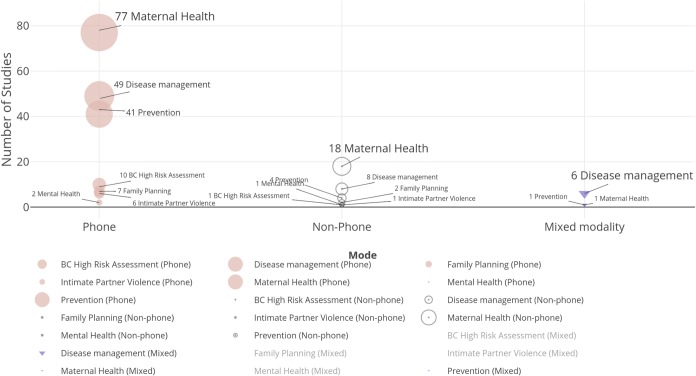
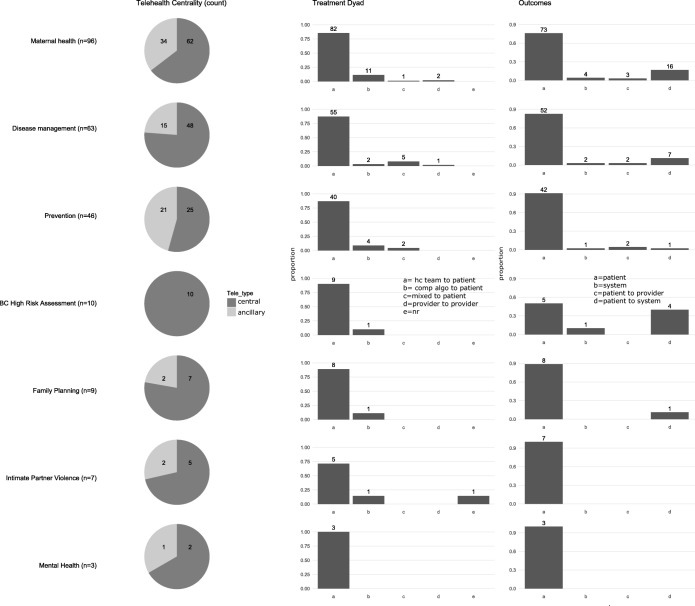
Results: Two hundred thirty-four primary studies and three SRs were eligible for abstraction. We grouped studies into focused areas of research: maternal health (n = 96), prevention (n = 46), disease management (n = 63), family planning (n = 9), high-risk breast cancer assessment (n = 10), intimate partner violence (n = 7), and mental health (n = 3). Most interventions focused on phone as the primary telehealth modality and featured healthcare team-to-patient communication and were limited in duration (e.g., < 12 weeks). Few interventions were conducted with older women (≥ 60 years) or in racially/ethnically diverse populations. There are few SRs in this area and limited evidence regarding newer telehealth modalities such as mobile-based applications or short message service/texting. Targeted search of clinical.trials.gov yielded 73 ongoing studies that show a shift in the use of non-telephone modalities.
Discussion: Our systematic evidence map highlights gaps in the existing literature, such as a lack of studies in key women's health areas (intimate partner violence, mental health), and a dearth of relevant SRs. With few existing SRs in this literature, there is an opportunity for examining effects, efficiency, and acceptability across studies to inform efforts at implementing telehealth for women.
Conflict of interest statement
Dr. Whited is a co-editor of
Figures

References
-
- U.S. Department of Health and Human Services. Health Resources & Services Adminstration: Telehealth Programs. Available at https://www.hrsa.gov/rural-health/telehealth/index.html. Accessed 17 July 2018.
-
- Agency for Healthcare Research and Quality (AHRQ). National Health IT Day. June 7, 2006. Available at: https://archive.ahrq.gov/news/sp060706.htm. Accessed 17 July 2018.
Publication types
MeSH terms
Grants and funding
LinkOut - more resources
Full Text Sources
Medical
