Patterns of Dementia Treatment and Frank Prescribing Errors in Older Adults With Parkinson Disease
- PMID: 30285047
- PMCID: PMC6382612
- DOI: 10.1001/jamaneurol.2018.2820
Patterns of Dementia Treatment and Frank Prescribing Errors in Older Adults With Parkinson Disease
Abstract
Importance: Dementia is common in Parkinson disease, but few data exist on dementia treatment patterns or the concurrent use of acetylcholinesterase inhibitors (ACHEIs) and anticholinergic medications, a frank prescribing error.
Objectives: To describe dementia treatment patterns, and to determine the extent to which the concurrent use of ACHEIs and drugs with strong anticholinergic activity occurs among individuals with Parkinson disease in the United States.
Design, setting, and participants: This cross-sectional analysis included adult Medicare beneficiaries (aged 65 years or older) with Parkinson disease diagnosis with 12 consecutive months of inpatient, outpatient, and prescription drug coverage from January 1, 2014, through December 31, 2014. Beneficiaries with other parkinsonian syndromes were excluded. Demographic, geographic, prescription claims, and other data were extracted from the 2014 Carrier, Beneficiary Summary, and Prescription Drug Event research identifiable files of the Centers for Medicare & Medicaid Services. Data analysis was conducted from August 1, 2017, to November 30, 2017.
Main outcomes and measures: Primary outcomes were use of dementia drug, specific dementia medication, and concurrent exposure to a high-potency anticholinergic drug and an ACHEI. Descriptive analyses and multivariable logistic regression models determined the extent to which patient characteristics and comorbid conditions were associated with dementia treatment or with a high-potency anticholinergic and ACHEI never event.
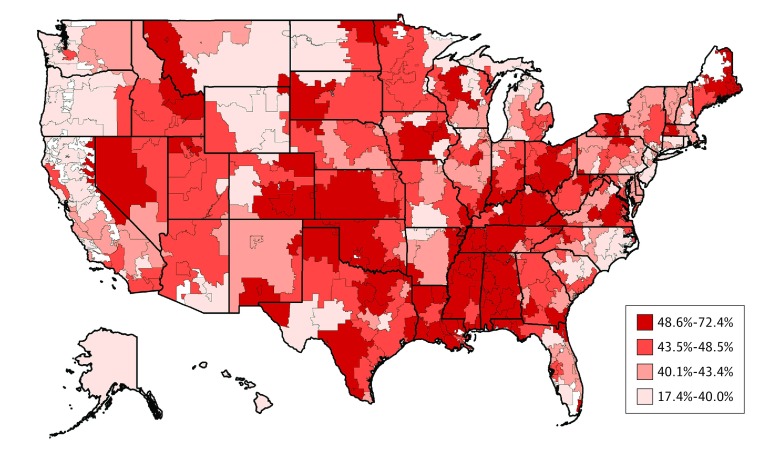
Results: Of 268 407 Medicare beneficiaries with Parkinson disease (mean [SD] age, 78.9 [7.5]; 134 575 male [50.1%]), most were identified in the files as white (232 831 [86.7%]), followed by black (14 629 [5.5%]), Hispanic (7176 [2.7%]), Asian (7115 [2.7%]), and Native American (874 [0.3%]). Among these beneficiaries, 73 093 (27.2%) were given a prescription for at least 1 antidementia medication. The most commonly prescribed medication was donepezil hydrochloride (46 027 [63.0%] users), followed by memantine hydrochloride (30 578 [41.8%] users) and rivastigmine tartrate (19 278 [26.4%] users). Dementia drugs were more likely to be prescribed to black (adjusted odds ratio [AOR], 1.33; 95% CI, 1.28-1.38) and Hispanic (AOR, 1.28; 95% CI, 1.22-1.35) beneficiaries and less likely for Native American beneficiaries (AOR, 0.62; 95% CI, 0.51-0.74). Women were less likely than men to be given a prescription for dementia medication (AOR, 0.85; 95% CI, 0.84-0.87). Of the 64 017 beneficiaries receiving an ACHEI, 28 495 (44.5%) experienced at least 1 high-potency anticholinergic-ACHEI event. Hispanic (AOR, 1.11; 95% CI, 1.00-1.23) and women (AOR, 1.30; 95% CI, 1.25-1.35) beneficiaries had greater odds of experiencing this never event. Statistically significant clusters of the prevalence of this prescribing error were observed across the United States (Moran I = 0.24; P < .001), with clusters of high prevalence in the southern and midwestern states.
Conclusions and relevance: Dementia medication use by persons with Parkinson disease varies by race/ethnicity and sex; potentially inappropriate prescribing is common among those being treated for cognitive impairment and varies by race/ethnicity, sex, and geography. These findings may serve as national and local targets for improving care quality and outcomes for persons with Parkinson disease.
Conflict of interest statement
Figures
Comment in
-
Challenges in Defining Inappropriate Medication Use in Parkinson Disease Dementia.JAMA Neurol. 2019 Jan 1;76(1):17-19. doi: 10.1001/jamaneurol.2018.2826. JAMA Neurol. 2019. PMID: 30285044 No abstract available.