


Efficacy of Low-Dose Amitriptyline for Chronic Low Back Pain: A Randomized Clinical Trial
- PMID: 30285054
- PMCID: PMC6248203
- DOI: 10.1001/jamainternmed.2018.4222
Efficacy of Low-Dose Amitriptyline for Chronic Low Back Pain: A Randomized Clinical Trial
Erratum in
-
Error in Axis in Figure 2B.JAMA Intern Med. 2019 Mar 1;179(3):457. doi: 10.1001/jamainternmed.2018.8236. JAMA Intern Med. 2019. PMID: 30830177 Free PMC article. No abstract available.
Abstract
Importance: Antidepressants at low dose are commonly prescribed for the management of chronic low back pain and their use is recommended in international clinical guidelines. However, there is no evidence for their efficacy.
Objective: To examine the efficacy of a low-dose antidepressant compared with an active comparator in reducing pain, disability, and work absence and hindrance in individuals with chronic low back pain.
Design, setting, and participants: A double-blind, randomized clinical trial with a 6-month follow-up of adults with chronic, nonspecific, low back pain who were recruited through hospital/medical clinics and advertising was carried out.
Intervention: Low-dose amitriptyline (25 mg/d) or an active comparator (benztropine mesylate, 1 mg/d) for 6 months.
Main outcomes and measures: The primary outcome was pain intensity measured at 3 and 6 months using the visual analog scale and Descriptor Differential Scale. Secondary outcomes included disability assessed using the Roland Morris Disability Questionnaire and work absence and hindrance assessed using the Short Form Health and Labour Questionnaire.
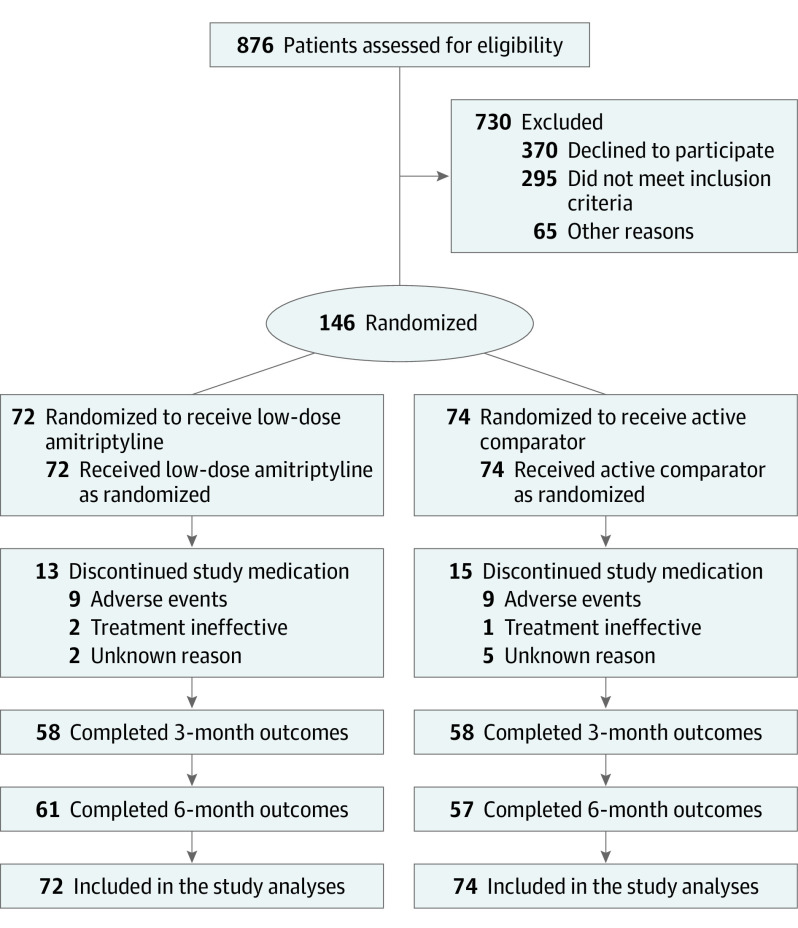
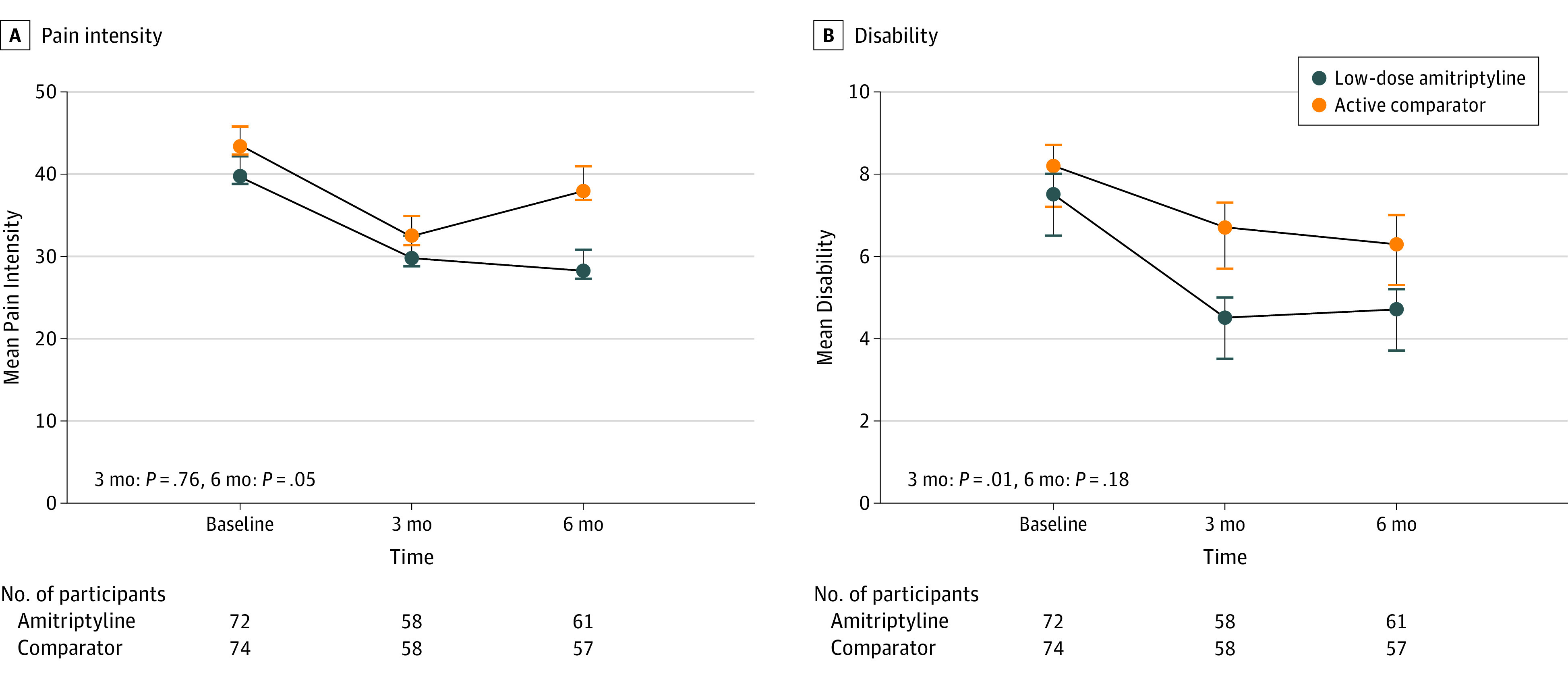
Results: Of the 146 randomized participants (90 [61.6%] male; mean [SD] age, 54.8 [13.7] years), 118 (81%) completed 6-month follow-up. Treatment with low-dose amitriptyline did not result in greater pain reduction than the comparator at 6 (adjusted difference, -7.81; 95% CI, -15.7 to 0.10) or 3 months (adjusted difference, -1.05; 95% CI, -7.87 to 5.78), independent of baseline pain. There was no statistically significant difference in disability between the groups at 6 months (adjusted difference, -0.98; 95% CI, -2.42 to 0.46); however, there was a statistically significant improvement in disability for the low-dose amitriptyline group at 3 months (adjusted difference, -1.62; 95% CI, -2.88 to -0.36). There were no differences between the groups in work outcomes at 6 months (adjusted difference, absence: 1.51; 95% CI, 0.43-5.38; hindrance: 0.53; 95% CI, 0.19-1.51), or 3 months (adjusted difference, absence: 0.86; 95% CI, 0.32-2.31; hindrance: 0.78; 95% CI, 0.29-2.08), or in the number of participants who withdrew owing to adverse events (9 [12%] in each group; χ2 = 0.004; P = .95).
Conclusions and relevance: This trial suggests that amitriptyline may be an effective treatment for chronic low back pain. There were no significant improvements in outcomes at 6 months, but there was a reduction in disability at 3 months, an improvement in pain intensity that was nonsignificant at 6 months, and minimal adverse events reported with a low-dose, modest sample size and active comparator. Although large-scale clinical trials that include dose escalation are needed, it may be worth considering low-dose amitriptyline if the only alternative is an opioid.
Trial registration: anzctr.org.au Identifier: ACTRN12612000131853.
Conflict of interest statement
Figures
Comment in
-
Low-Dose Amitriptyline for Chronic Low Back Pain.JAMA Intern Med. 2019 Mar 1;179(3):449-450. doi: 10.1001/jamainternmed.2018.8137. JAMA Intern Med. 2019. PMID: 30830186 No abstract available.
-
Low-Dose Amitriptyline for Chronic Low Back Pain.JAMA Intern Med. 2019 Mar 1;179(3):450. doi: 10.1001/jamainternmed.2018.8140. JAMA Intern Med. 2019. PMID: 30830187 No abstract available.
-
Low-Dose Amitriptyline for Chronic Low Back Pain-Reply.JAMA Intern Med. 2019 Mar 1;179(3):450-451. doi: 10.1001/jamainternmed.2018.8145. JAMA Intern Med. 2019. PMID: 30830194 No abstract available.
References
-
- Prescribing and Medicines Team . Prescriptions dispensed in the community—statistics for England, 2005-2015. National Health Service; 2016. https://digital.nhs.uk/data-and-information/publications/statistical/pre.... Accessed March 10, 2018.
Publication types
MeSH terms
Substances
LinkOut - more resources
Full Text Sources
Medical
