


Factors mediating the impacts of child abuse and intimate partner violence on chronic pain: a cross-sectional study
- PMID: 30285706
- PMCID: PMC6171313
- DOI: 10.1186/s12905-018-0642-9
Factors mediating the impacts of child abuse and intimate partner violence on chronic pain: a cross-sectional study
Abstract
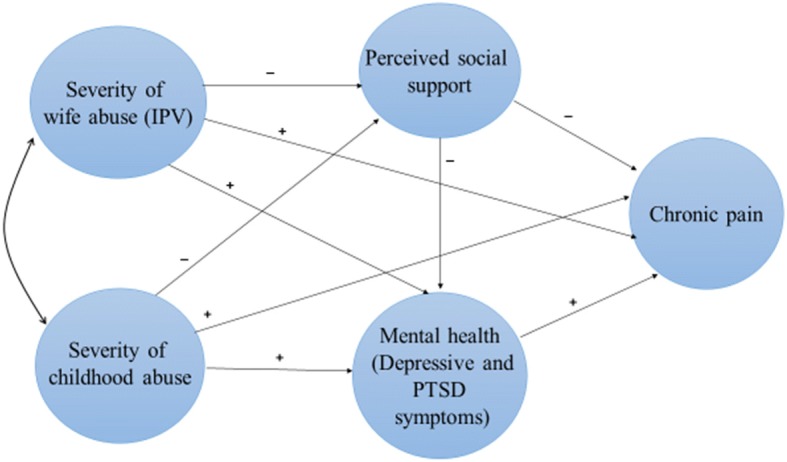
Background: Most research on the health impacts of intimate partner violence (IPV) and child abuse has been conducted in Western countries and may not be generalizable to women living in different contexts, such as Saudi Arabia. Chronic pain, a disabling health issue associated with experiences of both child abuse and IPV among women, negatively impacts women's well-being, quality of life, and level of functioning. Yet, the psychosocial mechanisms that explain how abuse relates to chronic pain are poorly understood. We developed and tested a theoretical model that explains how both IPV and child abuse are related to chronic pain.
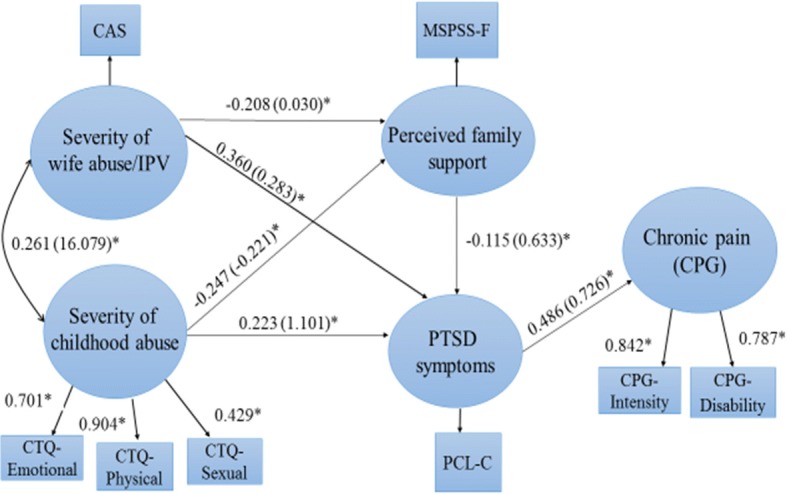
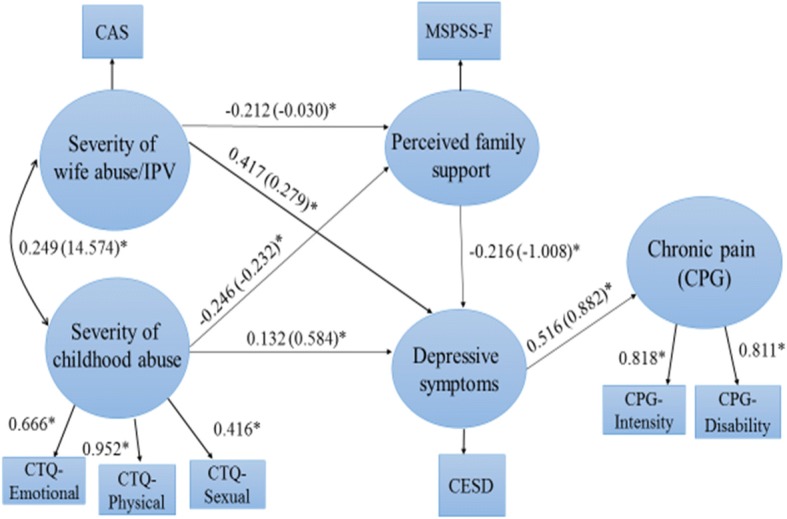
Methods: We recruited a convenience sample of 299 Saudi women, who had experienced IPV in the past 12 months, from nine primary health care centers in Saudi Arabia between June and August 2015. Women completed a structured interview comprised of self-report measures of IPV, child abuse, PTSD, depressive symptoms, chronic pain, and social support. Using Structural equation modeling (SEM), we analyzed the proposed model twice with different mental health indicators as mediators: PTSD symptoms (Model 1) and depressive symptoms (Model 2).
Results: Both models were found to fit the data, accounting for 31.6% (Model 1) and 32.4% (Model 2) of the variance in chronic pain severity. In both models, mental health problems (PTSD and depressive symptoms) fully mediated the relationship between severity of IPV and child abuse and chronic pain severity. Perceived family support partially mediated the relationship between abuse severity and depressive symptoms.
Conclusions: These results underscore the significance of considering lifetime abuse, women's mental health (depressive and PTSD symptoms) and their social resources in chronic pain management and treatment.
Keywords: And social support; Child abuse; Chronic pain; Depressive symptoms; Intimate partner violence; Post-traumatic stress disorder symptoms.
Conflict of interest statement
Ethics approval and consent to participate
Approval to conduct the study was obtained from the Research Ethics Board at Western University and Institutional Review Boards (IRB) for both Ministry of Health and King Abdullah International Medical Research Center (KAIMRC)/MNGHA in Saudi Arabia. All participants gave their written informed consent, then they took part in the study right away. Women who could not read or write, the letter of information was read to them and then they were asked to provide a thumb print to indicate consent in lieu of a signature. All data records were de-identified and women were assigned a unique ID number to ensure that data are anonymous and confidential.
Consent for publication
Not applicable, as no personal data have been included in this manuscript.
Competing interests
The authors declare that they have no competing interests.
Publisher’s Note
Springer Nature remains neutral with regard to jurisdictional claims in published maps and institutional affiliations.
Figures
References
-
- Tjaden P, Thoennes N. Extent, nature, and consequences of intimate partner violence: findings from the National Violence against Women Survey. Washington, DC: National Institute of Justice; 2000.
Publication types
MeSH terms
LinkOut - more resources
Full Text Sources
Medical
Miscellaneous
