


Determinants of having no general practitioner in Germany and the influence of a migration background: results of the German health interview and examination survey for adults (DEGS1)
- PMID: 30285753
- PMCID: PMC6171288
- DOI: 10.1186/s12913-018-3571-2
Determinants of having no general practitioner in Germany and the influence of a migration background: results of the German health interview and examination survey for adults (DEGS1)
Abstract
Background: It is aspired in the German healthcare system that general practitioners (GPs) act as initial contact for patients and guide through at all steps of medical treatment. This study aims at identifying factors associated with the odds of having no GP within the general population and especially among people with migration background.
Methods: This cross-sectional analysis was based on the "German Health Interview and Examination Survey for Adults" (DEGS1) conducted by the Robert Koch Institute. Descriptive analyses as well as multiple logistic regression models were performed to analyse the impact of a migration background, age, gender, residential area, socioeconomic status (SES) and other factors on having no GP among 7755 participants.
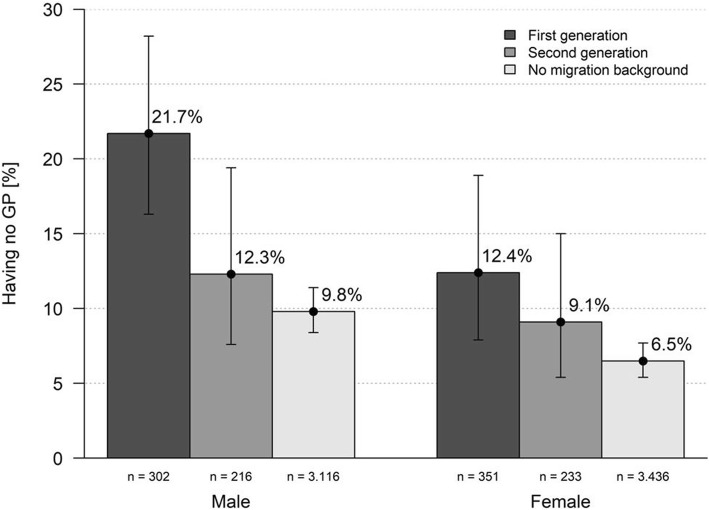
Results: 9.5% of the total study population and 14.8% of people with a migration background had no GP, especially men, adults living in big cities and without chronic diseases. The odds of not having a GP were higher for people with a two-sided migration background (aOR: 1.90, 95% CI: 1.42-2.55). Among the population with a migration background, particularly young adults, men, people living in big cities and having a private health insurance showed higher odds to have no GP.
Conclusions: It is necessary to investigate the causes of the differing utilization of healthcare of people with a migration background and, if necessary, to take measures for an equal access to healthcare for all population groups. Further research needs to be done to evaluate how to get young people into contact with a GP.
Keywords: DEGS; General practitioner; Migration; Use of health services.
Conflict of interest statement
Ethics approval and consent to participate
Not applicable as the analysis is based on secondary data. However, DEGS1 was approved by the Charité-Universitätsmedizin Berlin ethics committee (No. EA2/047/08) and participants provided written informed consent prior to the interview and examination [22].
Consent for publication
Not applicable.
Competing interests
The authors declare that they have no competing interests.
Publisher’s Note
Springer Nature remains neutral with regard to jurisdictional claims in published maps and institutional affiliations.
Figures
References
-
- Robert Koch-Institut. Statistisches Bundesamt . Health in Germany. Berlin: Robert Koch institute; Federal Statistical Office; 2008.
-
- Gerlach FM, Szecsenyi J. Hausarztzentrierte Versorgung. Inhalte und Qualität sind entscheidend. Deutsches Ärzteblatt. 2011;108:996–998.
-
- Fjær EL, Balaj M, Stornes P, Todd A, McNamara CL, Eikemo TA. Exploring the differences in general practitioner and health care specialist utilization according to education, occupation, income and social networks across Europe: findings from the European social survey (2014) special module on the social determinants of health. Eur J Pub Health. 2017;27:73–81. doi: 10.1093/eurpub/ckw255. - DOI - PubMed
MeSH terms
LinkOut - more resources
Full Text Sources
Medical
