


Assessment and agreement of the CT appearance pattern and its severity grading of radiation-induced lung injury after stereotactic body radiotherapy for lung cancer
- PMID: 30286105
- PMCID: PMC6171841
- DOI: 10.1371/journal.pone.0204734
Assessment and agreement of the CT appearance pattern and its severity grading of radiation-induced lung injury after stereotactic body radiotherapy for lung cancer
Abstract
Purpose: Radiographic severity of radiation-induced lung injury (RILI) has not been well-studied. The goal of this study was to assess the CT appearance pattern and severity of RILI without consideration of the clinical presentation.
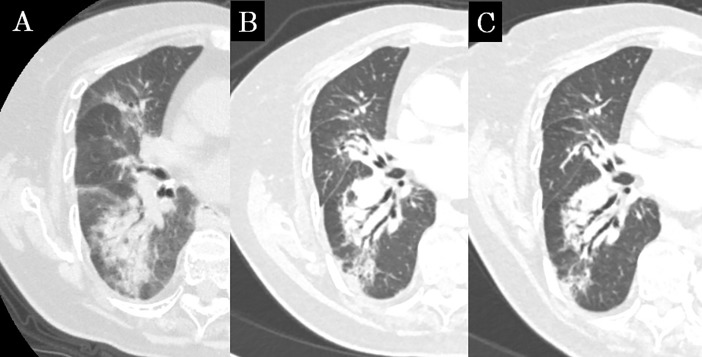
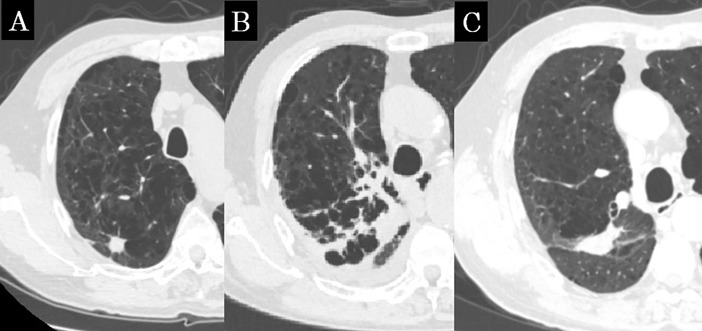
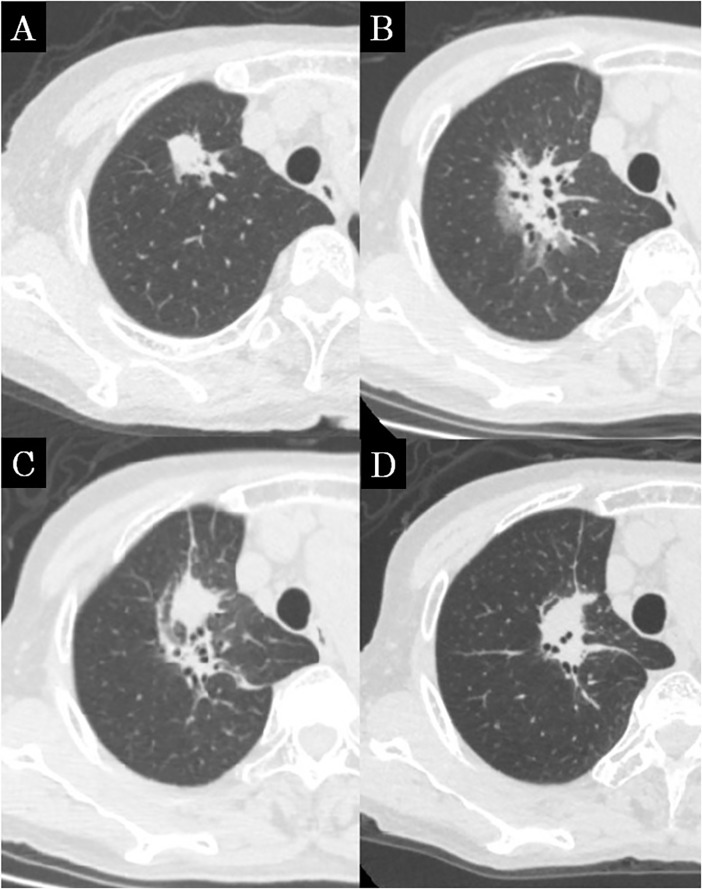
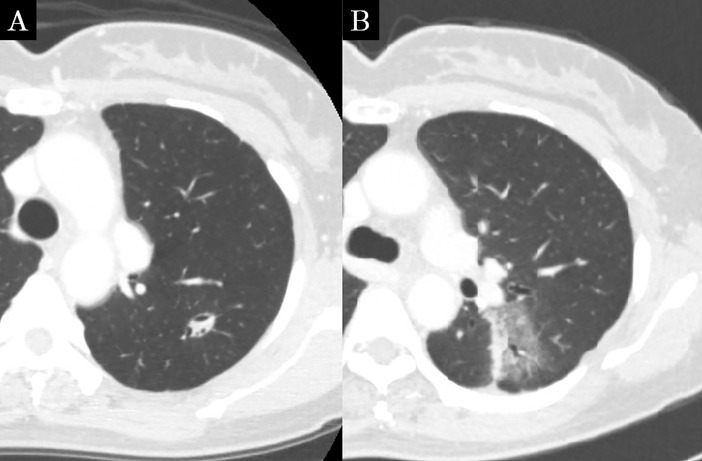
Material and methods: A total of 49 patients, 41 with primary lung cancer and 8 with metastatic lung cancer, were treated by 4-fraction stereotactic body radiotherapy (SBRT). RILI after SBRT was separately assessed by two observers. The early and late CT appearance patterns and CT-based severity grading were explored.
Results: The median follow-up period was 39.0 months. In the early CT findings of observers 1 and 2, there was diffuse consolidation in 15 and 8, diffuse ground glass opacity (GGO) in 0 and 0, patchy consolidation and GGO in 17 and 20, patchy GGO in 3 and 3, and no changes in 10 and 14, respectively (kappa = 0.61). In late CT findings of observer 1 and 2, there were modified conventional pattern in 28 and 24, mass-like pattern in 8 and 11, scar-like pattern in 12 and 12, and no changes in 1 and 2, respectively (kappa = 0.63). In the results of the CT-based grading by observers 1 and 2, there were grade 0 in 1 and 2, grade 1 in 10 and 14, grade 2 in 31 and 29, grade 3 in 7 and 4, and none of grade 4 or more, respectively (kappa = 0.66). According to multivariate analyses (MVA), the significant predicting factors of grade 2 or more CT-based RILI were age (p = 0.01), oxygen dependence (p = 0.03) and interstitial shadow (p = 0.03).
Conclusions: The agreement of the CT appearance and CT-based grading between two observers was good. These indicators may be able to provide us with more objective information and a better understanding of RILI.
Conflict of interest statement
The authors have declared that no competing interests exist.
Figures
References
MeSH terms
LinkOut - more resources
Full Text Sources
Medical
