


Retention of knowledge and skills after Emergency Obstetric Care training: A multi-country longitudinal study
- PMID: 30286129
- PMCID: PMC6171823
- DOI: 10.1371/journal.pone.0203606
Retention of knowledge and skills after Emergency Obstetric Care training: A multi-country longitudinal study
Abstract
Objective: To determine retention of knowledge and skills after standardised "skills and drills" training in Emergency Obstetric Care.
Design: Longitudinal cohort study.
Setting: Ghana, Malawi, Nigeria, Kenya, Tanzania and Sierra Leone.
Population: 609 maternity care providers, of whom 455 were nurse/midwives (NMWs).
Methods: Knowledge and skills assessed before and after training, and, at 3, 6, 9 and 12 months. Analysis of variance to explore differences in scores by country and level of healthcare facility for each cadre. Mixed effects regression analysis to account for potential explanatory factors including; facility type, years of experience providing maternity care, months since training and number of repeat assessments.
Main outcome measures: Change in knowledge and skills.
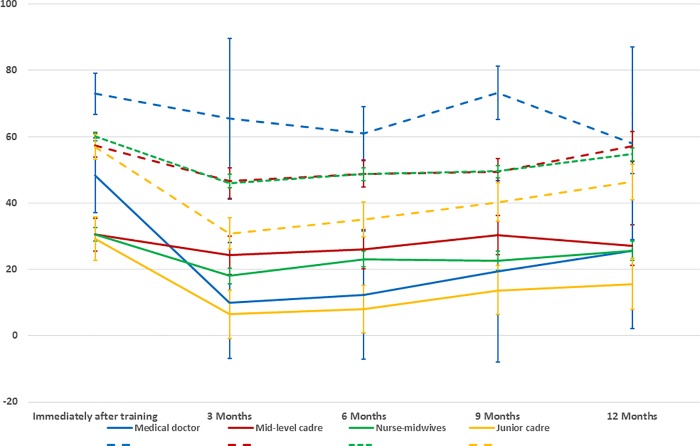
Results: Before training the overall mean (SD) score for skills was 48.8% (11.6%) and 65.6% (10.7%). for knowledge. After training the mean (95% CI) relative improvement in knowledge was 30.8% (29.1% - 32.6%) and 59.8% (58.6%- 60.9%) for skills. Mean scores for knowledge and skills at each subsequent assessment remained between those immediately post-training and those at 3 months. NMWs who attended all four assessments demonstrated statistically better retention of skills (14.9%, 95% CI 7.8%, 22.0% p<0.001) but not knowledge (8.6%, 95% CI -0.3%, 17.4%. p = 0.06) compared to those who attended one or two assessments only. Health care facility level or experience were not determinants of retention.
Conclusions: After training, healthcare providers retain knowledge and skills for up to 12 months. This effect can likely be enhanced by short repeat skills-training sessions, or, 'fire drills'.
Conflict of interest statement
The authors have declared that no competing interests exist.
Figures
References
-
- WHO, UNICEF, UNFPA, World Bank Group, United Nations Population Division. Trends in Maternal Mortality: 1990 to 2105. Geneva: World Health Organization; 2015.
-
- WHO, UNFPA, UNICEF, AMDD. Monitoring emergency obstetric care: a handbook, Geneva: World Health Organization; 2009.
-
- Ameh CA, Kerr R, Madaj B, Mdegela M, Kana T, Jones S, et al. Knowledge and Skills of Healthcare Providers in Sub-Saharan Africa and Asia before and after Competency-Based Training in Emergency Obstetric and Early Newborn Care. PLoS One 2016;11:e0167270 10.1371/journal.pone.0167270 - DOI - PMC - PubMed
Publication types
MeSH terms
LinkOut - more resources
Full Text Sources
Medical
