Effectiveness of Guided Internet-Based Cognitive Behavioral Therapy vs Face-to-Face Clinical Care for Treatment of Tinnitus: A Randomized Clinical Trial
- PMID: 30286238
- PMCID: PMC6583080
- DOI: 10.1001/jamaoto.2018.2238
Effectiveness of Guided Internet-Based Cognitive Behavioral Therapy vs Face-to-Face Clinical Care for Treatment of Tinnitus: A Randomized Clinical Trial
Abstract
Importance: Accessible clinical care is not always available to individuals with distressing tinnitus. Internet-based cognitive behavioral therapy has the potential to increase access to evidence-based services that manage tinnitus. Research comparing the effectiveness of this internet-based intervention with face-to-face care is required.
Objective: To evaluate whether an internet-based cognitive behavioral therapy intervention is at least as effective as established individualized face-to-face clinical care in reducing tinnitus distress and tinnitus-related difficulties.
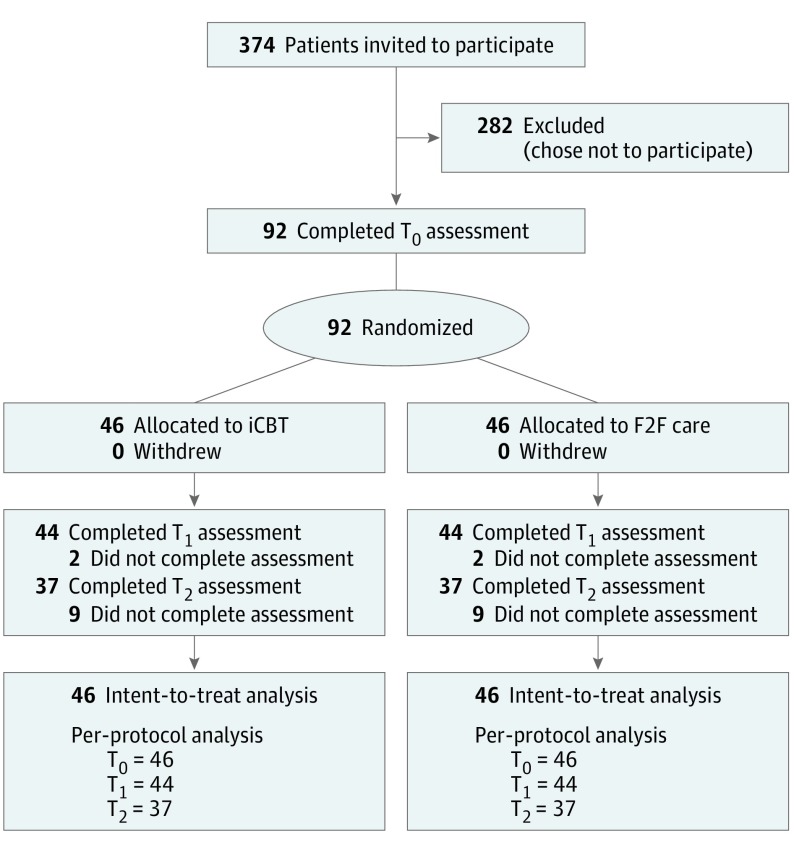
Design, setting, and participants: A randomized, multicenter, 2-arm parallel group, noninferiority trial with 2-month follow-up was performed between October 4, 2016, and July 14, 2017. Invited to participate were 374 adults based in the United Kingdom who had been referred to their local tinnitus clinics because of bothersome tinnitus. The experimental group received the internet-based intervention online, and the active control group underwent the usual face-to-face tinnitus care at 1 of 3 UK-based National Health Service hospitals. Participants were randomly assigned (1:1) to either intervention using variable permuted block sizes of 4 and 6. Of 92 participants who were randomized (46 each in the experimental and control groups), 88 participants completed the assessment immediately after intervention and 74 participants completed the follow-up assessment.
Interventions: Participants were randomized to receive either 8 weeks of guided internet-based cognitive behavioral therapy or a mean of 2 to 3 individualized face-to-face appointments in a tinnitus clinic.
Main outcomes and measures: The primary outcome was a change in tinnitus distress (assessed by the Tinnitus Functional Index). Secondary assessment measures were included for insomnia, anxiety, depression, hearing disability, hyperacusis, cognitive failures, and satisfaction with life.
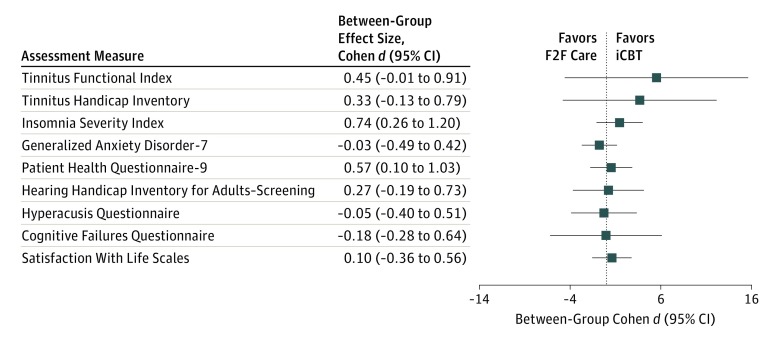
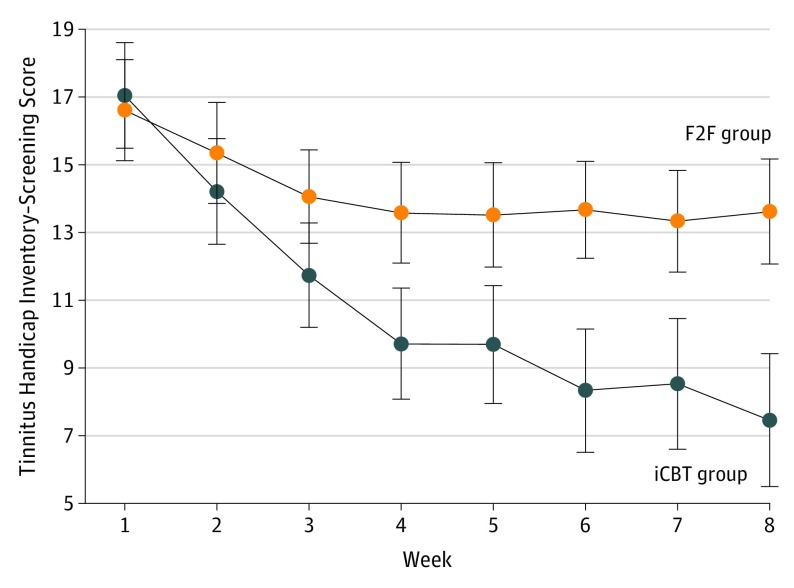
Results: Of 92 patients overall, 55 (60%) were men with a mean (SD) age of 52.96 (12.07) years and mean (SD) tinnitus duration of 6.54 (9.25) years. The between-group difference in the Tinnitus Functional Index scores after intervention were 5.18 (95% CI, -4.17 to 14.53) at the initial assessment and 5.52 (95% CI, -4.60 to 15.61) at follow-up; both differences were within the noninferiority margin of 13 points for the lower 95% CI. For the secondary outcomes, only outcomes for insomnia fell outside the noninferiority margin, both after intervention and at follow-up, favoring internet-based cognitive behavioral therapy.
Conclusions and relevance: This is the first trial, to our knowledge, to compare an internet-based intervention with standard individualized face-to-face care for tinnitus. It revealed that both interventions are equally effective for reducing tinnitus distress and most tinnitus-related difficulties.
Trial registration: ClinicalTrials.gov identifier: NCT02665975.
Conflict of interest statement
Figures
Comment in
-
Cognitive Behavioral Therapy for Tinnitus Unbound.JAMA Otolaryngol Head Neck Surg. 2018 Dec 1;144(12):1134-1135. doi: 10.1001/jamaoto.2018.2263. JAMA Otolaryngol Head Neck Surg. 2018. PMID: 30286237 No abstract available.
References
-
- Hoare DJ, Broomhead E, Stockdale D, Kennedy V. Equity and person-centredness in provision of tinnitus services in UK National Health Service audiology departments. Eur J Pers Cent Healthc. 2015;3(3):318-326. doi: 10.5750/ejpch.v3i3.984 - DOI