Service Provision for Children Who Are Hard of Hearing at Preschool and Elementary School Ages
- PMID: 30286245
- PMCID: PMC6430501
- DOI: 10.1044/2018_LSHSS-17-0145
Service Provision for Children Who Are Hard of Hearing at Preschool and Elementary School Ages
Abstract
Purpose: To characterize preschool and school services for children who are hard of hearing (CHH), we described service setting, amount, and configuration and analyzed the relationship between service receipt and student hearing levels and language scores. Characteristics of professionals providing services were described and then used to predict level of comfort with skills supporting listening and spoken language. The amount of provider communication with children's audiologists was also investigated.
Method: Participants included parents of CHH (preschool n = 174; school n = 155) and professionals (preschool n = 133; school n = 104) who completed interviews and questionnaires as part of a longitudinal study. Children's hearing, speech, and language data were collected from annual testing and analyzed in relation to service data.
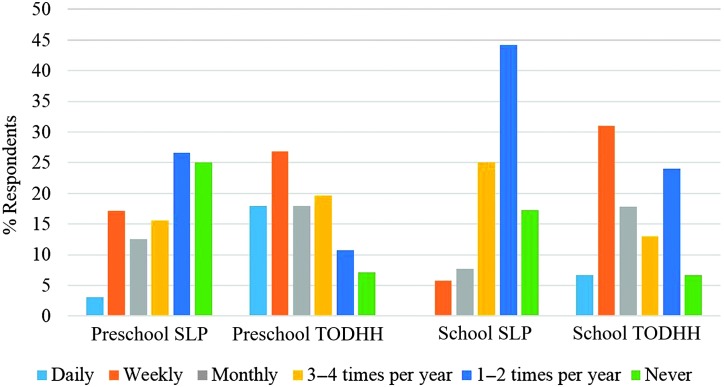
Results: A majority (81%) of preschool-age CHH received services. Children were more likely to be in a preschool for children who are deaf or hard of hearing (CDHH) or exceptional children than a general education preschool. By elementary school, 70% received services, nearly all in general education settings. Sessions averaged twice a week for a total of approximately 90 min. Children who no longer received services performed significantly better on speech/language measures than those who received services, regardless of service setting. Professionals were primarily speech-language pathologists (SLPs) and teachers of CDHH. SLPs reported significantly less comfort with skills involving auditory development and hearing technologies and less frequent communication with the child's audiologists than teachers of CDHH. Overall communication with audiologists was more frequent in the preschool years.
Conclusions: As preschool-age CHH transition into school, the majority continue to qualify for services. Congruent with national trends, school-age CHH in the Outcomes of Children with Hearing Loss study were most often in general education settings. Without specialized preprofessional or postgraduate training, SLPs and teachers of CDHH did not report comfort with all the skills critical to developing listening and spoken language. This finding supports the need for increased implementation of interprofessional practice among SLPs and teachers of CDHH, as well as audiologists, to best meet the needs unique to this population.
Figures
References
-
- Antia S. D., Jones P. B., Reed S., & Kreimeyer K. H. (2009). Academic status and progress of deaf and hard of hearing students in general education classrooms. Journal of Deaf Studies and Deaf Education, 14(3), 293–311. - PubMed
-
- Blackorby J., & Knokey A. M. (2006). A national profile of students with hearing impairments in elementary and middle school: A special topic report from the Special Education Elementary Longitudinal Study. Menlo Park, CA: SRI.
-
- Blair J. C., EuDaly M., & Benson P. V. A. (1999). The effectiveness of audiologists' information sources for classroom teachers. Language, Speech, and Hearing Services in Schools, 30(2), 173–182. - PubMed
-
- Blair J. C., Peterson M. D., & Viehweg S. H. (1985). The effect of mild hearing loss on academic performance of young school-age children. The Volta Review, 87(2), 87–93.
Publication types
MeSH terms
Grants and funding
LinkOut - more resources
Full Text Sources
Medical
Research Materials
Miscellaneous