


Disability, quality of life and all-cause mortality in older Mexican adults: association with multimorbidity and frailty
- PMID: 30286727
- PMCID: PMC6172837
- DOI: 10.1186/s12877-018-0928-7
Disability, quality of life and all-cause mortality in older Mexican adults: association with multimorbidity and frailty
Abstract
Background: Multimorbidity and frailty are relevant conditions among older adult population. There is growing evidence about their association with poor health outcomes like disability, worst quality of life, and death. Nonetheless, the independent associations of both conditions have been studied, and few evidence exists about an interaction between them. Our aims were to assess the association of frailty and multimorbidity with the disability, quality of life and all-cause mortality as well as to analyze a potential interaction between these conditions.
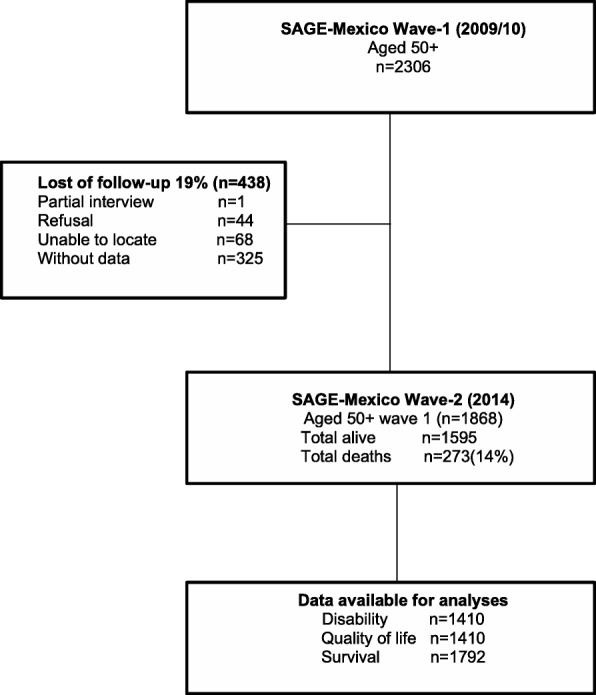
Methods: Analytical samples included 1410 respondents for disability and quality of life, and 1792 for mortality. We performed a longitudinal analysis with older Mexican adults aged 50, using data collected from the WHO's Study on global AGEing and Adult Health Waves 1 and 2. Disability was measured using the World Health Organization Disability Assessment Schedule (WHODAS 2.0), and quality of life using the WHOQOL (WHO Quality of Life) instrument. All-cause mortality was determined by reviewing death certificates. Associations of frailty and multimorbidity with disability, quality of life and mortality were estimated using linear regression and Cox proportional hazards models.
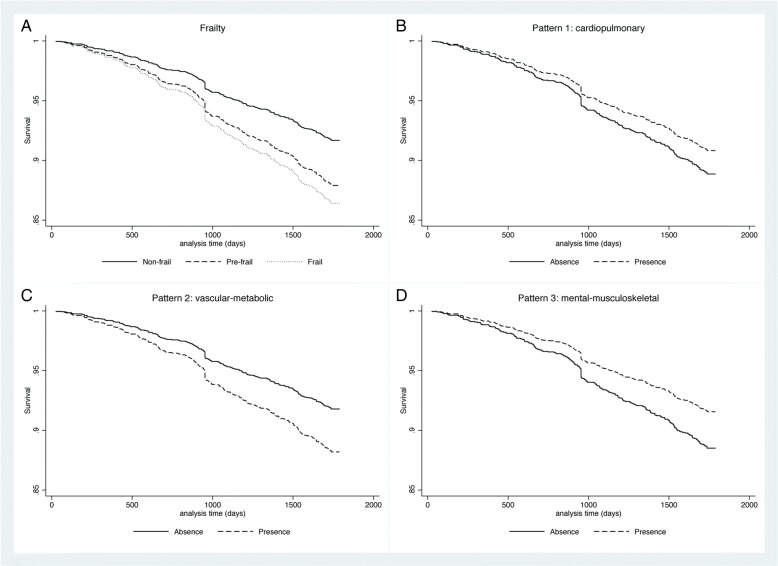
Results: Multimorbidity assessed through three patterns (cardiopulmonary, vascular-metabolic, and mental-musculoskeletal) was associated with the three outcomes in this study. Cardiopulmonary and mental-musculoskeletal patterns increased the WHODAS mean score (β = 5.05; p < 0.01 and β = 5.10; p < 0.01, respectively) and decreased WHOQOL score (β = - 1.81; p < 0.01 and β = - 2.99; p < 0.01, respectively). Vascular-metabolic was associated with mortality (HR = 1.47; p = 0.04), disability (β = 3.27; p < 0.01) and quality of life (β = - 1.30; p = 0.02). Frailty was associated with mortality (pre-frail: HR = 1.48; p = 0.02 and frail: HR = 1.68; p = 0.03), disability (pre-frail: β = 5.02; p < 0.01; frail: β = 13.29; p < 0.01) and quality of life (pre-frail: β = - 2.23; p < 0.01; frail: β = - 4.38; p < 0.01). Interaction terms of frailty and multimorbidity were not statistically significant.
Conclusions: Multimorbidity and frailty are important predictors of poor health outcomes. These results highlight the importance of carrying out health promotion and prevention actions as well as specific interventions aimed at older adults who suffer from multimorbidity and frailty, in such a way that deleterious effects on health can be avoided.
Keywords: Disability; Frailty; Mortality; Multimorbidity; Older adults; Quality of life.
Conflict of interest statement
Ethics approval and consent to participate
Ethics and Research Committees of the National Institute of Public Health in Mexico approved the SAGE-Mexico Study. All participants were provided with a detailed explanation of study procedures and signed an informed consent letter.
Consent for publication
Not applicable.
Competing interests
The authors declare that they have no competing interests.
Publisher’s Note
Springer Nature remains neutral with regard to jurisdictional claims in published maps and institutional affiliations.
Figures
References
-
- United Nations, Department of Economic and Social Affairs PD. World Population Prospects: The 2015 Revision, Key Findings and Advance Tables. 2015. Report No.: ESA/P/WP.241. Available from: https://esa.un.org/unpd/wpp/publications/files/key_findings_wpp_2015.pdf
Publication types
MeSH terms
Grants and funding
LinkOut - more resources
Full Text Sources
Medical
Molecular Biology Databases
