


Factors associated with bariatric surgery utilization among eligible candidates: who drops out?
- PMID: 30287182
- PMCID: PMC6294658
- DOI: 10.1016/j.soard.2018.08.014
Factors associated with bariatric surgery utilization among eligible candidates: who drops out?
Abstract
Background: Bariatric surgery is underutilized.
Objectives: To identify factors associated with eligible patient dropout from bariatric surgery.
Setting: University hospital, United States.
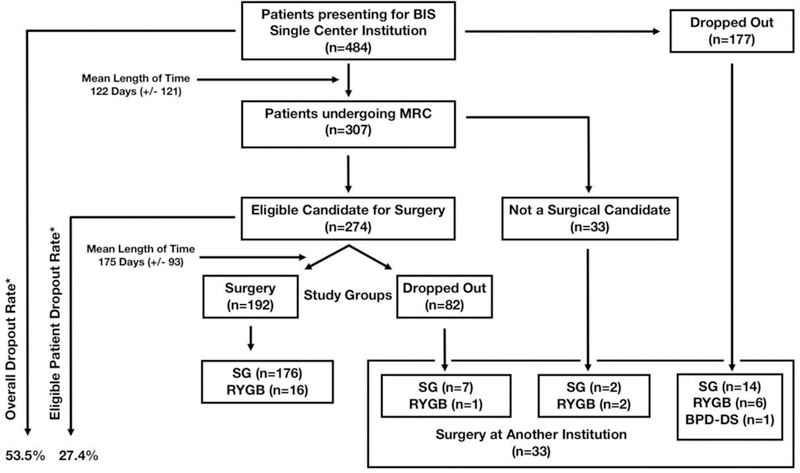
Methods: Eligible candidates were identified after a multidisciplinary review committee (MRC) of all patients (n = 484) who attended a bariatric surgery informational session (BIS) at a single-center academic institution in 2015. We compared patients who underwent surgery within 2 years of BIS with those who did not (i.e., dropped out) by evaluating patient, insurance, and program-specific variables. Univariate analyses and multivariable regressions were performed to identify factors associated with patient dropout among eligible candidates.
Results: We identified 307 (63%) patients who underwent MRC. Thirty-three (11%) patients were deemed poor candidates and surgery was not recommended. Among eligible candidates, 82 (30%) dropped out from the program. Factors independently associated with eligible patient dropout included coronary artery disease (odds ratio [OR] .13 [.02-.66]; P = .014), hypertension (OR .46 [.24-.87]; P = .017), time from BIS to MRC (OR .99 [.99-.99]; P = .002), 3 months of medically supervised weight loss documentation (OR .09 [.02-.51]; P = .007), endocrinology clearance (OR .26 [.09-.76]; P = .014), hematology clearance (OR .37 [.14-.95]; P = .039), urine drug screen testing (OR .31 [.13-.72]; P = .006), additional psychological evaluation (OR .43 [.20-.93]; P = .031), and required extra sessions with the dietician (OR .39 [.17-.92]; P = .032). Thirty-three (6.8%) patients underwent surgery at another institution, and 42% of these patients lived more than 50 miles from attended BIS site.
Conclusions: Twenty-seven percent of patients did not undergo bariatric surgery at their initial site of evaluation despite being considered eligible candidates after MRC. Dropout was independently associated with patient, insurance, and program-specific variables that may represent barriers to care amenable to improvement.
Keywords: Bariatric program requirements; Bariatric surgery; Failure to progress to bariatric surgery; Insurance requirements; Patient characteristics; Patient dropout.
Copyright © 2018 American Society for Bariatric Surgery. Published by Elsevier Inc. All rights reserved.
Figures
Comment in
-
Comment on: factors associated with bariatric surgery utilization among eligible candidates: who drops out?Surg Obes Relat Dis. 2019 Apr;15(4):668. doi: 10.1016/j.soard.2018.12.038. Epub 2019 Jan 14. Surg Obes Relat Dis. 2019. PMID: 30709750 No abstract available.
References
-
- Buchwald H, Avidor Y, Braunwald E, Jensen MD, Pories W, Fahrbach K, et al. Bariatric surgery: a systematic review and meta-analysis. JAMA 2004;292:1724–37. doi:10.1001/jama.292.14.1724. - DOI - PubMed
-
- Schauer PR, Kashyap SR, Wolski K, Brethauer SA, Kirwan JP, Pothier CE, et al. Bariatric surgery versus intensive medical therapy in obese patients with diabetes. N Engl J Med 2012;366:1567–76. doi:10.1056/NEJMoa1200225. - DOI - PMC - PubMed
-
- Mingrone G, Panunzi S, De Gaetano A, Guidone C, Iaconelli A, Leccesi L, et al. Bariatric surgery versus conventional medical therapy for type 2 diabetes. N Engl J Med 2012;366:1577–85. doi:10.1056/NEJMoa1200111. - DOI - PubMed
-
- Mingrone G, Panunzi S, De Gaetano A, Guidone C, Iaconelli A, Nanni G, et al. Bariatric-metabolic surgery versus conventional medical treatment in obese patients with type 2 diabetes: 5 year follow-up of an open-label, single-centre, randomised controlled trial. Lancet Lond Engl 2015;386:964–73. doi:10.1016/S0140-6736(15)00075-6. - DOI - PubMed
-
- Schauer PR, Bhatt DL, Kirwan JP, Wolski K, Aminian A, Brethauer SA, et al. Bariatric Surgery versus Intensive Medical Therapy for Diabetes - 5-Year Outcomes. N Engl J Med 2017;376:641–51. doi:10.1056/NEJMoa1600869. - DOI - PMC - PubMed
MeSH terms
Grants and funding
LinkOut - more resources
Full Text Sources
Medical
Miscellaneous
