


Application of Ultrasound in Food Science and Technology: A Perspective
- PMID: 30287795
- PMCID: PMC6210518
- DOI: 10.3390/foods7100164
Application of Ultrasound in Food Science and Technology: A Perspective
Abstract
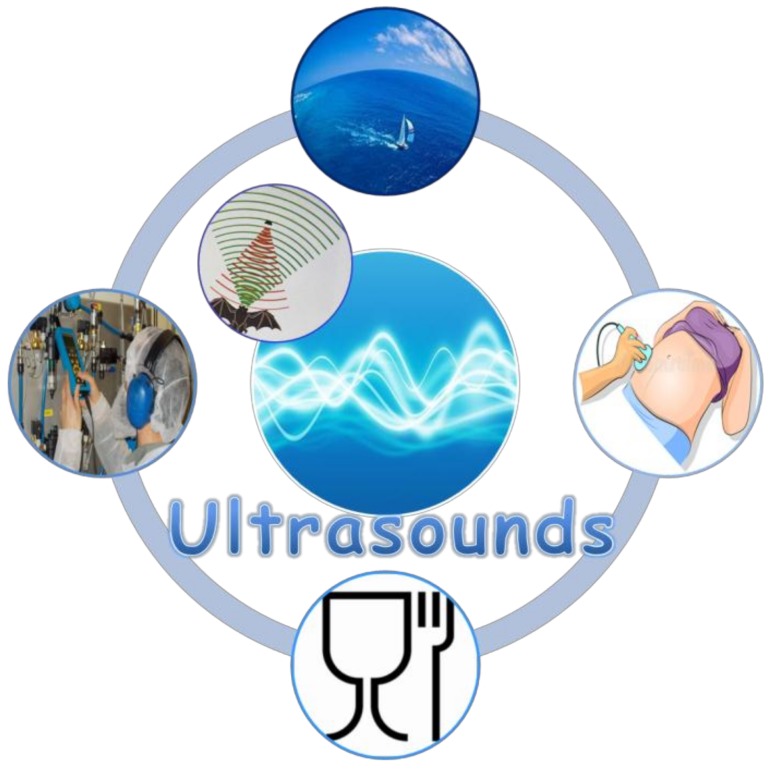
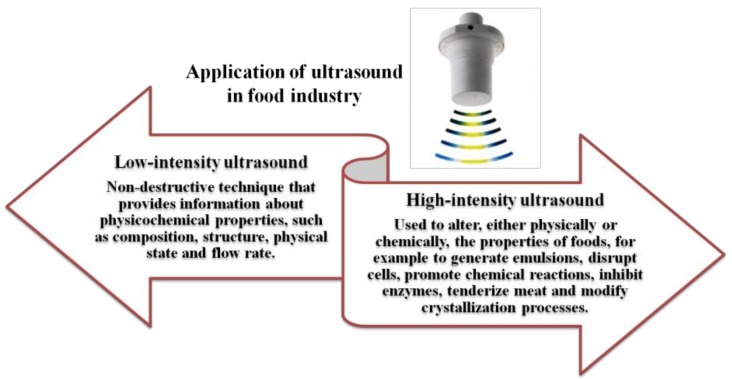
Ultrasound is composed of mechanical sound waves that originate from molecular movements that oscillate in a propagation medium. The waves have a very high frequency, equal to approximately 20 kHz, are divided into two categories (i.e., low-intensity and high-intensity waves) and cannot be perceived by the human ear. Nature has created the first ultrasound applications. Bats use ultrasound to navigate in the dark, and many cetaceans use echolocation to detect prey or obstacles using ultrasound produced by their vocal system. Ultrasound is commonly associated with the biomedical field. Today, ultrasound-based methods and equipment are available to detect organs, motion, tumour masses, and pre/post-natal handicaps, and for kidney stone removal, physiotherapy, and aesthetic cures. However, ultrasound has found multiple applications in many other fields as well. In particular, ultrasound has recently been used in the food industry to develop various effective and reliable food processing applications. Therefore, this review summarizes the major applications of ultrasound in the food industry. The most common applications in the food industry include cell destruction and extraction of intracellular material. Depending on its intensity, ultrasound is used for the activation or deactivation of enzymes, mixing and homogenization, emulsification, dispersion, preservation, stabilization, dissolution and crystallization, hydrogenation, tenderization of meat, ripening, ageing and oxidation, and as an adjuvant for solid-liquid extraction for maceration to accelerate and to improve the extraction of active ingredients from different matrices, as well as the degassing and atomization of food preparations.
Keywords: antimicrobial activity of ultrasound; high power; low power; ultrasonic extraction; ultrasound applications; ultrasound in food technology.
Conflict of interest statement
The authors declare no conflict of interest.
Figures
References
-
- Cheeke J., David N. Fundamental and Applications of Ultrasonics. 2nd ed. CRC Press; Boca Raton, Florida, USA: 2002.
-
- Mason T.J., Peters D. Practical Sonochemistry: Power Ultrasound Uses and Applications. Woodhead Publishing; Sawston, Cambridge, UK: 2002.
-
- Lempriere B.M. Ultrasound and Elastic Waves: Frequently Asked Questions. Elsevier; San Diego, CA, USA: 2013.
-
- Krautkrämer J., Krautkrämer H. Ultrasonic Testing of Materials. Springer Science & Business Media; Heidelberg, Germany: 2013.
-
- Rose J.L. Ultrasonic Guided Waves in Solid Media. Cambridge University Press; Cambridge, UK: 2014.
Publication types
LinkOut - more resources
Full Text Sources
