


Cost of hemodialysis in a public sector tertiary hospital of India
- PMID: 30288270
- PMCID: PMC6165756
- DOI: 10.1093/ckj/sfx152
Cost of hemodialysis in a public sector tertiary hospital of India
Abstract
Introduction: Nearly 220000 patients are diagnosed with end-stage renal disease (ESRD) every year, which calls for an additional demand of 34 million dialysis sessions in India. The government of India has announced a National Dialysis Programme to provide for free dialysis in public hospitals. In this article we estimate the overall cost of performing hemodialysis (HD) in a tertiary care hospital. Second, we assess the catastrophic impact of out-of-pocket expenditures (OOPEs) for HD on households and its determinants.
Methods: The economic health system cost of HD was estimated using bottom-up costing methods. All resources, capital and recurrent, utilized for service delivery from April 2015 to March 2016 were identified, measured and valued. Capital costs were annualized after accounting for their useful life and discounting at 3% for future years. Sensitivity analyses were undertaken to determine the effect of variation in the input prices and other assumptions on the annual health system cost. OOPEs were assessed by interviewing 108 patients undergoing HD in the study hospital to account for costs from the patient's perspective. The prevalence of catastrophic health expenditures (CHEs) was computed per threshold of 40% of non-food expenditures.
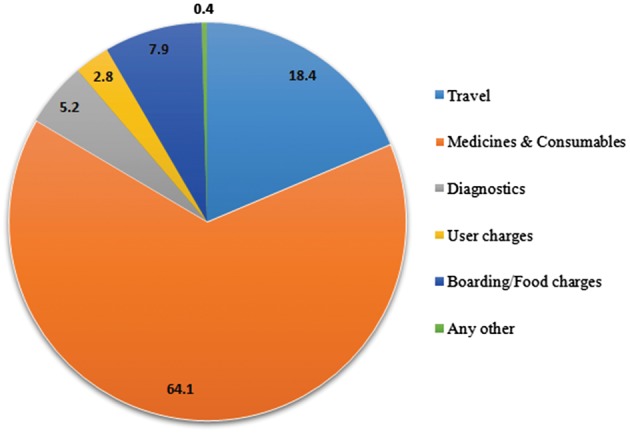
Results: The overall average cost incurred by the health system per HD session was INR 4148 (US$64). Adjusting for capacity utilization, the health system incurred INR 3025 (US$47) per HD at 100% bed occupancy. The mean OOPE per patient per session was INR 2838 (US$44; 95% confidence interval US$34-55). The major components of this OOPE were medicines and consumables (64.1%). The prevalence of a CHE per HD session was 11.1%.
Conclusion: Our study findings would be useful in the context of planning for dialysis services, setting provider payment rates for dialysis under various publicly sponsored health insurance schemes and undertaking future cost-effectiveness analysis to guide resource allocation decisions.
Keywords: catastrophic expenditure; cost analysis; dialysis; economic evaluation; hemodialysis; out-of-pocket expenditure.
Figures
References
-
- Dare AJ, Fu SH, Patra J. et al. Renal failure deaths and their risk factors in India 2001-13: nationally representative estimates from the Million Death Study. Lancet Glob Health 2017; 5: e89–e95 - PubMed
-
- Modi GK, Jha V.. The incidence of end-stage renal disease in India: a population-based study. Kidney Int 2006; 70: 2131–2133 - PubMed
-
- Veerappan I, Abraham G. Chronic kidney disease: current status, challenges and management in India. In Medicine Update. Mumbai: Association of Physicians of India, 2013, 593–597. http://www.apiindia.org/medicine_update_2013/chap130.pdf
-
- Jha V, John O, Joshi R. et al. Dialysis outcomes in India: a pilot study. Nephrology (Carlton) 2015; 20: 329–334 - PubMed
-
- Jha V, Chugh K.. Dialysis in developing countries: priorities and obstacles. Nephrology 1996; 996: 65–72
LinkOut - more resources
Full Text Sources
Miscellaneous
