. 2016 Jun 15;2(1):vew017.
doi: 10.1093/ve/vew017. eCollection 2016 Jan.

Islands of linkage in an ocean of pervasive recombination reveals two-speed evolution of human cytomegalovirus genomes

Affiliations

Islands of linkage in an ocean of pervasive recombination reveals two-speed evolution of human cytomegalovirus genomes

Florent Lassalle et al. Virus Evol. .

Abstract

Human cytomegalovirus (HCMV) infects most of the population worldwide, persisting throughout the host's life in a latent state with periodic episodes of reactivation. While typically asymptomatic, HCMV can cause fatal disease among congenitally infected infants and immunocompromised patients. These clinical issues are compounded by the emergence of antiviral resistance and the absence of an effective vaccine, the development of which is likely complicated by the numerous immune evasins encoded by HCMV to counter the host's adaptive immune responses, a feature that facilitates frequent super-infections. Understanding the evolutionary dynamics of HCMV is essential for the development of effective new drugs and vaccines. By comparing viral genomes from uncultivated or low-passaged clinical samples of diverse origins, we observe evidence of frequent homologous recombination events, both recent and ancient, and no structure of HCMV genetic diversity at the whole-genome scale. Analysis of individual gene-scale loci reveals a striking dichotomy: while most of the genome is highly conserved, recombines essentially freely and has evolved under purifying selection, 21 genes display extreme diversity, structured into distinct genotypes that do not recombine with each other. Most of these hyper-variable genes encode glycoproteins involved in cell entry or escape of host immunity. Evidence that half of them have diverged through episodes of intense positive selection suggests that rapid evolution of hyper-variable loci is likely driven by interactions with host immunity. It appears that this process is enabled by recombination unlinking hyper-variable loci from strongly constrained neighboring sites. It is conceivable that viral mechanisms facilitating super-infection have evolved to promote recombination between diverged genotypes, allowing the virus to continuously diversify at key loci to escape immune detection, while maintaining a genome optimally adapted to its asymptomatic infectious lifecycle.

Keywords: CMV; immune evasion; recombination; viral evolution.


Figures
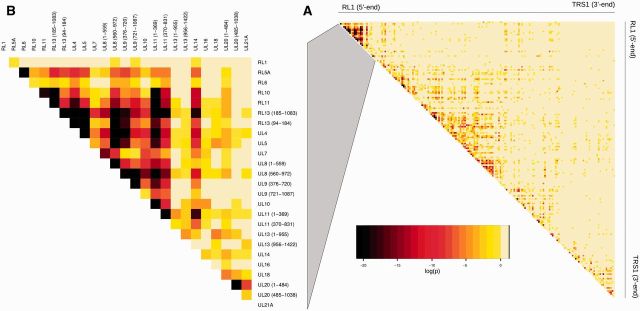
Figure 1.
Figure 1.
Heat map of correlation significance between the distribution of sequence genotypes in the 142 strains along (A) the whole genome or (B) in a close-up of the first 19 genes (25 non-recombining loci) in the prototypic HCMV genome organization. P values are indicated by coloring of the matrix cells (see Supplementary methods for attribution of genotypes). Each individual gene alignment was first scanned using GARD to identify recombination breakpoints and the alignments subsequently split either side of the breakpoint and considered as separate entities.
Figure 2.
Figure 2.
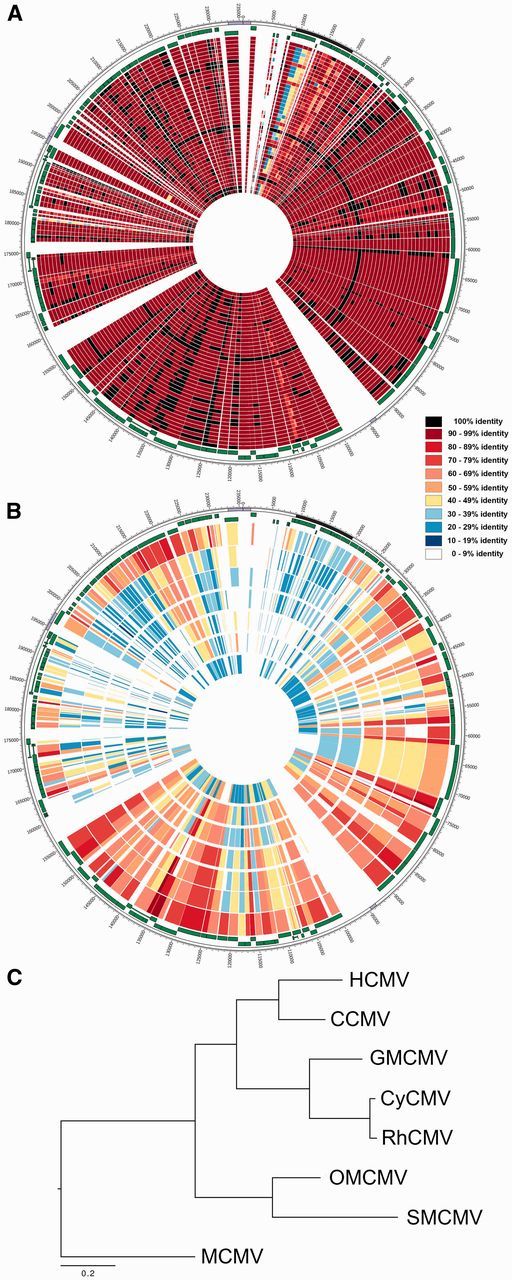
Conservation of protein sequences in cytomegalovirus. Syntenic circular genome maps showing protein sequence conservation (percent identity) against HCMV strain Merlin for (A) all 42 HCMV strains used in this study and (B) the non-human CMVs, from outer to inner track: CCMV, GMCMV, CyCMV, RhCMV, OMCMV, SMCMV, and MCMV. The percentage sequence identity is illustrated by the color legend for both A and B. (C) Maximum-likelihood tree of eight cytomegalovirus species (as in (B)) based on a whole genome alignment of conserved syntenic blocks. All bootstrap support values (based on 100 samples) were 100 percent.
Figure 3.
Figure 3.
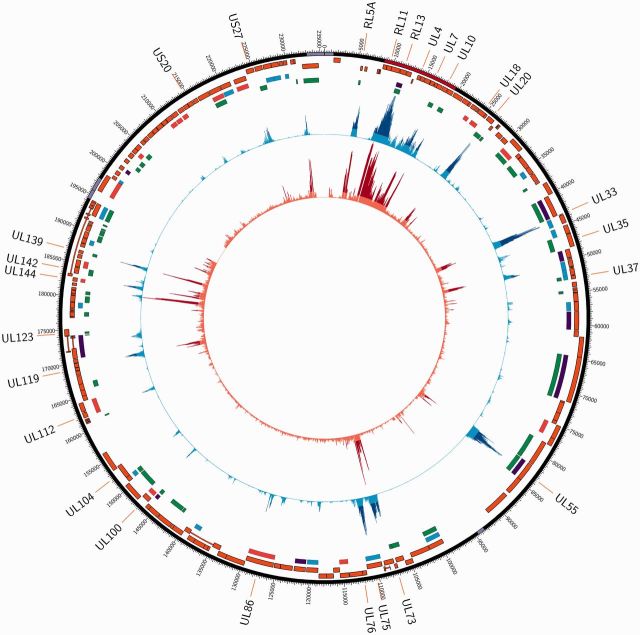
Circular genome map showing linkage disequilibrium and nucleotidic diversity. (A) The purple backbone represents the classical HCMV genome arrangement TRL–UL–IRL–IRS–US–TRS where repeat sequences are shown in a lighter shade, the origin of lytic replication highlighted in pink, and the RL11 gene family indicated by the red shading. Tracks are numbered inwards: (1) Map of the protein-coding genes; (2) Presence of epitopes for CD4+ (blue), CD8+ (red) or both (purple)T-cells (Sylwester et al. 2005); (3) location of genes that have undergone positive selection episodes; (4) Local LD index, computed in 700-bp windows, the hotspots of LD (top 5 percent values) are highlighted in dark blue, with corresponding gene names shown outside of the plot; (5) HCMV nucleotide diversity, computed in adjacent windows of 100 bp, the hypervariable loci (top 5 percent values) are highlighted in dark red.

References

    1. Atalay R., et al. (2002) ‘Identification and Expression of Human Cytomegalovirus Transcription Units Coding for Two Distinct Fcgamma Receptor Homologs’, Journal of Virology, 76: 8596–608 - PMC - PubMed
    1. Booth T. W., et al. (1993) ‘Molecular and Biological Characterization of New Strains of Murine Cytomegalovirus Isolated From Wild Mice’, Archive Virology 132: 209–20 - PubMed
    1. Bradley A. J., et al. (2008) ‘Genotypic Analysis of Two Hypervariable Human Cytomegalovirus Genes’, Journal of Medical Virology, 80: 1615–23 - PMC - PubMed
    1. Bradley A. J., et al. (2009) ‘High-Throughput Sequence Analysis of Variants of Human Cytomegalovirus Strains Towne and AD169’, Journal of General Virology, 90: 2375–80 - PMC - PubMed
    1. Bruen T. C., Philippe H., Bryant D. (2006) ‘A Simple and Robust Statistical Test for Detecting the Presence of Recombination’, Genetics, 172: 2665–81 - PMC - PubMed