


Prevalence of early repolarization syndrome and long-term clinical outcome in patients with the diagnosis of idiopathic ventricular fibrillation
- PMID: 30288567
- PMCID: PMC6437128
- DOI: 10.1007/s00380-018-1273-7
Prevalence of early repolarization syndrome and long-term clinical outcome in patients with the diagnosis of idiopathic ventricular fibrillation
Abstract
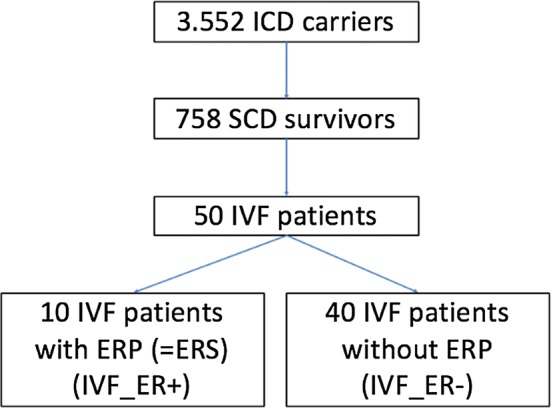
Idiopathic ventricular fibrillation (IVF) is diagnosed in up to 14% of sudden cardiac death (SCD) survivors. Early repolarization syndrome (ERS) in patients with ventricular tachyarrhythmia is characterized by an elevated J-point in inferior and/or antero-lateral leads. Our objectives were to determine the prevalence of ERS in IVF patients, and to evaluate potential differences in clinical outcome. Out of 3,552 implantable cardioverter defibrillator (ICD) carriers, 758 SCD survivors were retrospectively identified from the databases of the Medical Universities of Vienna and Innsbruck within the last three decades. Early repolarization pattern (ERP) was classified either as "notching" or "slurring". Endpoints were defined as appropriate ICD therapies for ventricular tachyarrhythmia, either anti-tachycardia pacing or shock, and all-cause mortality. After exclusion of recognized reasons for SCD, 50 patients were assigned to the diagnosis of IVF (6.6%). An ERP was identified in 10 patients, most of them with notching (n = 8). After a mean follow-up of 11.2 ± 6.7 years (539.3 patient years), appropriate ICD therapies were found in 50% of ERS and 43% of IVF patients without ERP (p = 0.732). In ERS patients, all ICD therapies were found in patients with notching pattern. Similarly, incidence of inappropriate ICD therapies, and all-cause mortality was comparable (30% vs. 23%, p = 0.707; 10% vs. 5%, p = 0.496, respectively). In 758 SCD survivors, we found a low prevalence of IVF and ERS. Similar event rates were reported concerning all-cause mortality and ICD therapies for ventricular tachyarrhythmia after long-term follow-up in this cohort.
Keywords: Early repolarization; Idiopathic ventricular fibrillation; Outcome; Prevalence.
Conflict of interest statement
The authors report no relationships that could be construed as a conflict of interest.
Figures

References
-
- [No authors listed] Survivors of out-of-hospital cardiac arrest with apparently normal heart. Need for definition and standardized clinical evaluation. Consensus Statement of the Joint Steering Committees of the Unexplained Cardiac Arrest Registry of Europe and of the Idiopathic Ventricular Fibrillation Registry of the United States. Circulation. 1997;95(1):265–272. doi: 10.1161/01.CIR.95.1.265. - DOI - PubMed
-
- Haïssaguerre M, Shah DC, Jais P, Shoda M, Kautzner J, Arentz T, Kalushe D, Kadish A, Griffith M, Gaita F, Yamane T, Garrigue S, Hocini M, Clémenty J. Role of Purkinje conducting system in triggering of idiopathic ventricular fibrillation. Lancet. 2002;359(9307):677–678. doi: 10.1016/S0140-6736(02)07807-8. - DOI - PubMed
-
- Paul M, Schäfers M, Kies P, Acil T, Schäfers K, Breithardt G, Schober O, Wichter T. Impact of sympathetic innervation on recurrent life-threatening arrhythmias in the follow-up of patients with idiopathic ventricular fibrillation. Eur J Nucl Med Mol Imaging. 2006;33(8):866–870. doi: 10.1007/s00259-005-0061-7. - DOI - PubMed
Publication types
MeSH terms
Supplementary concepts
LinkOut - more resources
Full Text Sources
Medical
