


Recommendation-based dietary indexes and risk of colorectal cancer in the Nurses' Health Study and Health Professionals Follow-up Study
- PMID: 30289433
- PMCID: PMC6250984
- DOI: 10.1093/ajcn/nqy171
Recommendation-based dietary indexes and risk of colorectal cancer in the Nurses' Health Study and Health Professionals Follow-up Study
Abstract
Background: Many dietary indexes exist for chronic disease prevention, but the optimal dietary pattern for colorectal cancer prevention is unknown.
Objective: We sought to determine associations between adherence to various dietary indexes and incident colorectal cancer in 2 prospective cohort studies.
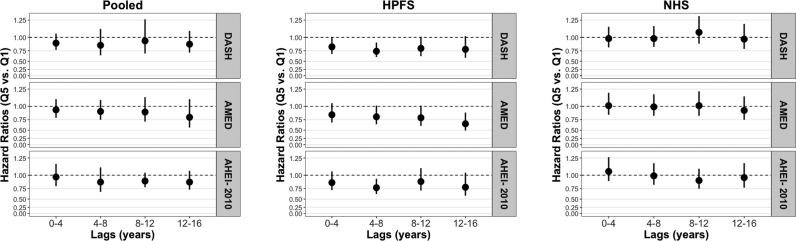
Design: We followed 78,012 women in the Nurses' Health Study and 46,695 men in the Health Professionals Follow-up Study from 1986 and 1988, respectively, until 2012. We created dietary index scores for the Dietary Approaches to Stop Hypertension (DASH) diet, Alternative Mediterranean Diet (AMED), and Alternative Healthy Eating Index-2010 (AHEI-2010) and used Cox regression to estimate HRs and 95% CIs for risk of colorectal cancer (CRC) and by anatomic subsite. We also conducted latency analyses to examine associations between diet and CRC risk during different windows of exposure. We conducted analyses in men and women separately, and subsequently pooled these results in a random-effects meta-analysis.
Results: We documented 2690 colorectal cancer cases. Pooled multivariable HRs for colorectal cancer risk comparing the highest to lowest quintile of diet scores were 0.89 (95% CI: 0.74, 1.08; P-trend = 0.10) for DASH, 0.89 (95% CI: 0.73, 1.10; P-trend = 0.31) for AMED, and 0.95 (95% CI: 0.83, 1.09; P-trend = 0.56) for AHEI-2010 (P-heterogeneity ≥ 0.07 for all). In sex-specific analyses, we observed stronger associations in men for all dietary indexes (DASH: multivariable HR = 0.81, 95% CI: 0.66, 0.98; P-trend = 0.003; AMED: multivariable HR = 0.80, 95% CI: 0.65, 0.98; P-trend = 0.02; AHEI-2010: multivariable HR = 0.88, 95% CI: 0.72, 1.07; P-trend = 0.04) than in women (multivariable HRs range from 0.98 to 1.01).
Conclusions: Adherence to the DASH, AMED, and AHEI-2010 diets was inversely associated with colorectal cancer risk in men. These diets were not associated with colorectal cancer risk in women. This observational study was registered at http://www.clinicaltrials.gov as NCT03364582.
Figures
References
-
- World Cancer Research Fund International/American Institute for Cancer Research. Continuous Update Project Report: Diet, Nutrition, Physical Activity and Colorectal Cancer. 2017.
-
- Hu FB. Dietary pattern analysis: a new direction in nutritional epidemiology. Curr Opin Lipidol. 2002;13(1):3–9. - PubMed
-
- Bamia C, Lagiou P, Buckland G, Grioni S, Agnoli C, Taylor AJ, Dahm CC, Overvad K, Olsen A, Tjonneland A et al. .. Mediterranean diet and colorectal cancer risk: results from a European cohort. Eur J Epidemiol. 2013;28(4):317–28. - PubMed
Publication types
MeSH terms
Associated data
Grants and funding
LinkOut - more resources
Full Text Sources
Medical
