Review
. 2019 Mar 1;43(2):109-122.
doi: 10.1093/femsre/fuy036.

DNA phosphorothioate modification-a new multi-functional epigenetic system in bacteria

Affiliations
Review

DNA phosphorothioate modification-a new multi-functional epigenetic system in bacteria

Lianrong Wang et al. FEMS Microbiol Rev. .

Abstract

Synthetic phosphorothioate (PT) internucleotide linkages, in which a nonbridging oxygen is replaced by a sulphur atom, share similar physical and chemical properties with phosphodiesters but confer enhanced nuclease tolerance on DNA/RNA, making PTs a valuable biochemical and pharmacological tool. Interestingly, PT modification was recently found to occur naturally in bacteria in a sequence-selective and RP configuration-specific manner. This oxygen-sulphur swap is catalysed by the gene products of dndABCDE, which constitute a defence barrier with DndFGH in some bacterial strains that can distinguish and attack non-PT-modified foreign DNA, resembling DNA methylation-based restriction-modification (R-M) systems. Despite their similar defensive mechanisms, PT- and methylation-based R-M systems have evolved to target different consensus contexts in the host cell because when they share the same recognition sequences, the protective function of each can be impeded. The redox and nucleophilic properties of PT sulphur render PT modification a versatile player in the maintenance of cellular redox homeostasis, epigenetic regulation and environmental fitness. The widespread presence of dnd systems is considered a consequence of extensive horizontal gene transfer, whereas the lability of PT during oxidative stress and the susceptibility of PT to PT-dependent endonucleases provide possible explanations for the ubiquitous but sporadic distribution of PT modification in the bacterial world.

Keywords: DNA modification; DNA phosphorothioate modification; defence system; environmental fitness; epigenetics; restriction modification.


Figures

Figure 1.
Figure 1.
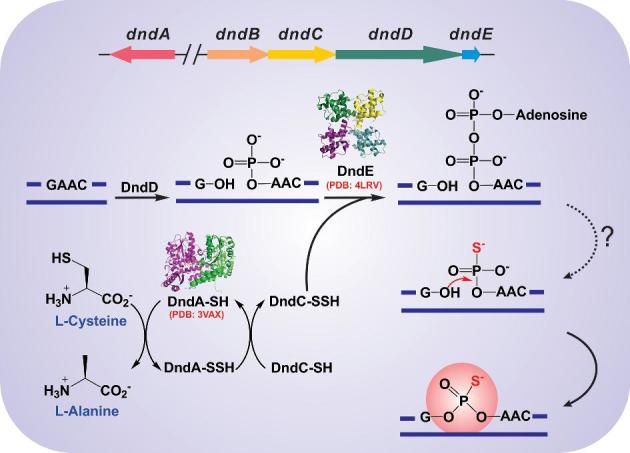
Proposed biochemical pathway of DNA PT modification. PT modification, conferred by DndACDE proteins, is predicted to start with the desulphurisation of cysteine by DndA. The sulphur atom is later transferred to the target DNA site, cleaved and activated, likely by DndD and DndC, to complete the sulphur incorporation.
Figure 2.
Figure 2.
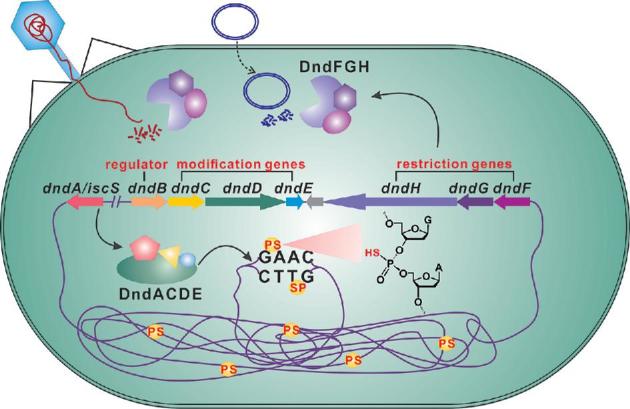
DNA PT modification-based R-M defence mechanism. PT-based R-M systems recognise the PT status of invading foreign DNA, e.g. phage genomes and plasmids. PT modification of the DNA backbone is performed by DndA, DndC, DndD and DndE, which form a large protein complex with equimolar stoichiometry in vitro. DndB functions as a negative regulator controlling the expression of dndCDE and itself via its affinity to their upstream promoter regions. DndFGH act as a cognate restriction enzyme that recognises foreign DNA lacking PT modification in consensus sequences such as the PT-modified 5΄-GPSAAC-3΄/5΄-GPSTTC-3΄ in E. coli B7A and cleaves double-stranded DNA.
Figure 3.
Figure 3.
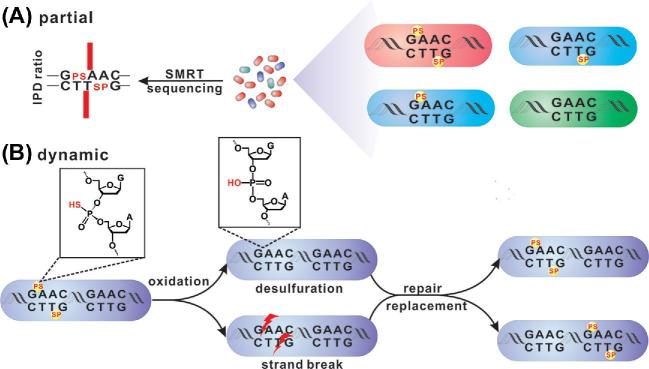
Partial and dynamic PT modification features. (A) In terms of a given 5΄-GAAC-3΄/5΄-GTTC-3΄ consensus in a population of cells, the kinetic signal of SMRT sequencing averaged over all molecules strongly represents 5΄-GPSAAC-3΄/5΄-GPSTTC-3΄. However, single-molecule analysis reveals the presence of DNA molecules possessing 5΄-GAAC-3΄/5΄-GTTC-3΄, 5΄-GPSAAC-3΄/5΄-GTTC-3΄ and 5΄-GAAC-3΄/5΄-GPSTTC-3΄ sequences in addition to 5΄-GPSAAC-3΄/5΄-GPSTTC-3΄, a result of partial modification. (B) Upon exposure to oxidants, e.g. HOCl, the PT backbone undergoes desulphuration, strand breakage and phosphonate formation. A repair/replacement mechanism is proposed to explain why the total PT level remains unchanged during oxidative stress even though PT-causing DNA damage is occurring; this mechanism provides an alternative explanation for the dynamic nature of PT modifications.
Figure 4.
Figure 4.
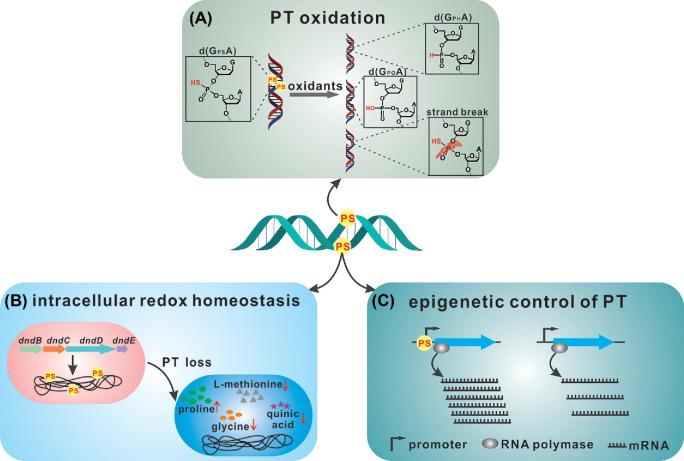
The functional diversity of DNA PT modification. DNA PT modification is a versatile player in environmental fitness (A), the maintenance of cellular redox homeostasis in addition to serving as a component of R-M defence barriers (B) and epigenetic regulation (C).
Figure 5.
Figure 5.
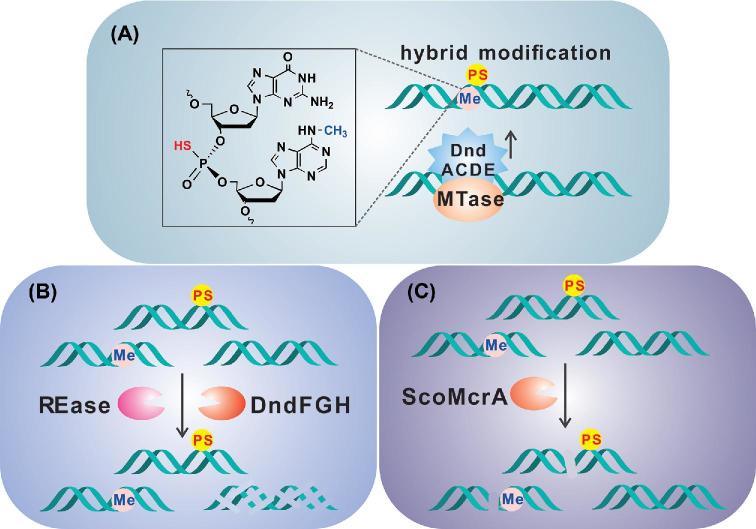
Interaction of DNA PT modifications with other defensive systems. (A) Dnd modification enzymes and Dam can share the same DNA motif, 5΄-GATC-3΄/5΄-GATC-3΄, to generate a hybrid 5΄-GPS6mATC-3΄/5΄-GPS6mATC-3΄ product modified with a PT in the DNA backbone and methylation of a nucleobase. (B) The methylated species 5΄-G6mATC-3΄/5΄-G6mATC-3΄ can be substituted with the PT-modified 5΄-GPSATC-3΄/5΄-GPSATC-3΄ to resist cleavage by DndFGH. (C) Bacteria have evolved the type IV ScoMcrA endonuclease to specifically recognise foreign DNA possessing 5mC and PT.

References

    1. Ahlgren NA, Chen Y, Needham DM et al.. Genome and epigenome of a novel marine Thaumarchaeota strain suggest viral infection, phosphorothioation DNA modification and multiple restriction systems. Environ Microbiol 2017;19:2434–52. - PubMed
    1. Albalat R, Canestro C. Evolution by gene loss. Nat Rev Genet 2016;17:379–91. - PubMed
    1. Alhasawi A, Castonguay Z, Appanna ND et al.. Glycine metabolism and anti-oxidative defence mechanisms in Pseudomonas fluorescens. Microbiol Res 2015;171:26–31. - PubMed
    1. An X, Xiong W, Yang Y et al.. A novel target of IscS in Escherichia coli: participating in DNA phosphorothioation. PLoS One 2012;7:e51265. - PMC - PubMed
    1. Atack JM, Tan A, Bakaletz LO et al.. Phasevarions of bacterial pathogens: methylomics sheds new light on old enemies. Trends Microbiol 2018;26:715–26. - PMC - PubMed

Publication types