


Age-disparate partnerships and incident HIV infection in adolescent girls and young women in rural South Africa
- PMID: 30289813
- PMCID: PMC6279556
- DOI: 10.1097/QAD.0000000000002037
Age-disparate partnerships and incident HIV infection in adolescent girls and young women in rural South Africa
Abstract
Objective: Adolescent girls and young women (AGYW) have a much higher risk of HIV infection than young men of the same age. One hypothesis for this disparity is AGYW are more likely to be in sexual partnerships with older men with HIV; however, evidence has been inconclusive.
Design: We used longitudinal data from a randomized trial in South Africa (HPTN 068) to determined whether partner age difference is associated with incident HIV infection in AGYW.
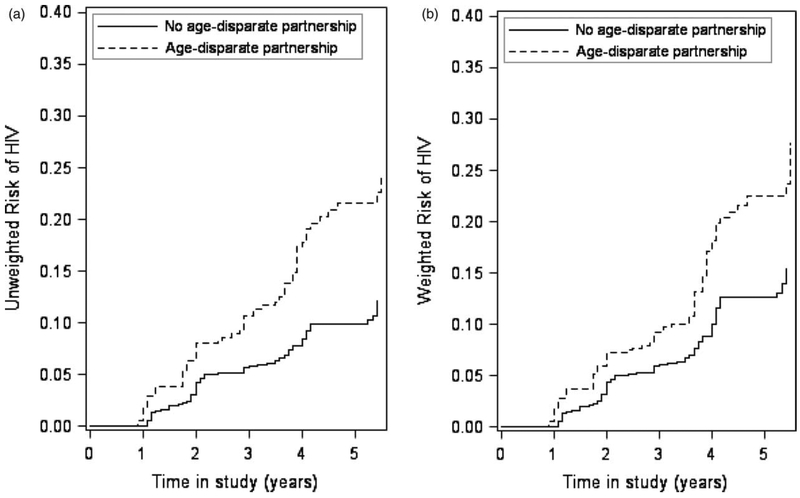
Methods: Age difference was examined continuously and dichotomously (≥5 years). We examined inverse probability of exposure weighted survival curves and calculated time-specific risk differences and risk ratios over 5.5 years of follow-up. We also used a marginal structural Cox model to estimate hazard ratios over the entire study period.
Results: Risk of HIV was higher in AGYW with an age-disparate partnership versus not and the risk difference was largest at later time points. At 5.5 years, AGYW with an age-disparate partnership had a 12.6% (95% confidence interval 1.9-23.3) higher risk than AGYW with no age-disparate partnerships. The weighted hazard ratio was 1.91 (95% confidence interval 1.33-2.74), an association that remained after weighting for either transactional or condomless sex, and after examining continuous age-differences.
Conclusion: Age-disparate partnerships increased risk of HIV infection, even after accounting for transactional sex and condomless sex. The relationship between age-disparate partnerships and HIV infection may be explained by increased exposure to infection from men in a higher HIV prevalence pool rather than differences in sexual behaviour within these partnerships.
Conflict of interest statement
Conflicts of interest
The content is solely the responsibility of the authors and does not necessarily represent the official views of the National Institutes of Health.
We have no conflicts of interest to declare.
Figures
References
-
- Luke N. Age and economic asymmetries in the sexual relationships of adolescent girls in sub-Saharan Africa. Stud Fam Plann 2003; 34:67–86. - PubMed
-
- Luke N Confronting the ‘sugar daddy’ stereotype: age and economic asymmetries and risky sexual behavior in urban Kenya. Int Fam Plan Perspect 2005; 31:6–14. - PubMed
-
- Jewkes RK, Levin JB, Penn-Kekana LA. Gender inequalities, intimate partner violence and HIV preventive practices: findings of a South African cross-sectional study. Soc Sci Med 2003; 56:125–134. - PubMed
Publication types
MeSH terms
Grants and funding
- UM1 AI069423/AI/NIAID NIH HHS/United States
- R01 MH110186/MH/NIMH NIH HHS/United States
- P30 MH043520/MH/NIMH NIH HHS/United States
- 069683/Z/02/Z/WT_/Wellcome Trust/United Kingdom
- R01 MH087118/MH/NIMH NIH HHS/United States
- T32 MH019139/MH/NIMH NIH HHS/United States
- 085477/Z/08/Z/WT_/Wellcome Trust/United Kingdom
- R24 HD050924/HD/NICHD NIH HHS/United States
- P2C HD050924/HD/NICHD NIH HHS/United States
- 085477/B/08/Z/WT_/Wellcome Trust/United Kingdom
- UM1 AI068617/AI/NIAID NIH HHS/United States
- 058893/Z/99/A/WT_/Wellcome Trust/United Kingdom
- UM1 AI068619/AI/NIAID NIH HHS/United States
- UM1 AI068613/AI/NIAID NIH HHS/United States
- WT_/Wellcome Trust/United Kingdom
LinkOut - more resources
Full Text Sources
Medical
