. 2018 Oct 4;103(4):535-552.
doi: 10.1016/j.ajhg.2018.08.017.

Phenotype-Specific Enrichment of Mendelian Disorder Genes near GWAS Regions across 62 Complex Traits

Affiliations

Phenotype-Specific Enrichment of Mendelian Disorder Genes near GWAS Regions across 62 Complex Traits

Malika Kumar Freund et al. Am J Hum Genet. .

Abstract

Although recent studies provide evidence for a common genetic basis between complex traits and Mendelian disorders, a thorough quantification of their overlap in a phenotype-specific manner remains elusive. Here, we have quantified the overlap of genes identified through large-scale genome-wide association studies (GWASs) for 62 complex traits and diseases with genes containing mutations known to cause 20 broad categories of Mendelian disorders. We identified a significant enrichment of genes linked to phenotypically matched Mendelian disorders in GWAS gene sets; of the total 1,240 comparisons, a higher proportion of phenotypically matched or related pairs (n = 50 of 92 [54%]) than phenotypically unmatched pairs (n = 27 of 1,148 [2%]) demonstrated significant overlap, confirming a phenotype-specific enrichment pattern. Further, we observed elevated GWAS effect sizes near genes linked to phenotypically matched Mendelian disorders. Finally, we report examples of GWAS variants localized at the transcription start site or physically interacting with the promoters of genes linked to phenotypically matched Mendelian disorders. Our results are consistent with the hypothesis that genes that are disrupted in Mendelian disorders are dysregulated by non-coding variants in complex traits and demonstrate how leveraging findings from related Mendelian disorders and functional genomic datasets can prioritize genes that are putatively dysregulated by local and distal non-coding GWAS variants.

Keywords: GWAS; Hi-C; Mendelian; body mass index; common disease; complex traits; monogenic; polygenic; statistical genetics.


Figures

Figure 1
Figure 1
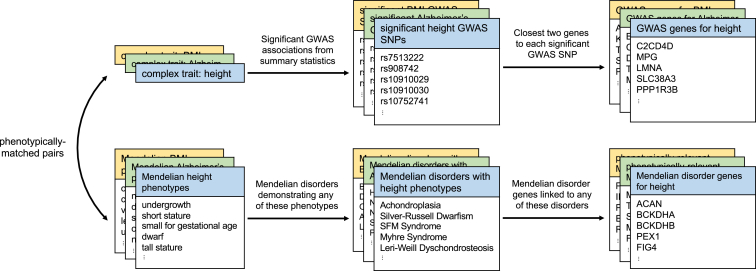
GWAS Gene Sets and Phenotype-Specific Mendelian Disorder Gene Sets For each complex trait (e.g., height), we first identified matched Mendelian phenotypes (e.g., undergrowth and short stature; Table S2). Using publicly available GWAS data, we defined the “GWAS genes” for a given complex trait to be the closest upstream and closest downstream protein-coding genes for every genome-wide-significant variant in the GWAS. We selected phenotype-matched Mendelian disorder genes by first identifying Mendelian disorders expressing any of the matched Mendelian phenotypes and then identifying all genes linked to any of those disorders.
Figure 2
Figure 2
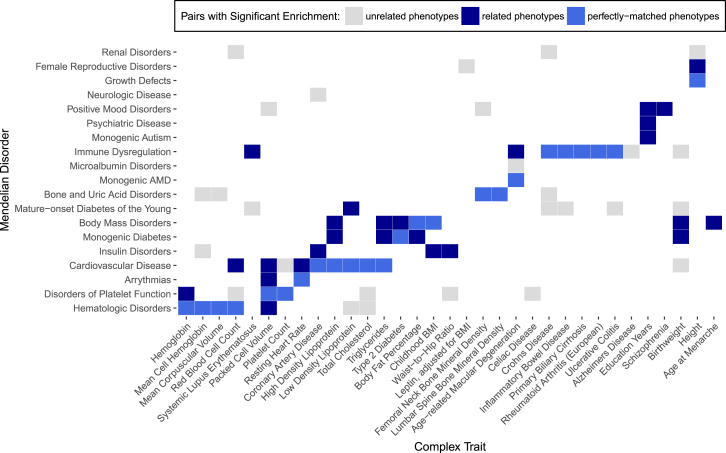
Overlap between GWAS Genes and Mendelian Disorder Genes Demonstrates Trait Specificity Significant overlaps from phenotypically matched pairs of complex traits and Mendelian disorders (blue) and pairs with unrelated phenotypes (gray) are shown. Phenotypically matched pairs are subdivided into pairs with perfectly matched phenotypes (light blue) and pairs with related phenotypes (dark blue). Complex traits and Mendelian disorders with no significant overlaps are excluded here; results from all traits are presented in Figure S2. We assessed significance by controlling for FDR < 5% at p < 0.00310.
Figure 3
Figure 3
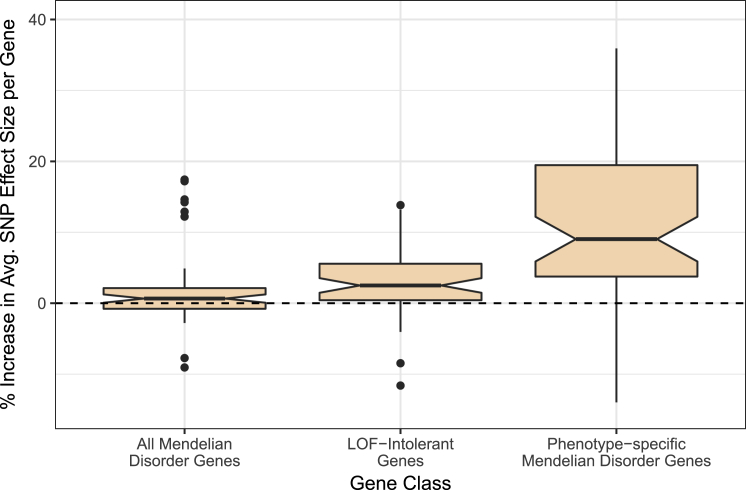
Effect Sizes for SNPs on Complex Traits from GWASs Are Higher for LoF-Intolerant Genes and for Phenotypically Relevant Mendelian Disorder Genes The increase in average SNP effect size per gene across gene categories, as compared with all protein-coding genes (dashed line), is shown. We averaged effect size (Z2) across all SNPs falling within 50 kb of a gene to obtain an average SNP effect size per gene and averaged across all genes in each category (all protein-coding genes, all Mendelian disorder genes, all LoF-intolerant genes, and all phenotypically relevant Mendelian disorder genes for each trait). We normalized these averages to the average SNP effect per gene for any protein-coding genes. The boxplots represent the distribution of increases in average effect size per gene across all traits, and notches designate the confidence intervals (CIs). From left to right, CIs read (0.07, 1.24), (1.47, 3.54), and (5.88, 12.19).
Figure 4
Figure 4
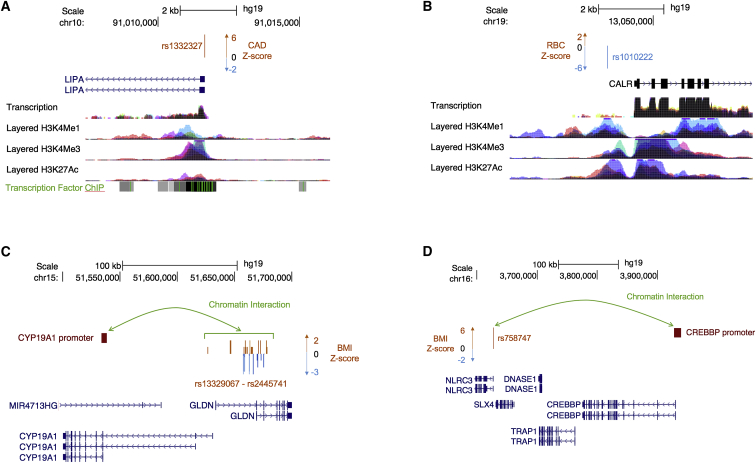
Candidate Regulatory SNPs Fall at TSSs and Long-Range Promoters of Phenotypically Relevant Mendelian Disorder Genes (A and B) Shown here are two examples of putative causal SNPs localizing at a TSS of a phenotypically relevant Mendelian disorder gene. (A) Putative causal SNP rs1332327, associated with coronary artery disease (Z = 6.80), lies at the TSS of LIPA. (B) Putative causal SNP rs1010222, associated with red blood cell count (Z = −5.97), lies at the TSS of CALR. (C and D) Shown here are two representations of chromatin interactions in white adipose tissue. (C) A cluster of SNPs from the credible set of variants associated with BMI (Z score plotted in orange and blue) physically interacts with the promoter of a particular isoform of CYP19A1. (D) A single SNP (rs758747) from the credible set, associated with BMI (Z = 6.08), physically interacts with the promoter of a distant gene, CREBBP.

References

    1. Schork N.J., Murray S.S., Frazer K.A., Topol E.J. Common vs. rare allele hypotheses for complex diseases. Curr. Opin. Genet. Dev. 2009;19:212–219. - PMC - PubMed
    1. Cutting G.R., Kasch L.M., Rosenstein B.J., Zielenski J., Tsui L.C., Antonarakis S.E., Kazazian H.H., Jr. A cluster of cystic fibrosis mutations in the first nucleotide-binding fold of the cystic fibrosis conductance regulator protein. Nature. 1990;346:366–369. - PubMed
    1. Henriksen M.G., Nordgaard J., Jansson L.B. Genetics of schizophrenia: Overview of methods, findings and limitations. Front. Hum. Neurosci. 2017;11:322. - PMC - PubMed
    1. Katsanis N. The continuum of causality in human genetic disorders. Genome Biol. 2016;17:233. - PMC - PubMed
    1. Auer P.L., Teumer A., Schick U., O’Shaughnessy A., Lo K.S., Chami N., Carlson C., de Denus S., Dubé M.P., Haessler J. Rare and low-frequency coding variants in CXCR2 and other genes are associated with hematological traits. Nat. Genet. 2014;46:629–634. - PMC - PubMed

Publication types

MeSH terms