


Musculoskeletal complaints in healthcare personnel in hospital: An interdepartmental, cross-sectional comparison
- PMID: 30290628
- PMCID: PMC6200550
- DOI: 10.1097/MD.0000000000012597
Musculoskeletal complaints in healthcare personnel in hospital: An interdepartmental, cross-sectional comparison
Abstract
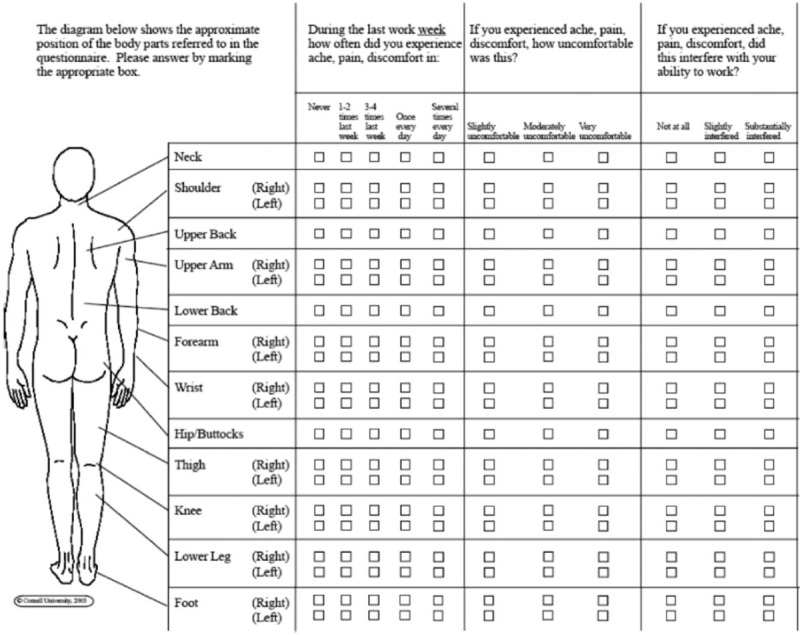
The objective of this study is to investigate musculoskeletal complaints (MSCs) in healthcare workers (HCWs) in 3 community hospital-based departments [internal medicine (IM), general surgery (GS), and emergency department (ED)] and its effects on the quality of work life (QWL) of hospital HCW.This prospective cross-sectional study was performed in the 700-bed community training hospital. All HCW staffed in 3 departments (IM, GS, ED) of the hospital were asked to respond to items in the study data sheet. Enrolled personnel were inquired about their demographic data, work history and schedule, and medical history. The 16-item Cornell Musculoskeletal Discomfort Questionnaire (CMDQ) Turkish version was applied to evaluate MSC. A total of 216 HCW constituted the study sample and demographic characteristics, history, and clinical findings were analyzed.Among all, 103 personnel (47.7%) were women (n = 42, 41.1% in physicians, n = 57, 87.6% in nurses and n = 4, 8% in other HCW) (P = .000). A total of 173 personnel (79.7%) reported MSC in some part of their bodies. Female personnel had MSC significantly more commonly than males (chi-square = 40.7, P = .000). Numbers and percentages of the personnel with MSC in 3 departments (IM, GS, ED) were 51/61, 52/65, and 70/90, respectively (P = .67). Total QWL score of those without MSC was significantly higher than others (74.7 + -12 vs 63.2 + -15, respectively; t test, P = .000). Total frequency score of MSC as elicited via CMDQ was significantly higher in those without MSC compared to the others (8.1 + -7.6 vs 0.1 + -0.6, respectively, t test, P = .000).Female sex, high-income, university graduation, being a nurse or a physician, and older age impose risk for HCW in hospital with respect to having MSC. Presence of MSC affects QWL negatively.
Conflict of interest statement
The authors have no conflicts of interest to disclose.
Figures
References
-
- Punnett L, Wegman DH. Work-related musculoskeletal disorders: the epidemiologic evidence and the debate. J Electromyogr Kinesiol 2004;14:13. - PubMed
-
- Smith DR, Wei N, Ishıtake T, et al. Musculoskeletal disorders among Chinese medical students. Kurume Med J 2005;52:139–46. - PubMed
-
- Noack-Cooper KL, Sommerich CM, Mirka GA. College students and computers: assessment of usage patterns and musculoskeletal discomfort. Work 2009;32:285–98. - PubMed
Publication types
MeSH terms
LinkOut - more resources
Full Text Sources
Medical
