


Behavioral economics-based incentives supported by mobile technology on HIV knowledge and testing frequency among Latino/a men who have sex with men and transgender women: Protocol for a randomized pilot study to test intervention feasibility and acceptability
- PMID: 30290851
- PMCID: PMC6173939
- DOI: 10.1186/s13063-018-2867-1
Behavioral economics-based incentives supported by mobile technology on HIV knowledge and testing frequency among Latino/a men who have sex with men and transgender women: Protocol for a randomized pilot study to test intervention feasibility and acceptability
Abstract
Background: Mobile Technology and Incentives (MOTIVES) is a randomized pilot study of a mobile technology-based and behavioral economics-supported HIV prevention intervention. Behavioral economics (BE) uses financial incentives in a way that departs from the traditional focus on large monetary payments. Instead, BE suggests that relatively small "nudges" can effectively initiate and sustain behavior change. This pilot study examines the feasibility and acceptability of an HIV prevention intervention that uses text messages in combination with BE incentives to improve retention of HIV prevention information and increase frequency of HIV testing among Latino/a men who have sex with men (MSM) and transgender women (TGW). The pilot will also estimate mission-critical design parameters with point and confidence interval estimates of the intervention to inform a future, fully powered effectiveness study.
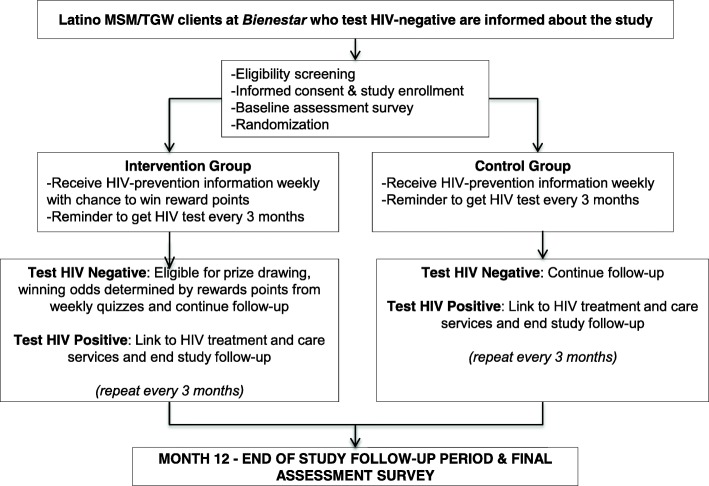
Methods: The project will be conducted in collaboration with Bienestar Human Services, Inc. (Bienestar), a non-profit community-based service organization. The intervention is being tested in a small, randomized controlled trial to pilot the intervention's feasibility and acceptability among 200 Latino/a MSM and TGW from Bienestar's HIV testing sites. Information on feasibility will include recruitment, refusal, and retention rates as well as message sending success rates; acceptability will include perceived appropriateness based on responses to the intervention. Participants will be randomized into either the "information only" control group (e.g. receiving text messages with HIV prevention information) or the "information plus" intervention group (e.g. additionally receiving quiz questions that provide the possibility of winning prizes). Participants will be followed for 12 months from enrollment. In addition to using data abstracted from Bienestar's routine data collection mechanisms, we will also collect survey data (blinded outcome assessment) from participants at 0, 6, and 12 months to provide an initial assessment of whether incentives affect their level of HIV knowledge and testing frequency.
Discussion: If shown to be acceptable, feasible, and resource-efficient, MOTIVES will provide an innovative way to communicate the latest HIV prevention information and support trimestral HIV screening among Latino/a MSM and TGW.
Trial registration: ClinicalTrials.gov, NCT03144336 . Registered on 5 May 2017.
Keywords: Behavioral economics; Feasibility and acceptability; HIV testing; Incentives; Intervention; Latino; Men who have sex with men; Mobile technology; Transgender women.
Conflict of interest statement
Ethics approval and consent to participate
Manuscripts reporting studies involving human participants, human data, or human tissue must:
Include a statement on ethics approval and consent (even where the need for approval was waived):
ATTACHED The work covered in this manuscript has been conducted with the ethical approval of all relevant participants.Include the name of the ethics committee that approved the study and the committee’s reference number, if appropriate
RAND: 2016–0234-AM01Bienestar: 2016-09-657NYSPI: 7401
Consent for publication
Not applicable.
Competing interests
The authors declare that they have no competing interests.
Publisher’s Note
Springer Nature remains neutral with regard to jurisdictional claims in published maps and institutional affiliations.
References
-
- Belzer ME, Kolmodin MacDonell K, Clark LF, Huang J, Olson J, Kahana SY, et al. Acceptability and feasibility of a cell phone support intervention for youth living with HIV with nonadherence to antiretroviral therapy. AIDS Patient Care STDs. 2015;29(6):338–345. doi: 10.1089/apc.2014.0282. - DOI - PMC - PubMed
Publication types
MeSH terms
Associated data
Grants and funding
LinkOut - more resources
Full Text Sources
Medical
