


Implications of Epigenetic Drift in Colorectal Neoplasia
- PMID: 30291105
- PMCID: PMC6359943
- DOI: 10.1158/0008-5472.CAN-18-1682
Implications of Epigenetic Drift in Colorectal Neoplasia
Abstract
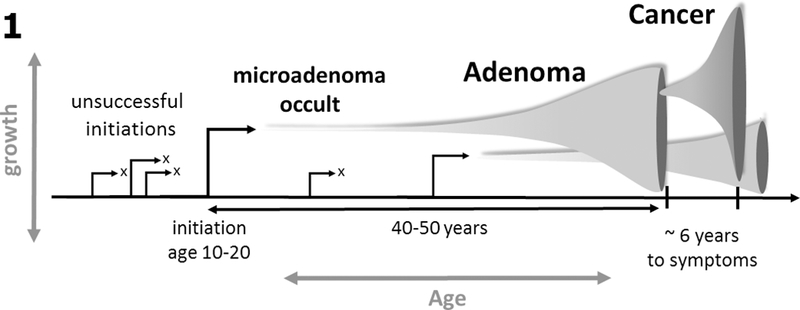
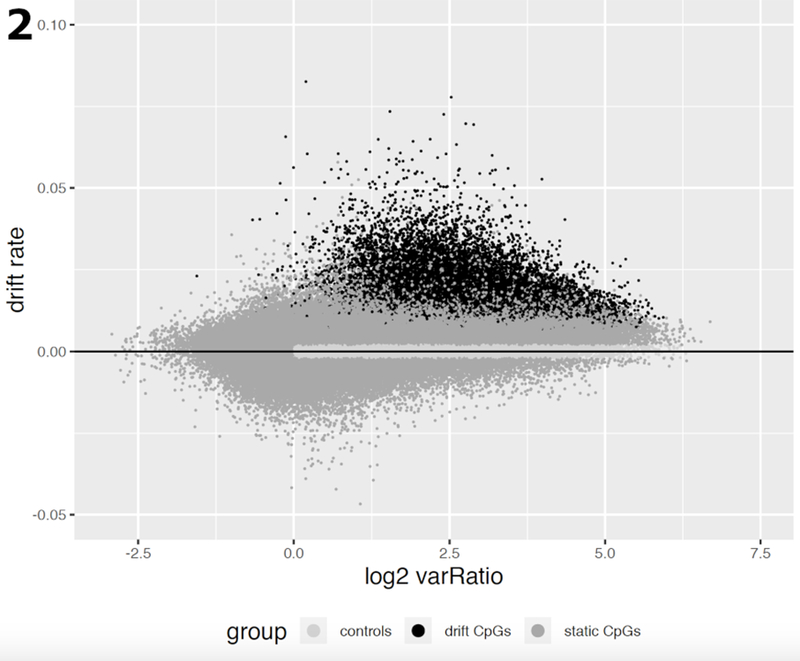
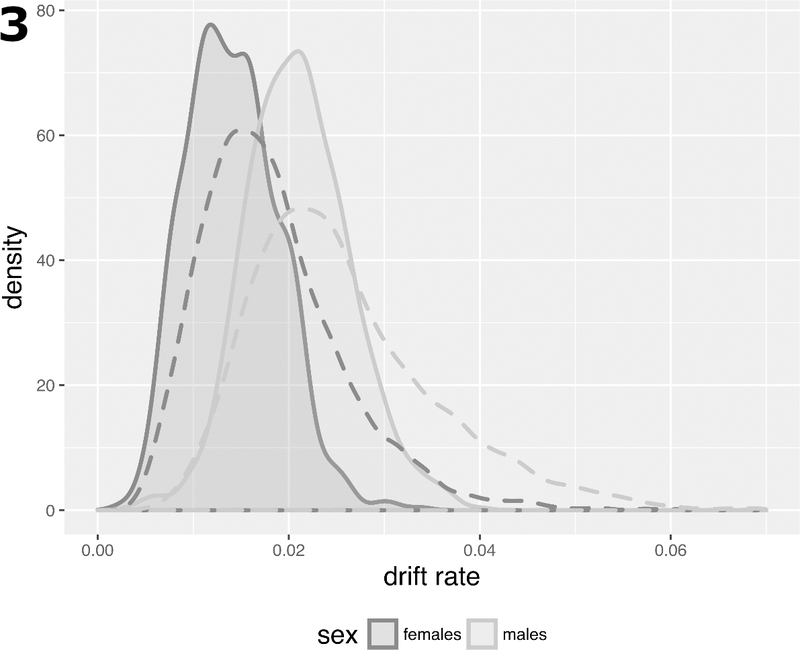
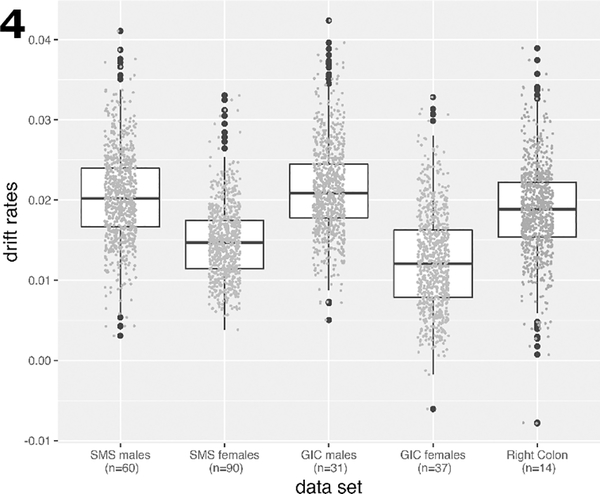
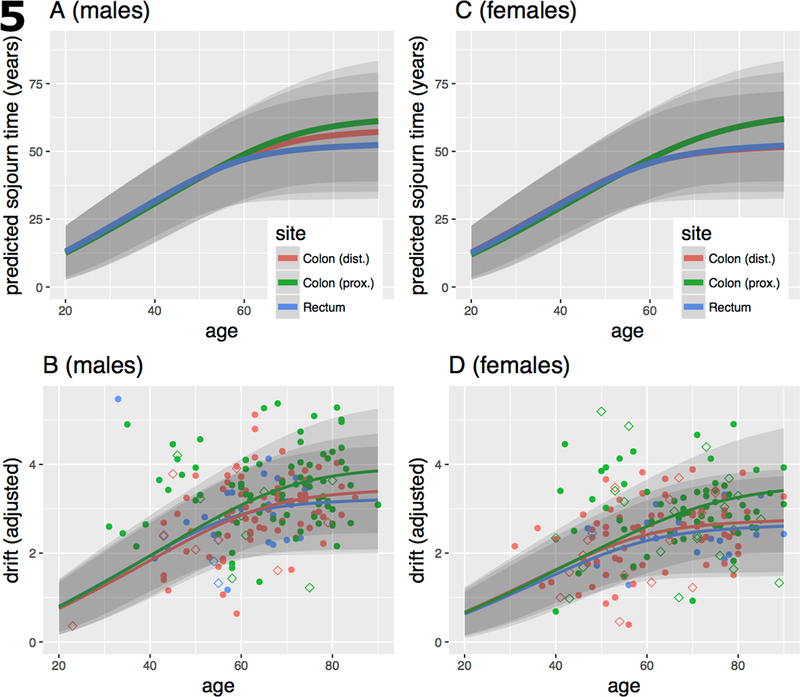
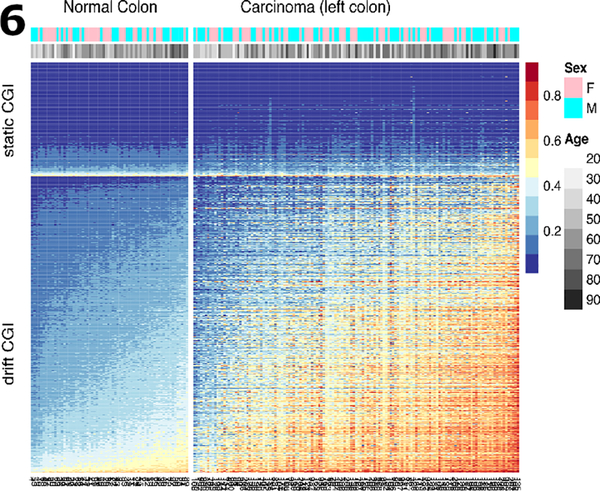
Many normal tissues undergo age-related drift in DNA methylation, providing a quantitative measure of tissue age. Here, we identify and validate 781 CpG islands (CGI) that undergo significant methylomic drift in 232 normal colorectal tissues and show that these CGI continue to drift in neoplasia while retaining significant correlations across samples. However, compared with normal colon, this drift advanced (∼3-4-fold) faster in neoplasia, consistent with increased cell proliferation during neoplastic progression. The observed drift patterns were broadly consistent with modeled adenoma-to-carcinoma sojourn time distributions from colorectal cancer incidence data. These results support the hypothesis that, beginning with the founder premalignant cell, cancer precursors frequently sojourn for decades before turning into cancer, implying that the founder cell typically arises early in life. At least 77% to 89% of the observed drift variance in distal and rectal tumors was explained by stochastic variability associated with neoplastic progression, whereas only 55% of the variance was explained for proximal tumors. However, gene-CGI pairs in the proximal colon that underwent drift were significantly and primarily negatively correlated with cancer gene expression, suggesting that methylomic drift participates in the clonal evolution of colorectal cancer. Methylomic drift advanced in colorectal neoplasia, consistent with extended sojourn time distributions, which accounts for a significant fraction of epigenetic heterogeneity in colorectal cancer. Importantly, these estimated long-duration premalignant sojourn times suggest that early dietary and lifestyle interventions may be more effective than later changes in reducing colorectal cancer incidence. SIGNIFICANCE: These findings present age-related methylomic drift in colorectal neoplasia as evidence that premalignant cells can persist for decades before becoming cancerous.See related commentary by Sapienza, p. 437.
©2018 American Association for Cancer Research.
Conflict of interest statement
Figures
Comment in
-
Epigenetic Drift in Colorectal Cancer-It's Probably Later Than You Think.Cancer Res. 2019 Feb 1;79(3):437-438. doi: 10.1158/0008-5472.CAN-18-3806. Cancer Res. 2019. PMID: 30709871
References
-
- Vogelstein B, Fearon ER, Hamilton SR, Kern SE, Preisinger AC, Leppert M, Nakamura Y, White R, Smits AM, Bos JL. Genetic alterations during colorectal-tumor development. The New England journal of medicine. 1988;319(9):525–32. Epub 1988/09/01. doi: 10.1056/NEJM198809013190901. PubMed PMID: . - DOI - PubMed
-
- Luo Y, Wong CJ, Kaz AM, Dzieciatkowski S, Carter KT, Morris SM, Wang J, Willis JE, Makar KW, Ulrich CM, Lutterbaugh JD, Shrubsole MJ, Zheng W, Markowitz SD, Grady WM. Differences in DNA methylation signatures reveal multiple pathways of progression from adenoma to colorectal cancer. Gastroenterology. 2014;147(2):418–29 e8. Epub 2014/05/06. doi: 10.1053/j.gastro.2014.04.039. PubMed PMID: ; PMCID: PMC4107146. - DOI - PMC - PubMed
-
- Borras E, San Lucas FA, Chang K, Zhou R, Masand G, Fowler J, Mork ME, You YN, Taggart MW, McAllister F, Jones DA, Davies GE, Edelmann W, Ehli EA, Lynch PM, Hawk ET, Capella G, Scheet P, Vilar E. Genomic Landscape of Colorectal Mucosa and Adenomas. Cancer Prev Res (Phila). 2016;9(6):417–27. doi: 10.1158/1940-6207.CAPR-16-0081. PubMed PMID: 27221540. - DOI - PMC - PubMed
Publication types
MeSH terms
Grants and funding
- K24 DK080941/DK/NIDDK NIH HHS/United States
- U01 CA199336/CA/NCI NIH HHS/United States
- P30 CA015704/CA/NCI NIH HHS/United States
- P01 CA077852/CA/NCI NIH HHS/United States
- U54 CA143862/CA/NCI NIH HHS/United States
- R01 CA189184/CA/NCI NIH HHS/United States
- U24 CA074794/CA/NCI NIH HHS/United States
- U01 CA206110/CA/NCI NIH HHS/United States
- R01 CA112516/CA/NCI NIH HHS/United States
- R03 CA165153/CA/NCI NIH HHS/United States
- R01 CA120523/CA/NCI NIH HHS/United States
- U01 CA152756/CA/NCI NIH HHS/United States
- R01 CA194663/CA/NCI NIH HHS/United States
- R50 CA233042/CA/NCI NIH HHS/United States
- U01 CA182940/CA/NCI NIH HHS/United States
- R01 CA220004/CA/NCI NIH HHS/United States
- P30 CA042014/CA/NCI NIH HHS/United States
- MR/S003851/1/MRC_/Medical Research Council/United Kingdom
- R01 CA207371/CA/NCI NIH HHS/United States
- R01 CA114467/CA/NCI NIH HHS/United States
LinkOut - more resources
Full Text Sources
Medical
Molecular Biology Databases
