. 2018 Oct 5;8(1):14879.
doi: 10.1038/s41598-018-33067-w.

A genomic Neolithic time transect of hunter-farmer admixture in central Poland

Affiliations

A genomic Neolithic time transect of hunter-farmer admixture in central Poland

D M Fernandes et al. Sci Rep. .

Abstract

Ancient DNA genome-wide analyses of Neolithic individuals from central and southern Europe indicate an overall population turnover pattern in which migrating farmers from Anatolia and the Near East largely replaced autochthonous Mesolithic hunter-gatherers. However, the genetic history of the Neolithic transition in areas lying north of the European Neolithic core region involved different levels of admixture with hunter-gatherers. Here we analyse genome-wide data of 17 individuals spanning from the Middle Neolithic to the Early Bronze Age (4300-1900 BCE) in order to assess the Neolithic transition in north-central Poland, and the local impacts of hunter-farmer contacts and Late Neolithic steppe migrations. We evaluate the influence of these on local populations and assess if and how they change through time, reporting evidence of recurrent hunter-farmer admixture over three millennia, and the co-existence of unadmixed hunter-gatherers as late as 4300 BCE. During the Late Neolithic we report the appearance of steppe ancestry, but on a lesser scale than previously described for other central European regions, with evidence of stronger affinities to hunter-gatherers than to steppe pastoralists. These results help understand the Neolithic palaeogenomics of another central European area, Kuyavia, and highlight the complexity of population interactions during those times.


Conflict of interest statement

The authors declare no competing interests.

Figures
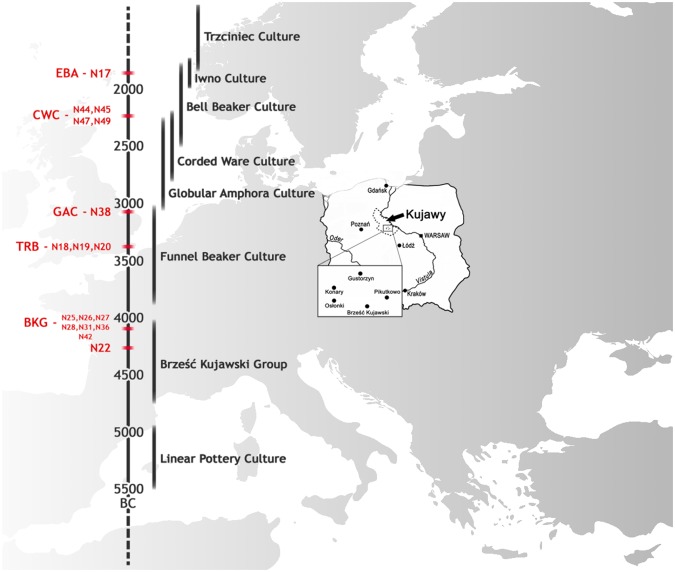
Figure 1
Figure 1
Timeline with culture acronyms and sample names, and map with location of archaeological sites.
Figure 2
Figure 2
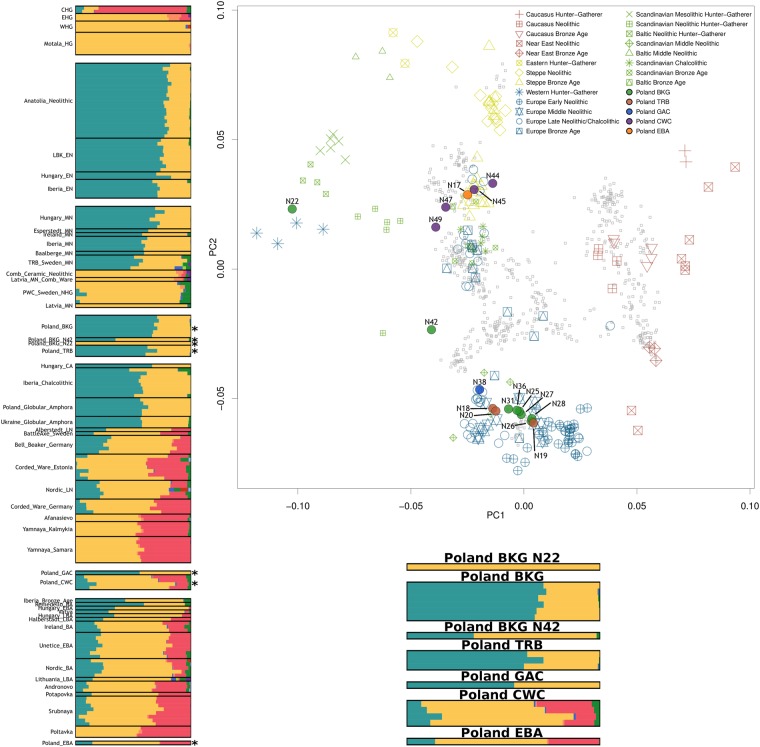
Principal component analysis with modern populations greyed out on the background (top-right), ADMIXTURE results with K = 10 with asterisks indicating the samples from this study (left) and those same samples amplified (bottom).
Figure 3
Figure 3
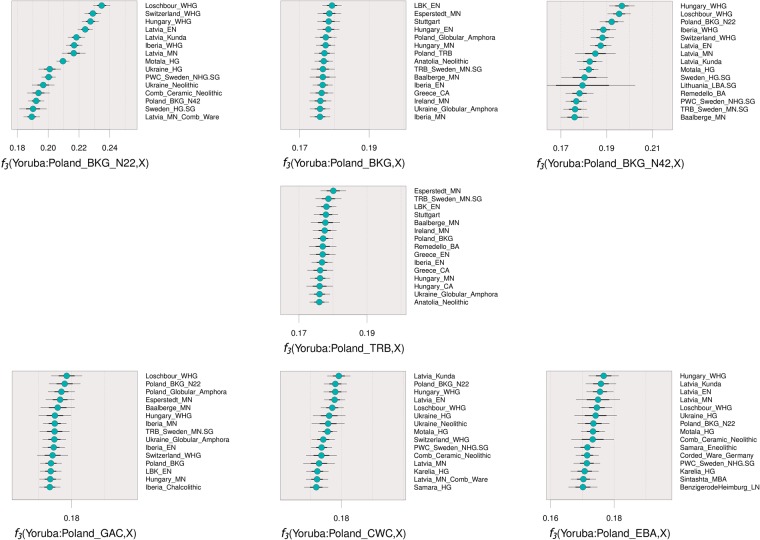
Top 15 outgroup f3 results for each culture and outlier. Thin and thick bars represent 1 and 3 standard deviations, respectively.
Figure 4
Figure 4
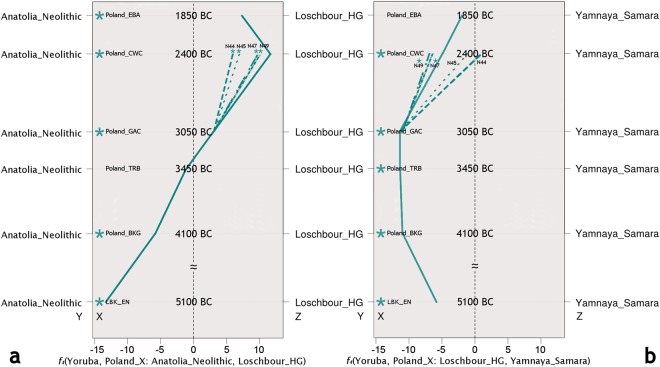
Chronologically ordered WHG (a) and steppe (b) ancestry variation along the time series. Z scores are presented instead of f4-statistic, for easier understanding of significance. Asterisks denote statistical significance (|Z| > 3).
Figure 5
Figure 5
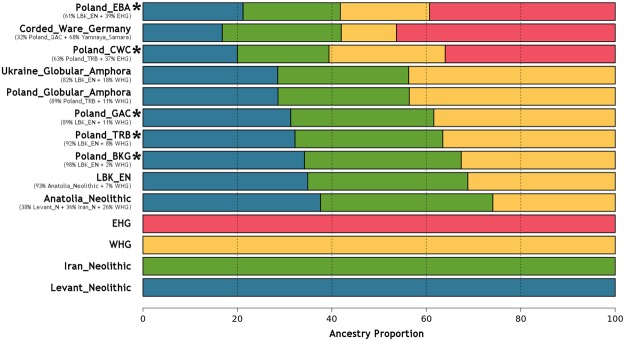
Ancestry proportions based on qpAdm. Visual representation of the main results presented in Supplementary Table S5. Populations from this study marked with an asterisk. Values and populations in brackets show the nested model results marked in green in Supplementary Table S5.

References

    1. Gamba C, et al. Genome flux and stasis in a five millennium transect of European prehistory. Nat. Commun. 2014;5:5257. doi: 10.1038/ncomms6257. - DOI - PMC - PubMed
    1. Haak W, et al. Massive migration from the steppe was a source for Indo-European languages in Europe. Nature. 2015;522:207–211. doi: 10.1038/nature14317. - DOI - PMC - PubMed
    1. Mathieson I, et al. Genome-wide patterns of selection in 230 ancient Eurasians. Nature. 2015;528:499–503. doi: 10.1038/nature16152. - DOI - PMC - PubMed
    1. Mittnik A, et al. The genetic prehistory of the Baltic Sea region. Nat. Commun. 2018;9:442. doi: 10.1038/s41467-018-02825-9. - DOI - PMC - PubMed
    1. Valdiosera C, et al. Four millennia of Iberian biomolecular prehistory illustrate the impact of prehistoric migrations at the far end of Eurasia. Proc. Natl. Acad. Sci. USA. 2018;115:3428–3433. doi: 10.1073/pnas.1717762115. - DOI - PMC - PubMed

Publication types