


The neurobiology of impulsivity and substance use disorders: implications for treatment
- PMID: 30291624
- PMCID: PMC6450787
- DOI: 10.1111/nyas.13977
The neurobiology of impulsivity and substance use disorders: implications for treatment
Abstract
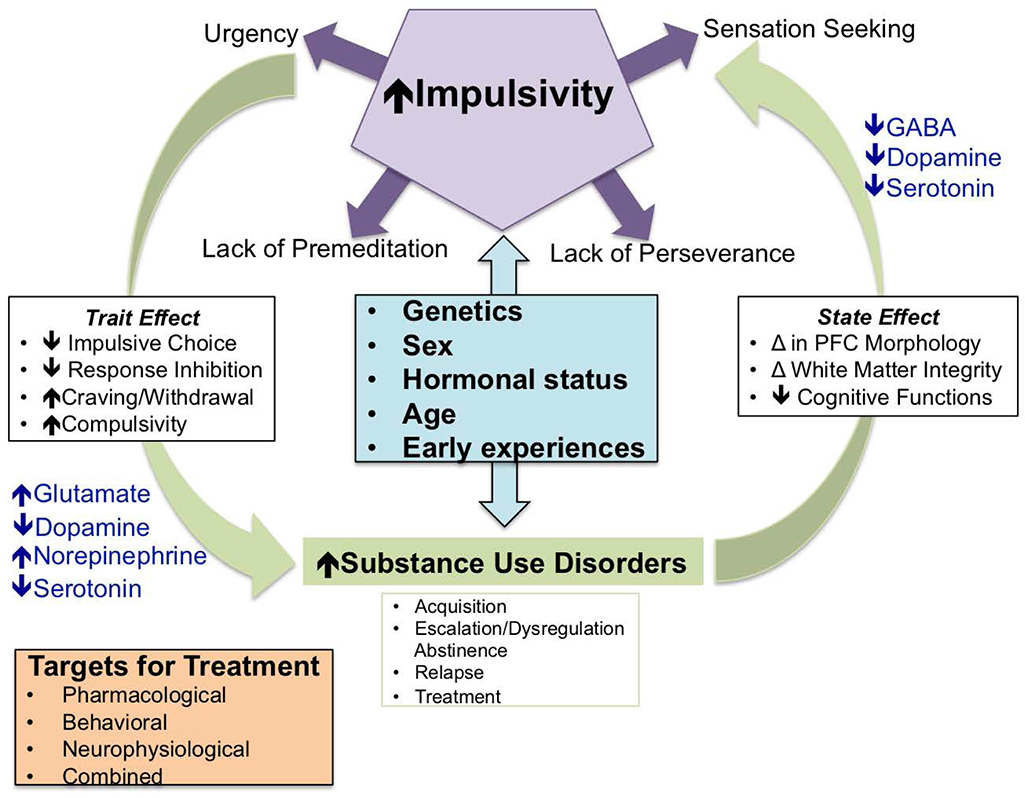
Impulsivity is strongly associated with substance use disorders (SUDs). Our review discusses impulsivity as an underlying vulnerability marker for SUDs, and treatment of co-occurring impulsivity in SUDs. Three factors should be considered for the complex relationship between impulsivity and a SUD: (1) the trait effect of impulsivity, centering on decreased cognitive and response inhibition, (2) the state effect resulting from either acute or chronic substance use on brain structure and function, and (3) the genetic and environmental factors (e.g., age and sex) may influence impulsive behavior associated with SUDs. Both subjective and objective measures are used to assess impulsivity. Together, treatment developments (pharmacological, behavioral, and neurophysiological) should consider these clinically relevant dimensions assessed by a variety of measures, which have implications for treatment matching in individuals with SUD. Despite its heterogeneity, impulsivity is a marker associated with SUDs and may be understood as an imbalance of bottom-up and top-down neural systems. Further investigation of these relationships may lead to more effective SUD treatments.
Keywords: alcohol; cannabis; impulsivity; substance use disorders; tobacco; treatment.
© 2018 New York Academy of Sciences.
Conflict of interest statement
Competing interests
The authors declare no competing interests
Figures
References
-
- WHO. World Drug Report. 2017; Available from: https://www.unodc.org/wdr2017/en/exsum.html.
-
- Perry JL and Carroll ME, The role of impulsive behavior in drug abuse. Psychopharmacology (Berl), 2008. 200(1): p. 1–26. - PubMed
-
- Aron AR, The neural basis of inhibition in cognitive control. Neuroscientist, 2007. 13(3): p. 214–28. - PubMed
