


Self-reported fatigue in children with advanced cancer: Results of the PediQUEST study
- PMID: 30291811
- PMCID: PMC6214736
- DOI: 10.1002/cncr.31639
Self-reported fatigue in children with advanced cancer: Results of the PediQUEST study
Abstract
Background: Pediatric cancer-related fatigue is prevalent and significantly impairs health-related quality of life, yet its patterns and correlates are poorly understood. The objectives of this study were to describe fatigue as prospectively reported by children with advanced cancer and to identify the factors associated with fatigue and associated distress.
Methods: Children (age ≥2 years) with advanced cancer (N = 104) or their parents at 3 academic hospitals reported symptoms at most weekly over 9 months using the computer-based Pediatric Quality of Life Evaluation of Symptoms Technology (PediQUEST) system. PediQUEST administered a modified version of the Memorial Symptom Assessment Scale (PQ-MSAS) as part of a randomized controlled trial. Clinical information was abstracted from medical records. Primary outcomes were: 1) fatigue prevalence (yes/no response to PQ-MSAS fatigue item) and 2) fatigue distress (composite score of severity, frequency, and bother). Multivariable models were constructed to identify factors independently associated with fatigue prevalence and scores reflecting fatigue distress (ie, burden).
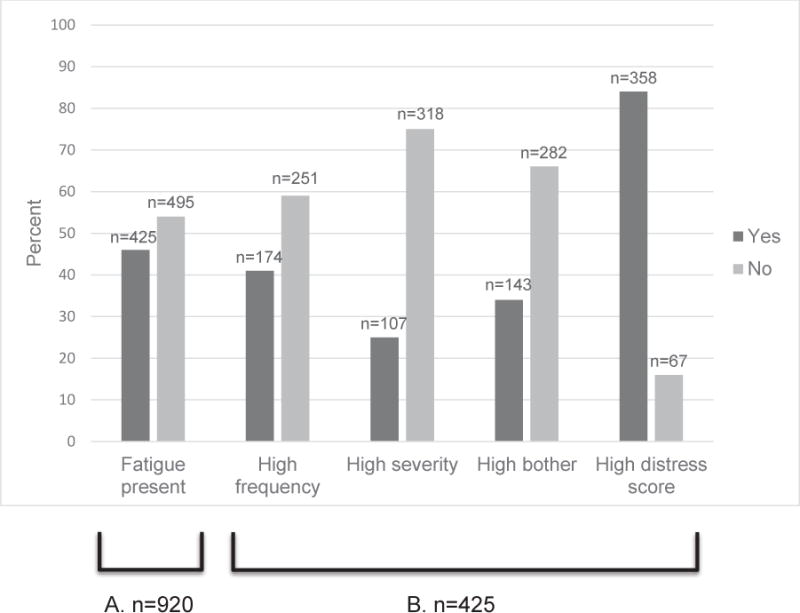
Results: Of 920 reports, 46% (n = 425) noted fatigue. When reported, fatigue was of high frequency in 41% of respondents (n = 174), severity in 25%of respondents (n = 107), and bother in 34%of respondents (n = 143). Most reports (84%; n = 358) were associated with scores indicating fatigue distress. In multivariable analyses, fatigue was associated with older age, lower hemoglobin, and distress from particular symptoms (anorexia, nausea, sleep disturbance, sadness, and irritability). In contrast, fatigue distress was associated with distress from nausea, cough, and pain.
Conclusions: Fatigue is common among children with advanced cancer and is often highly distressing. Interventions focused on uncontrolled symptoms may ease fatigue distress in children with advanced cancer.
Keywords: fatigue; palliative care; patient-reported outcomes; pediatric cancer; symptoms.
© 2018 American Cancer Society.
Conflict of interest statement
Figures
References
-
- Jalmsell L, Kreicbergs U, Onelov E, Steineck G, Henter JI. Symptoms Affecting Children with Malignancies During the Last Month of Life: A Nationwide Follow-Up. Pediatrics. 2006;117(4):1314–1320. - PubMed
-
- Wolfe J, Grier HE, Klar N, et al. Symptoms and Suffering at the End of Life in Children with Cancer. N Engl J Med. 2000;342(5):326–333. - PubMed
-
- Theunissen JM, Hoogerbrugge PM, van Achterberg T, Prins JB, Vernooij-Dassen MJ, van den Ende CH. Symptoms in the Palliative Phase of Children with Cancer. Pediatr Blood Cancer. 2007;49(2):160–165. - PubMed
-
- Pritchard M, Burghen E, Srivastava DK, et al. Cancer-Related Symptoms Most Concerning to Parents During the Last Week and Last Day of Their Child’s Life. Pediatrics. 2008;121(5):e1301–1309. - PubMed
Publication types
MeSH terms
Grants and funding
- K07 CA096746/CA/NCI NIH HHS/United States
- 1K07 CA096746-01/National Institutes of Health/National Cancer Institute/International
- 1K23 HL107452/National Institutes of Health/National Heart, Lung, and Blood Institute/International
- American Cancer Society Pilot and Exploratory Project Award in Palliative Care of Cancer Patients and Their Families/International
- K23 HL107452/HL/NHLBI NIH HHS/United States
LinkOut - more resources
Full Text Sources
Medical
