Review
. 2019 Jan;15(1):164-174.
doi: 10.1016/j.nano.2018.09.004. Epub 2018 Oct 4.

Protein-based nanoparticles in cancer vaccine development

Affiliations
Review

Protein-based nanoparticles in cancer vaccine development

Medea Neek et al. Nanomedicine. 2019 Jan.

Abstract

Peptide and protein-based cancer vaccines usually fail to elicit efficient immune responses against tumors. However, delivery of these peptides and proteins as components within caged protein nanoparticles has shown promising improvements in vaccine efficacy. Advantages of protein nanoparticles over other vaccine platforms include their highly organized structures and symmetry, biodegradability, ability to be specifically functionalized at three different interfaces (inside and outside the protein cage, and between subunits in macromolecular assembly), and ideal size for vaccine delivery. In this review, we discuss different classes of virus-like particles and caged protein nanoparticles that have been used as vehicles to transport and increase the interaction of cancer vaccine components with the immune system. We review the effectiveness of these protein nanoparticles towards inducing and elevating specific immune responses, which are needed to overcome the low immunogenicity of the tumor microenvironment.

Keywords: Caged protein nanoparticles; Cancer vaccines; Tumor antigens; Virus-like particles.


Conflict of interest statement

The authors have no conflicts of interest to disclose.

Figures
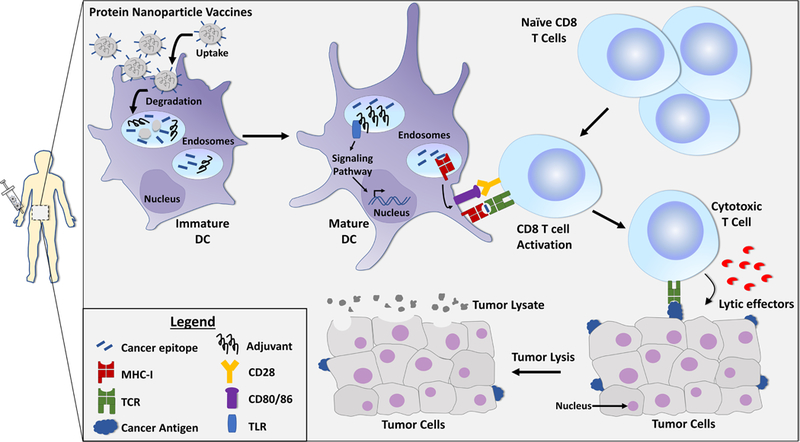
Figure 1.
Figure 1.. Common mechanism of tumor cell elimination.
Protein nanoparticle (NP) cancer vaccines that are injected in vivo can accumulate in the LNs and spleen. Immature DCs residing in these tissues internalize and degrade the NPs and process the antigens and adjuvants for potential danger signals. If DCs are activated through an adjuvant-TLR interaction, they present the antigens to the T cells in the context of MHC- I molecules for specific and longer-term T cell responses (i.e., cross-presentation). Upon T cell activation and recognition of tumor-associated antigens on cancer cells, T cells secrete lytic effectors (such as perforin), leading to tumor lysis and elimination. Abbreviations in the figure include: MHC-I (major histocompatibility complex, class I), TCR (T-cell receptor), CD28 (cluster of differentiation 28, costimulatory molecule), CD80/86 (cluster of differentiation 80/86, costimulatory molecules), TLR (Toll-like receptor).
Figure 2.
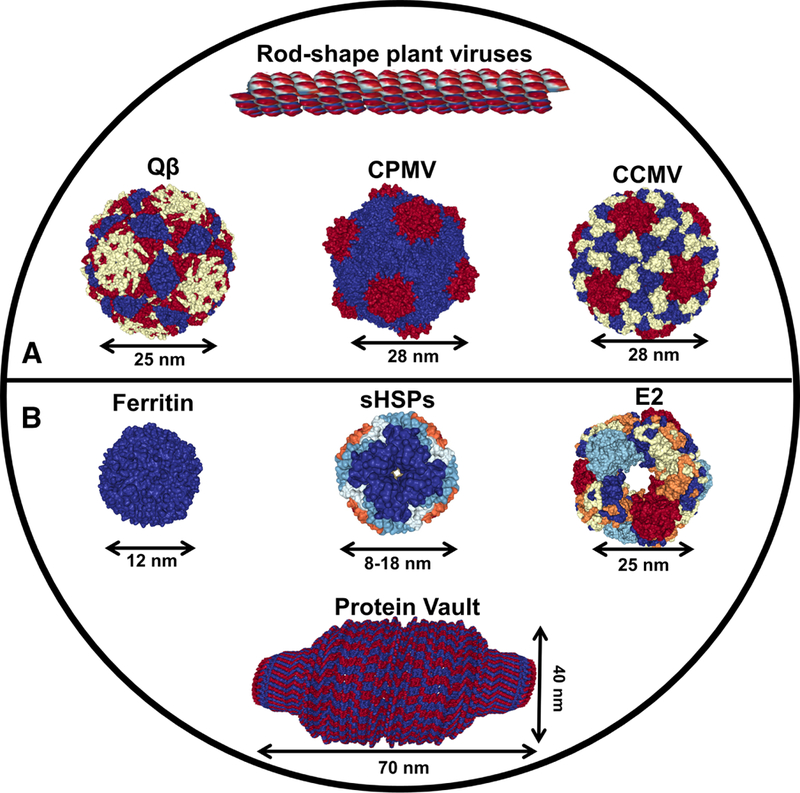
Figure 2.. Protein structures of different virus-like particles (panel A), and caged protein nanoparticles (panel B).
Structural images are from Protein Data Bank (PDB; http://www.rcsb.org/pdb/home/home.do). Structure of TMV is reconstructed from helical structure (PDB ID code: 3J06), Qβ (1QBE), CPMV (1NY7), CCMV (1ZA7), ferritin (1MFR), small HSPs (3VQK), E2 (1B5S), and protein vault (2QZV).
Figure 3.
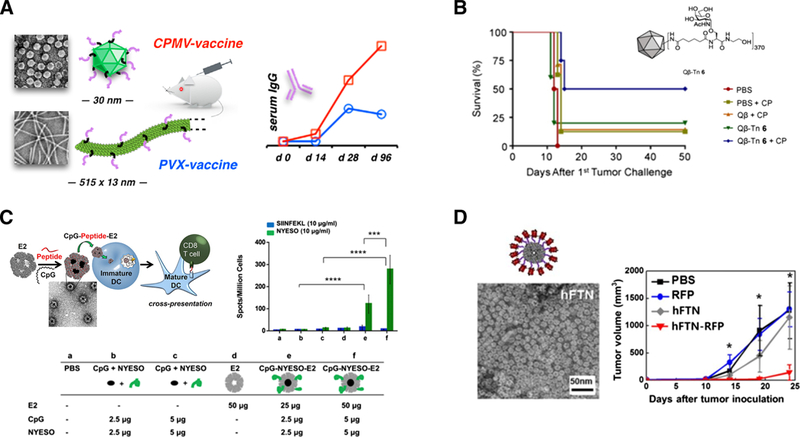
Figure 3.. Examples of protein-based cancer vaccines.
(A) TEM images and antibody responses of plant virus-based cancer vaccines. HER2 antigen conjugated to CPMV and PVX nanoparticles resulted in higher antibody responses. Reprinted from Shukla et al., Biomaterials 121, 15–27, copyright (2017); with permission from Elsevier. (B) Tumor-associated carbohydrate antigens conjugated to Qp resulted in increased survival of mice challenged with mammary tumor cells. Reprinted from Yin et al., ACS ChemBiol. 10, 2364–2372, copyright (2015); with permission from American Chemical Society. (C) E2 nanoparticles in cancer vaccine studies. Upper left: Schematic of E2 interaction with immune cells. High DC activation and antigen crosspresentation result when antigen and DC-activating molecules are both attached to E2 nanoparticles. Reprinted from Molino et al. ACS Nano 7, 9743–9752, copyright (2013); with permission from American Chemical Society. Upper right and bottom: Conjugation of human cancer-testis antigen and adjuvant to E2 nanoparticle increased specific IFN-γ secretion. Reprinted from Neek et al., Biomaterials 156, 194–203, copyright (2018); with permission from Elsevier. (D) TEM image of ferritin nanoparticles (left). Immunization with red fluorescence protein (RFP) significantly decreased the RFP-expressing melanoma tumor growth in mice. Reprinted from Lee et al., Scientific Reports 6: 35182 (2016). doi:10.1038/srep35182. License for use at http://creativecommons.org/licenses/by/4.0/.

References

    1. Rosenberg SA, Yang JC, Restifo NP. Cancer immunotherapy: moving beyond current vaccines. Nat. Med. 2004; 10: 909–915. - PMC - PubMed
    1. Even-Desrumeaux K, Baty D, Chames P. State of the Art in T umor Antigen and Biomarker Discovery. Cancer 2011;3: 2554–2596. - PMC - PubMed
    1. Vesely MD, Schreiber RD. Cancer immunoediting: Antigens, mechanisms, and implications to cancer immunotherapy. Ann. N. Y. Acad. Sci 2013; 1284: 1–5 (2013). - PMC - PubMed
    1. Reyes D, Salazar L, Espinoza E, Pereda C, Castellón E, Valdevenito R,et al. Tumour cell lysate-loaded dendritic cell vaccine induces biochemical and memory immune response in castration-resistant prostate cancer patients. Br. J. Cancer 2013; 109: 1488–1497. - PMC - PubMed
    1. Reed SG, Orr MT, Fox CB. Key roles of adjuvants in modern vaccines. Nat. Med. 2013; 19: 1597–1608. - PubMed

Publication types

MeSH terms