


Valproate preparations for agitation in dementia
- PMID: 30293233
- PMCID: PMC6516950
- DOI: 10.1002/14651858.CD003945.pub4
Valproate preparations for agitation in dementia
Abstract
Background: Agitation has been reported in up to 90% of people with dementia. Agitation in people with dementia worsens carer burden, increases the risk of injury, and adds to the need for institutionalisation. Valproate preparations have been used in an attempt to control agitation in dementia, but their safety and efficacy have been questioned.
Objectives: To determine the efficacy and adverse effects of valproate preparations used to treat agitation in people with dementia, including the impact on carers.
Search methods: We searched ALOIS - the Cochrane Dementia and Cognitive Improvement Group's Specialized Register on 7 December 2017 using the terms: valproic OR valproate OR divalproex. ALOIS contains records from all major health care databases (the Cochrane Library, MEDLINE, Embase, PsycINFO, CINAHL, LILACS) as well as from many trials databases and grey literature sources.
Selection criteria: Randomised, placebo-controlled trials that assessed valproate preparations for agitation in people with dementia.
Data collection and analysis: Two review authors independently screened the retrieved studies against the inclusion criteria and extracted data and assessed methodological quality of the included studies. If necessary, we contacted trial authors to ask for additional data, including relevant subscales, or for other missing information. We pooled data in meta-analyses where possible. This is an update of a Cochrane Review last published in 2009. We found no new studies for inclusion.
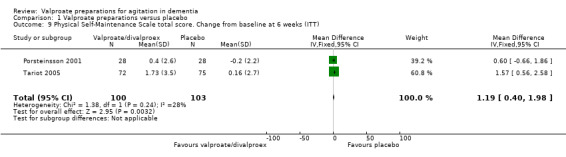
Main results: The review included five studies with 430 participants. Studies varied in the preparations of valproate, mean doses (480 mg/day to 1000 mg/day), duration of treatment (three weeks to six weeks), and outcome measures used. The studies were generally well conducted although some methodological information was missing and one study was at high risk of attrition bias.The quality of evidence related to our primary efficacy outcome of agitation varied from moderate to very low. We found moderate-quality evidence from two studies that measured behaviour with the total Brief Psychiatric Rating Scale (BPRS) score (range 0 to 108) and with the BPRS agitation factor (range 0 to 18). They found that there was probably little or no effect of valproate treatment over six weeks (total BPRS: mean difference (MD) 0.23, 95% confidence interval (CI) -2.14 to 2.59; 202 participants, 2 studies; BPRS agitation factor: MD -0.67, 95% CI -1.49 to 0.15; 202 participants, 2 studies). Very low-quality evidence from three studies which measured agitation with the Cohen-Mansfield Agitation Index (CMAI) were consistent with a lack of effect of valproate treatment on agitation. There was variable quality evidence on other behaviour outcomes reported in single studies of no difference between groups or a benefit for the placebo group.Three studies, which measured cognitive function using the Mini-Mental State Examination (MMSE), found little or no effect of valproate over six weeks, but we were uncertain about this result because the quality of the evidence was very low. Two studies that assessed functional ability using the Physical Self-Maintenance Scale (PSMS) (range 6 to 30) found that there was probably slightly worse function in the valproate-treated group, which was of uncertain clinical importance (MD 1.19, 95% CI 0.40 to 1.98; 203 participants, 2 studies; moderate-quality evidence).Analysis of adverse effects and serious adverse events (SAE) indicated a higher incidence in valproate-treated participants. A meta-analysis of three studies showed that there may have been a higher rate of adverse effects among valproate-treated participants than among controls (odds ratio (OR) 2.02, 95% CI 1.30 to 3.14; 381 participants, 3 studies, low-quality evidence). Pooled analysis of the number of SAE for the two studies that reported such data indicated that participants treated with valproate preparations were more likely to experience SAEs (OR 4.77, 95% CI 1.00 to 22.74; 228 participants, 2 studies), but the very low quality of the data made it difficult to draw any firm conclusions regarding SAEs. Individual adverse events that were more frequent in the valproate-treated group included sedation, gastrointestinal symptoms (nausea, vomiting, and diarrhoea), and urinary tract infections.
Authors' conclusions: This updated review corroborates earlier findings that valproate preparations are probably ineffective in treating agitation in people with dementia, but are associated with a higher rate of adverse effects, and possibly of SAEs. On the basis of this evidence, valproate therapy cannot be recommended for management of agitation in dementia. Further research may not be justified, particularly in light of the increased risk of adverse effects in this often frail group of people. Research would be better focused on effective non-pharmacological interventions for this patient group, or, for those situations where medication may be needed, further investigation of how to use other medications as effectively and safely as possible.
Conflict of interest statement
SB: none known.
UN: none known.
JL: none known.
AC: none known.
Figures




Update of
-
Valproate preparations for agitation in dementia.Cochrane Database Syst Rev. 2009 Jul 8;(3):CD003945. doi: 10.1002/14651858.CD003945.pub3. Cochrane Database Syst Rev. 2009. Update in: Cochrane Database Syst Rev. 2018 Oct 05;10:CD003945. doi: 10.1002/14651858.CD003945.pub4. PMID: 19588348 Updated.
Comment in
-
Do valproate preparations improve agitation in dementia? A Cochrane Review summary with commentary.Australas J Ageing. 2021 Sep;40(3):336-338. doi: 10.1111/ajag.12984. Epub 2021 Aug 13. Australas J Ageing. 2021. PMID: 34390114 No abstract available.
References
References to studies included in this review
Herrmann 2007 {published data only}
-
- Herrmann N, Lanctot KL, Rothenberg LS, Eryavec G. A placebo‐controlled trial of valproate for agitation and aggression in Alzheimer's disease. Dementia and Geriatric Cognitive Disorders 2007;23:116‐9. - PubMed
Porsteinsson 2001 {published data only}
-
- Porsteinsson AP, Tariot PN, Erb R, Cox C, Smith E, Jakimovich L, et al. Placebo controlled study of divalproex sodium for agitation in dementia. American Journal of Geriatric Psychiatry 2001;9(1):58‐66. - PubMed
Sival 2002 {published data only}
-
- Sival RC, Haffmans PM, Jansen PA, Duursma SA. Sodium valproate in the treatment of aggressive behavior in patients with dementia – a randomised placebo controlled clinical trial. International Journal of Psychiatry 2002;17(6):579‐85. - PubMed
Tariot 2001 {published data only}
-
- Tariot PN, Schneider LS, Mintzer JE, Cutler AJ, Cunningham MR, Thomas MS, et al. Safety and tolerability of divalproex sodium in the treatment of signs and symptoms of mania in elderly patients with dementia: results of a double‐blind, placebo‐controlled trial. Current Therapeutic Research 2001;62(1):51‐67.
Tariot 2005 {published data only}
-
- Tariot PN, Raman R, Jakimovich L, Schneider L, Porsteinsson A, Thomas R, et al. Divalproex sodium in nursing home residents with possible or probable Alzheimer disease complicated by agitation: a randomized, controlled trial. American Geriatric Psychiatry 2005;13:942‐9. - PubMed
References to studies excluded from this review
Forester 2007 {published data only}
-
- Forester B, Vanelli M, Hyde J, Perez R, Ahokpossi C, Scribney W, et al. Report on an open label prospective study of divalproex sodium on the behavioral and psychological symptoms of dementia as monotherapy and in combination with second generation antipsychotic medication. American Journal of Geriatric Pharmacotherapy 2007;5:209‐17. - PubMed
Goldberg 1999 {published data only}
-
- Goldberg RJ. The use of adjunctive divalproex for neuroleptic unresponsive behavioral disturbances in nursing home residents with dementia. Annals of Long‐Term Care 1999;7:63‐6.
Gupta 1998 {published data only}
-
- Gupta S, O'Connell RO, Parekh A, Krotz B, Stockwell D. Efficacy of valproate for agitation and aggression in dementia: CAS reports. International Journal of Geriatric Psychopharmacology 1998;1:244‐8.
Haas 1997 {published data only}
-
- Haas S, Vincent K, Holt J, Lippmann S. Divalproex: a possible treatment alternative for demented elderly aggressive patients. Annals of Clinical Psychiatry 1997;9(3):145‐7. - PubMed
Horne 1995 {published data only}
-
- Horne M, Lindley SE. Divalproex sodium in the treatment of aggressive behavior and dysphoria in patients with organic brain syndromes. Journal of Clinical Psychiatry 1995;56(9):430‐1. - PubMed
Kasckow 1997 {published data only}
-
- Kasckow JW, McElroy SL, Cameron RL, Mahler LL, Fudala SJ. A pilot study on the use of divalproex sodium in the treatment of behavioral agitation in elderly patients with dementia: assessment with the BEHAVED‐AD and CGI rating scales. Current Therapeutic Research 1997;58(12):351‐4.
Lott 1995 {published data only}
-
- Lott AD, McElroy SL, Keys MA. Valproate in the treatment of behavioral agitation in elderly patients with dementia. Journal of Neuropsychiatry Clinical Neuroscience 1995;7(3):314‐9. - PubMed
Mazure 1992 {published data only}
-
- Mazure CM, Druss BG, Cellar JS. Valproate treatment of older patients with organic mental syndromes and behavioral dyscontrol. Journal of American Geriatric Society 1992;40(9):914‐6. - PubMed
Mellow 1993 {published data only}
-
- Mellow AM, Solano‐Lopez C, Davis S. Sodium valproate in the treatment of behavioral disturbances in dementia. Journal of Geriatric Psychiatry and Neurology 1993;6(4):205‐9. - PubMed
Narayan 1997 {published data only}
-
- Narayan M, Nelson JC. Treatment of dementia with behavioral disturbance using divalproex or a combination of divalproex and a neuroleptic. Journal of Clinical Psychiatry 1997;58(8):351‐4. - PubMed
Niedermier 1998 {published data only}
-
- Niedermier JA, Nasrallah HA. Clinical correlates of response to valproate in geriatric inpatients. Annals of Clinical Psychiatry 1998;10(4):165‐8. - PubMed
Porsteinsson 1997 {published data only}
-
- Porsteinsson AP, Tariot PN, Erb R, Gaile S. An open trial of valproate for agitation in geriatric neuropsychiatric disorders. American Journal Geriatric Psychiatry 1997;5(4):344‐51. - PubMed
Sandborn 1995 {published data only}
-
- Sandborn WD, Bendfeldt F, Hamdy R. Valproic acid for physically aggressive behavior in geriatric patients. American Journal of Geriatric Psychiatry 1995;3(3):239‐42. - PubMed
Sival 1994 {published data only}
-
- Sival RC, Haffman PM, Gent PP, Nieuwkerk JF, Jansen PA. The effects of sodium valproate on disturbed behavior in dementia. Journal of American Geriatric Society 1994;42(8):906‐7. - PubMed
Takahashi 1996 {published data only}
-
- Takahashi M, Akagi M. Case report of sodium valproate treatment of aggression associated with Alzheimer's disease [in Japanese]. No to Shinkei [Brain and Nerve] 1996;48(8):757‐60. - PubMed
Tariot 2002 {published data only}
-
- Tariot P, Porsteinsson AP, Jakimovich LJ, Kowalski N, Holt C. Open valproate treatment following a double‐blind trial for agitation. 8th International Conference of Alzheimer's Disease and Related Disorders; 2002 July 20–25; Stockholm, Sweden. 2002:26.
Additional references
Alzheimer's Society 2011a
-
- Alzheimer's Society. Optimising Treatment and Care for People with Behavioural and Psychological Symptoms of Dementia: a Best Practice Guide for Health and Social Care Professionals. London: Alzheimer's Society, 2011.
Alzheimer's Society 2011b
-
- Alzheimer's Society. Reducing the Use of Anti‐psychotic Drugs: a Guide to the Treatment and Care of Behavioural and Psychological Symptoms of Dementia. London: Alzheimer's Society, 2011.
APA 1980
-
- American Psychiatric Association. Diagnostic and Statistical Manual of Mental Disorders. 3rd Edition. Washington (DC): American Psychiatric Association, 1980.
APA 1987
-
- American Psychiatric Association. Diagnostic and Statistical Manual of Mental Disorders. 3rd Edition. Washington (DC): American Psychiatric Publishing, 1987.
APA 1994
-
- American Psychiatric Association. Diagnostic and Statistical Manual of Mental Disorders. 4th Edition. Washington (DC): American Psychiatric Publishing, 1994.
Bech 1978
-
- Bech P, Rafaelson OJ, Krampt P, Bolwig TG. The mania rating scale: scale construction and inter‐observer agreement. Neuropharmacology 1978;17:430‐1. - PubMed
Bierman 2007
-
- Bierman EJ, Comijs HC, Gundy CM, Sonnenberg C, Jonker C, Beekman AT. The effect of chronic benzodiazepine use on cognitive functioning in older persons: good, bad or indifferent?. International Journal of Geriatric Psychiatry 2007;22:1194‐200. - PubMed
Billig 1991
-
- Billig N, Cohen‐Mansfield J, Lipson S. Pharmaceutical treatment of agitation in a nursing home. Journal of the American Geriatrics Society 1991;39:1002‐5. - PubMed
Cohen‐Mansfield 1986
-
- Cohen‐Mansfield J, Billig N. Agitated behaviours in the elderly. 1. A conceptual review. Journal of the American Geriatrics Society 1986;34:711‐21. - PubMed
Cohen‐Mansfield 1989
-
- Cohen‐Mansfield J, Werner P, Marx MS. An observational study of agitation in agitated nursing home residents. International Psychogeriatrics 1989;1:153‐65. - PubMed
Colenda 1991
-
- Colenda CC, Hamer RM. Antecedents and interventions for aggressive behavior of patients at a geropsychiatric state hospital. Hospital and Community Psychiatry 1991;42:287‐92. - PubMed
COSTART 1989
-
- COSTART: Coding Symbols Thesaurus for Adverse Reaction Terms. US Food and Drug Administration. 3. Rockville (MD): US Food and Drug Administration: Center for Drugs and Biologics, Division of Drug and Biological Products Experience, 1989.
Cummings 1994
-
- Cummings JL, Mega M, Gray K, Rosenberg‐Thompson S, Carusi DA, Gornbein J. The Neuropsychiatric Inventory: comprehensive assessment of psychopathology in dementia. Neurology 1994;44:2308‐14. - PubMed
Egger 1997
-
- Egger M, Smith G D, Schneider M, Minder C. Bias in meta‐analysis detected by a simple, graphical test. BMJ 1997:315:629. [https://doi.org/10.1136/bmj.315.7109.629 ] - PMC - PubMed
Folstein 1975
-
- Folstein MF, Folstein SE, McHugh PR. A practical method for grading the cognitive state of patients for the clinician. Journal of Psychiatric Research 1975;12:189‐98. - PubMed
Guy 1976
-
- Guy W. ECDEU Assessment Manual for Psychopharmacology. USA Department of Health, Education and Welfare Publication (ADM) 76‐338. 2nd Edition. Washington (DC): US Government Printing Office, 1976:218‐22.
Higgins 2011
-
- Higgins JP, Green S, editor(s). Cochrane Handbook for Systematic Reviews of Interventions Version 5.1.0 (updated March 2011). The Cochrane Collaboration, 2011. Available from handbook.cochrane.org.
Hughes 1982
-
- Hughes CP, Berg L, Danziger WL, Cohen LA, Martin RL. A new clinical scale for the staging of dementia. British Journal of Psychiatry 1982;140:566‐72. - PubMed
Lawton 1969
-
- Lawton MP, Brody EM. Assessment of older people: self‐maintaining and instrumental activities of daily living. Gerontologist 1969;9:179‐86. - PubMed
Livingstone 2014
-
- Livingston G, Kelly L, Lewis‐Holmes E, Baio G, Morris S, Patel N, et al. Non‐pharmacological interventions for agitation in dementia: systematic review of randomised controlled trials. British Journal of Psychiatry 2014;205(6):436‐42. - PubMed
Lon 1995
-
- Lon AD, McElroy SL, Keys MA. Valproate in the treatment of behavioral agitation in elderly patients with dementia. Journal of Neuropsychiatry and Clinical Neurosurgery 1995;7:314‐9. - PubMed
Maher 2011
-
- Maher AR, Maglione M, Bagley S, Suttorp M, Hu JH, Ewing B, et al. Efficacy and comparative effectiveness of atypical antipsychotic medications for off‐label uses in adults: a systematic review and meta‐analysis. Journal of the American Medical Association 2011;306:1359‐69. - PubMed
McKhann 1984
-
- McKhann G, Brackman D, Folstein M, Katzman R, Price D, Stadlan EM. Clinical diagnosis of Alzheimer's disease: report of the NINCDS‐ADRDA workgroup under the auspices of the Department of Health and Human Services Task Force on Alzheimer's Disease. Neurology 1984;34:939‐44. - PubMed
MHRA 2012
-
- Medicines and Healthcare products Regulatory Agency. Antipsychotics: initiative to reduce prescribing to older people with dementia. Drug Safety Update 2012;5(10):H1.
NICE 2006
-
- National Institute for Health and Care Excellence. Dementia: Supporting People with Dementia and their Carers in Health and Social Care. Clinical guideline CG42. London: National Institute of Health and Care Excellence, 2006.
NICE 2015
-
- National Institute for Health and Care Excellence. Management of Aggression, Agitation and Behavioural Disturbances in Dementia: Valproate Preparations. London: National Institute for Health and Care Excellence, 2015.
NICE 2016
-
- National Institute for Health and Care Excellence. Dementia: Supporting People with Dementia and their Carers in Health and Social Care. Updated Clinical guideline CG42. London: National Institute for Health and Care Excellence, 2016.
Overall 1962
-
- Overall JE, Gorham DR. The Brief Psychiatric Rating Scale. Psychology Reports 1962;10:799‐812.
Overall 1988
-
- Overall J, Gorham D. Introduction: the Brief Psychiatric Rating Scale (BPRS): recent developments in ascertainment and scaling. Psychopharmacology Bulletin 1988;24:97‐8. - PubMed
Patel 1993
-
- Patel V, Hope T. Aggressive behavior in elderly people with dementia: a review. International Journal of Geriatric Psychiatry 1993;8:457‐72.
Porteinsson 2014
Review Manager 2014 [Computer program]
-
- Nordic Cochrane Centre, The Cochrane Collaboration. Review Manager (RevMan). Version 5.3. Copenhagen: Nordic Cochrane Centre, The Cochrane Collaboration, 2014.
Schünemann 2011
-
- Schünemann HJ, Oxman AD, Higgins JP, Vist GE, Glasziou P, Guyatt GH. Chapter 11: Presenting results and 'Summary of findings' tables. In: Higgins JP, Green S, editor(s). Cochrane Handbook for Systematic Reviews of Interventions Version 5.1.0 (updated March 2011). The Cochrane Collaboration, 2011. Available from handbook.cochrane.org.
Seitz 2011
Verstraten 1988
-
- Verstraten PF. The GIP: an observational ward behavior scale. Psychopharmacology Bulletin 1988;24:717‐9. - PubMed
WHO 1991
-
- World Health Organization. ICD‐10. Tenth Revision of the International Classification of Diseases. Mental and Behavioural Disorders. Clinical Descriptions and Diagnostic Guidelines. 10th Edition. Geneva: World Health Organization, 1991.
Wistedt 1990
-
- Wistedt B, Rasmussen A, Pedersen L, Malm U, Träskman‐Bendz L, Wakelin J, et al. The development of an observer‐scale for measuring social dysfunction and aggression. Pharmacopsychiatry 1990;23:249‐52. - PubMed
Yudofsky 1986
-
- Yudofsky SC, Silver JM, Jackson W, Endicott J, Williams D. The Overt Aggression Scale for the objective rating of verbal and physical aggression. American Journal of Psychiatry 1986;143:35‐9. - PubMed
References to other published versions of this review
Lonergan 2004
Publication types
MeSH terms
Substances
LinkOut - more resources
Full Text Sources
Medical
