. 2018 Oct;1864(10):3527-3536.
doi: 10.1016/j.bbadis.2018.08.007. Epub 2018 Aug 8.

Mechanisms underlying modulation of podocyte TRPC6 channels by suPAR: Role of NADPH oxidases and Src family tyrosine kinases

Affiliations

Mechanisms underlying modulation of podocyte TRPC6 channels by suPAR: Role of NADPH oxidases and Src family tyrosine kinases

Eun Young Kim et al. Biochim Biophys Acta Mol Basis Dis. 2018 Oct.

Abstract

The soluble urokinase receptor (suPAR) has been implicated in the pathogenesis of chronic kidney diseases (CKD) and may function as a circulating "permeability factor" driving primary focal and segmental glomerulosclerosis (FSGS). Here we examined the mechanisms whereby suPAR causes mobilization and increased activation of Ca2+-permeable TRPC6 channels, which are also implicated in FSGS. Treatment of immortalized mouse podocytes with recombinant suPAR for 24 h caused a marked increase in cytosolic reactive oxygen species (ROS) that required signaling through integrins. This effect was associated with increased assembly of active cell surface NADPH oxidase 2 (Nox2) complexes and was blocked by the Nox2 inhibitor apoycynin. Treatment with suPAR also evoked a functionally measurable increase in TRPC6 channels that was blocked by concurrent treatment with the ROS-quencher TEMPOL as well as by inhibition of Rac1, an essential component of active Nox2 complexes. Elevated ROS evoked by exposing cells to suPAR or H2O2 caused a marked increase in the abundance of tyrosine-phosphorylated proteins including Src, and suPAR-evoked Src activation was blocked by TEMPOL. Moreover, mobilization and increased activation of TRPC6 by suPAR or H2O2 was blocked by concurrent exposure to PP2, an inhibitor of Src family tyrosine kinases. These data suggest that suPAR induces oxidative stress in podocytes that in turn drives signaling through Src family kinases to upregulate TRPC6 channels. The combination of oxidative stress and altered Ca2+ signaling may contribute to loss of podocytes and progression of various forms of CKD.

Keywords: Chronic kidney disease; Integrins; Reactive oxygen species; Src; TRPC6; suPAR.


Figures

Figure 1.
Figure 1.
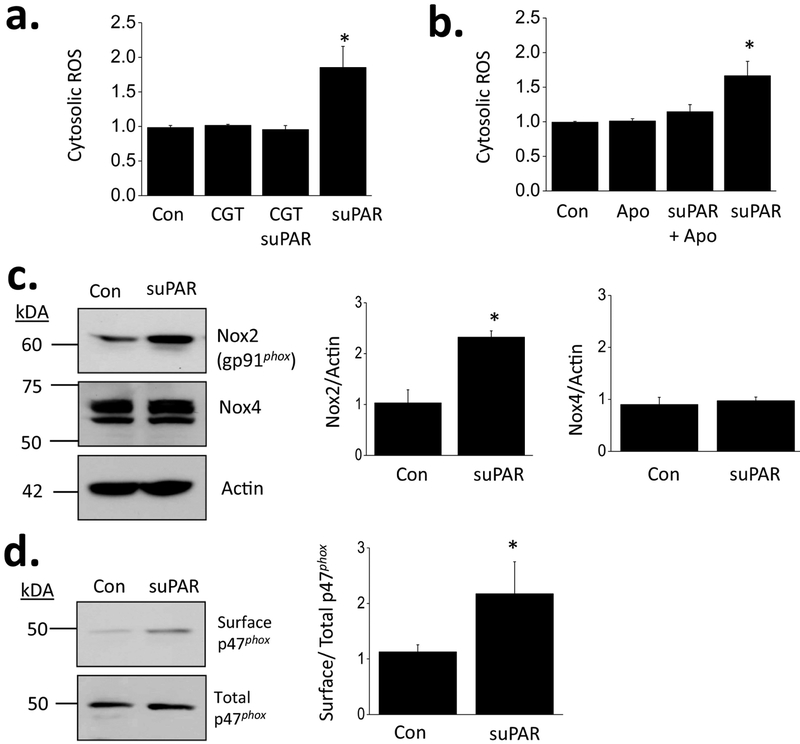
Increased ROS generation in podocytes evoked by suPAR and Nox2 in mouse podocytes. (a) Fluorescence assay showing effects of recombinant suPAR (10 ng/ml for 24 hr) on cytosolic ROS abundance in immortalized mouse podocytes. The effect of suPAR was blocked by concurrent exposure to 1 μM cilengitide (CGT), an inhibitor of signaling through αVβ3 integrin. Ordinate shows fold increase in signal over control. In this and all subsequent panels, error bars denote SD. (b) The effects of suPAR on ROS abundance were blocked by concurrent exposure to 10 μM apocynin (Apo), an inhibitor of NADPH oxidase Nox2. (c) Immunnoblots showing that exposure to suPAR increases abundance of heme-containing catalytic subunits of Nox2 but not of Nox4. (d) Cell surface biotinylation assays showing that suPAR treatment increases abundance of Nox2 regulatory subunit p47phox at the cell surface. Bar graphs in (c) and (d) show results of densitometric analyses.
Figure 2.
Figure 2.
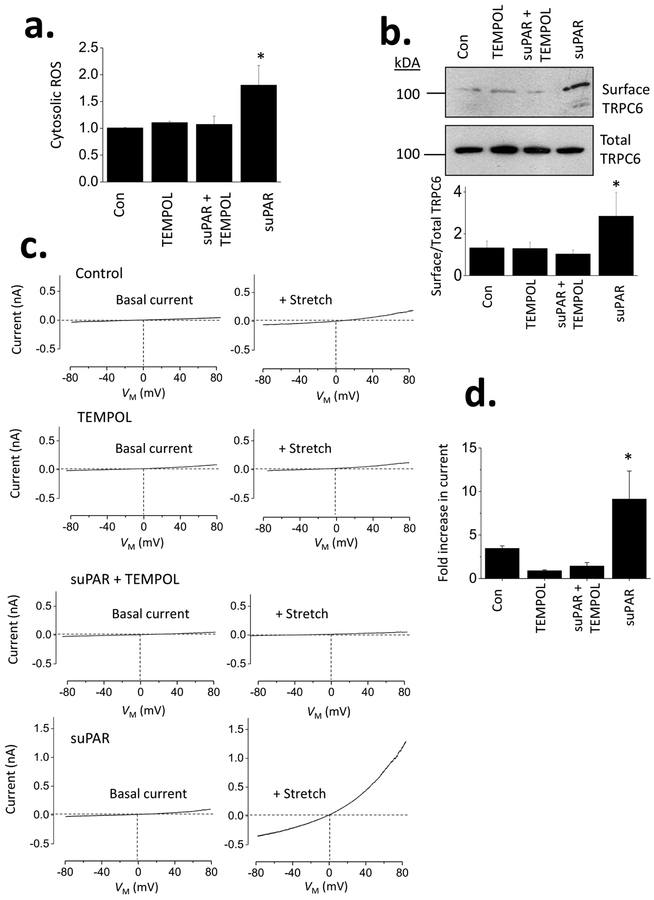
ROS are required for TRPC6 upregulation by suPAR in mouse podocytes. (a) Increases in ROS evoked by suPAR are prevented in cells concurrently treated with 100 μM TEMPOL, a membrane-permeable ROS quencher. (b) Concurrent exposure to 100 μM TEMPOL also prevents increase in steady-state cell surface expression of TRPC6 evoked by suPAR, as measured by cell-surface biotinylation assay. (c) Examples of whole-cell recordings show that membrane stretch-evoked cationic currents (previously shown to be mediated by TRPC6) are markedly increased in cells treated with suPAR (10 ng/ml for 24 hr). However, this did not occur in cells concurrently exposed to suPAR and TEMPOL or in cells exposed to TEMPOL alone for 24 hr. (d) Bar graphs showing mean fold increases in current (measured at +80 mV) evoked by membrane stretch depending on previous 24 hr of treatment.
Figure 3.
Figure 3.
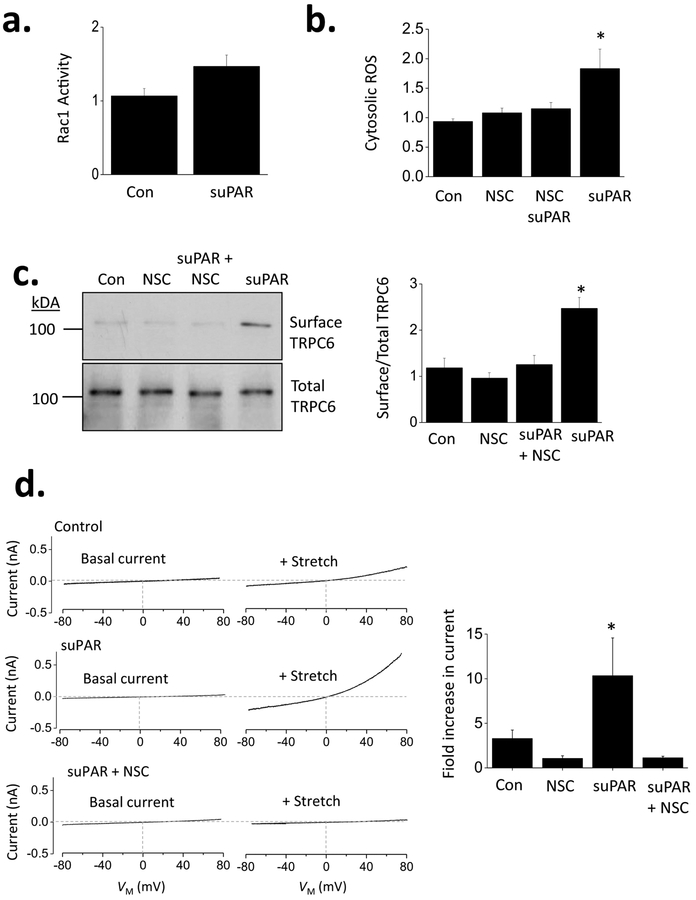
Effects of suPAR on TRPC6 require activation of Rac1 in mouse podocytes. (a) Treatment of suPAR increases activation of Rac1 measured by ELISA assay from podocyte lysates. (b) Increases in cytosolic ROS activation evoked by suPAR were prevented by concurrent exposure to 50 μM NSC23766 (NSC), an agent that blocks interactions of Rac1 with guanine nucleotide exchange factors, thereby preventing its activation. (c) Concurrent exposure to NSC23766 also prevented increase in steady-state cell surface expression of TRPC6 evoked by suPAR, assessed here by cell-surface biotinylation assay. (d) Increases in stretch-activated cationic currents evoked by 24 hr exposure to suPAR were prevented by concurrent exposure to NSC23766. Examples of recordings are shown to the left, and a bar graph summarizing results of this experiment are shown to the right.
Figure 4.
Figure 4.
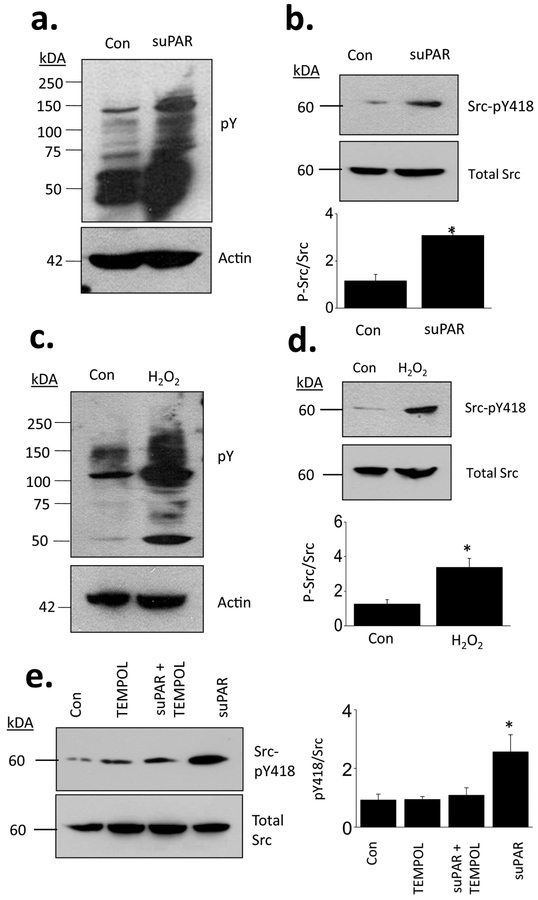
Exposure to suPAR increases abundance of proteins phosphorylated on tyrosine residues and causes ROS-dependent activation of Src. (a) Immunoblot analysis showing increased abundance of phosphotyrosine in podocytes treated with suPAR for 24 hr. (b) Immunoblot showing increased abundance of Src-pY418 relative to total Src in cells treated with suPAR. Exposing podocytes to medium containing 1 mM H2O2 for 30 min increased abundance of phosphortyrosine (c) and increased the abundance of Src-pY418 relative to total Src (d). (e) suPAR-evoked increases in SrcpY418 relative to total Src were blocked by concurrent exposure to TEMPOL.
Figure 5.
Figure 5.
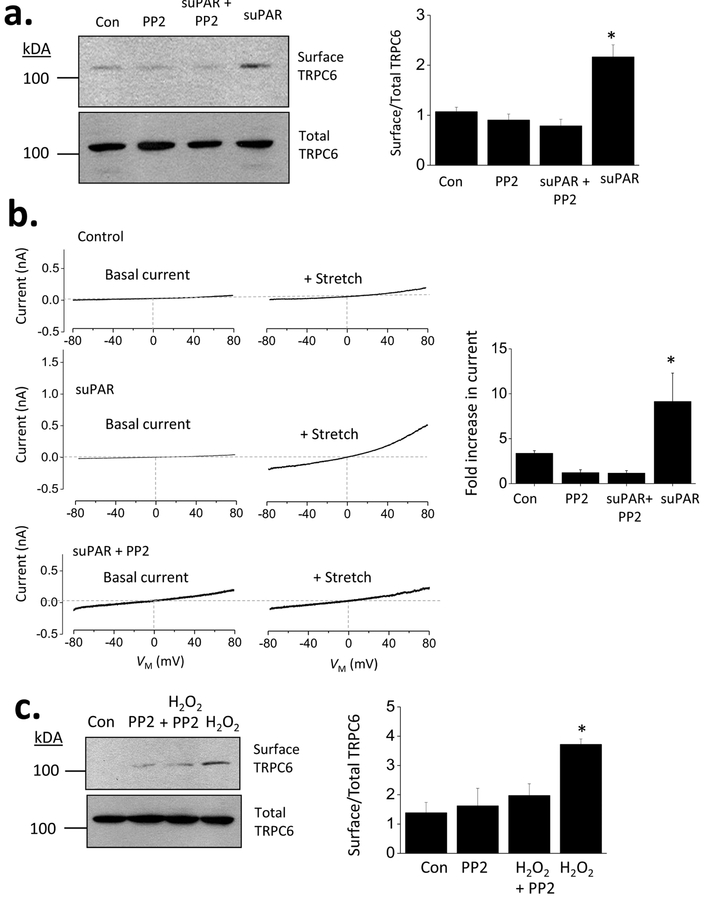
Upregulation of TRPC6 by suPAR or by oxidative stress requires activation of Src family kinases. (a) Cell surface biotinylation assays showing increased steady-state surface expression of TRPC6 evoked by suPAR was blocked by concurrent exposure to 5 μM PP2, an inhibitor of Src family tyrosine kinases. (b) Concurrent exposure PP2 also blocked increases in stretch-evoked cationic currents that follow 24 hr exposure to suPAR. (c) PP2 also prevented mobilization of TRPC6 channels evoked by 1 mM H2O2.
Figure 6.
Figure 6.
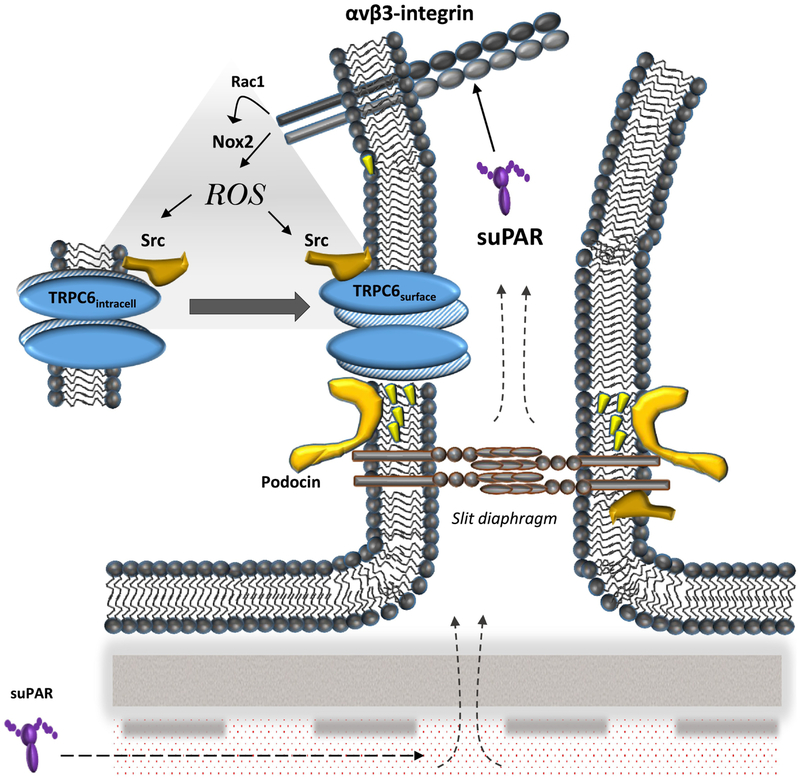
Schematic diagram summarizing results of this study. Circulating suPAR, which is increased in some patients, including a subset of patients with primary or recurrent FSGS, causes outside-in activation of αVβ3 integrins in podocytes. This results in Rac1-dependent activation of Nox2, which results in production of ROS. Those in turn lead to increased surface expression of TRPC6, which can be seen as an increase in cationic currents evoked by mechanical stimuli. The modulation of TRPC6 requires Src activation, which is in a position to cause a variety of effects on other proteins in slit diaphragm domains.

References

    1. Montuori N, Carriero MV, Salzano S, Rossi G, Ragno P. The cleavage of the urokinase receptor regulates its multiple functions. J BiolChem. 2002. 277(49):46932–9. - PubMed
    1. Desmedt S, Desmedt V, Delanghe JR, Speeckaert R, Speeckaert MM. The intriguing role of soluble urokinase receptor in inflammatory diseases. Crit Rev Clin Lab Sci. 2017. 54(2):117–133. - PubMed
    1. Zeier M, Reiser J. suPAR and chronic kidney disease-a podocyte story. Pflugers Arch. 2017. 469(7–8):1017–1020. - PubMed
    1. Rosenberg AZ, Kopp JB. Focal Segmental Glomerulosclerosis. Clin J Am Soc Nephrol. 2017. 12(3):502–517. - PMC - PubMed
    1. Blosser CD, Bloom RD. Recurrent glomerular disease after kidney transplantation. Curr Opin Nephrol Hypertens. 2017. 26(6):501–508. - PubMed

Publication types

MeSH terms