. 2019 May;21(5):1121-1130.
doi: 10.1038/s41436-018-0295-y. Epub 2018 Oct 8.

Copy-number variants in clinical genome sequencing: deployment and interpretation for rare and undiagnosed disease

Affiliations

Copy-number variants in clinical genome sequencing: deployment and interpretation for rare and undiagnosed disease

Andrew M Gross et al. Genet Med. 2019 May.

Abstract

Purpose: Current diagnostic testing for genetic disorders involves serial use of specialized assays spanning multiple technologies. In principle, genome sequencing (GS) can detect all genomic pathogenic variant types on a single platform. Here we evaluate copy-number variant (CNV) calling as part of a clinically accredited GS test.

Methods: We performed analytical validation of CNV calling on 17 reference samples, compared the sensitivity of GS-based variants with those from a clinical microarray, and set a bound on precision using orthogonal technologies. We developed a protocol for family-based analysis of GS-based CNV calls, and deployed this across a clinical cohort of 79 rare and undiagnosed cases.

Results: We found that CNV calls from GS are at least as sensitive as those from microarrays, while only creating a modest increase in the number of variants interpreted (~10 CNVs per case). We identified clinically significant CNVs in 15% of the first 79 cases analyzed, all of which were confirmed by an orthogonal approach. The pipeline also enabled discovery of a uniparental disomy (UPD) and a 50% mosaic trisomy 14. Directed analysis of select CNVs enabled breakpoint level resolution of genomic rearrangements and phasing of de novo CNVs.

Conclusion: Robust identification of CNVs by GS is possible within a clinical testing environment.

Keywords: copy number variation (CNV); microarray; rare and undiagnosed disease; structural variation (SV); whole genome sequencing (WGS).


Conflict of interest statement

A.M.G., S.S.A., V.R., C.B., K.B., N.J.B., A.C., A.J.C., A.M., A.S., E.T., E.D., B.L., J.B., E.R., S.I., S.T., J.M., M.E., R.T.H., D.R.B., D.L.P. and R.J.T. are current employees and shareholders of Illumina. N.D., K.H., T.S., A.K., T.H. are current employees and shareholders of Invitae. S.C. declares no conflicts of interest.

Figures
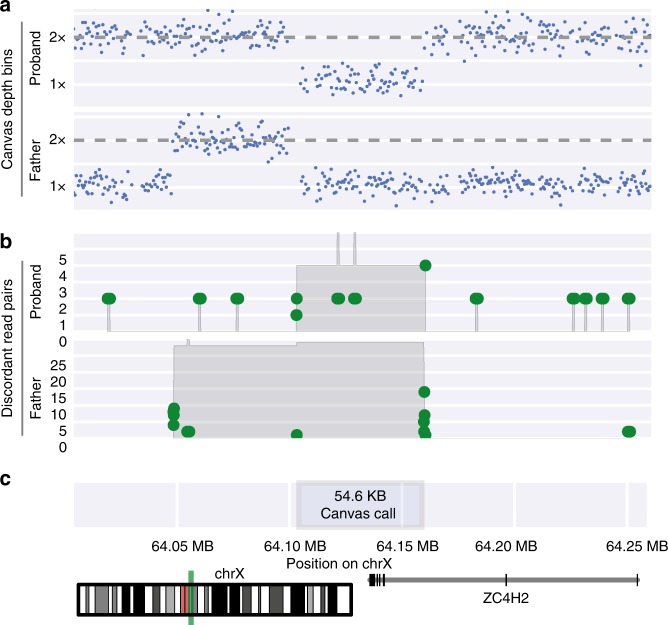
Fig. 1
Fig. 1
ZC4H2 de novo deletion in case P1. a Normalized sequencing depth for proband and her father. b Location of discordant read-pairs (>1000 bp insert size), where green dots represent the location of paired ends in a discordant read-pair, the gray shaded area represents the total number of discordant read-pairs spanning a given genomic segments. c Annotation of the original Canvas call boundaries as well as the location of the copy-number variant (CNV) on chromosome X.
Fig. 2
Fig. 2
Case P7: derivative chromosome inherited from a balanced translocation in a parent. a, b Sequencing depth support for a duplication on 16q and b deletion on 2p. Slices in the image represent distribution of normalized sequencing depth across 100-kb genomic intervals. c, d Distribution of maternal allele frequency for all phased variants in copy number altered regions corresponding to c 16q gain and d 2p loss. Note that variant frequency distributions are colored by the parent of origin as determined by trio phasing. e Summary of split and discordant sequencing read evidence for recombinant chromosomes at copy-number variant (CNV) breakpoints.
Fig. 3
Fig. 3
Mosaic 14q32.2 26-kb microdeletion. a–c Normalized depth across pedigree sequenced for subject P12. Shown here is the genomic region between 101.21 MB and 101.34 MB on chromosome 14 (hg19 coordinates). d Annotations for the genomic region. The orange box represents the Canvas CNV call boundaries, the green box represents breakpoint assembled coordinates of the deletion from the Manta SV caller, the black lines represent subjects from Kagami et al. with deletions in this region, the blue box represents the gene boundaries of the imprinted gene MEG3. e Average depth across the region of the CNV call for samples across an internal reference population; depth for the proband is indicated with a horizontal dashed line. f Variant allele frequency for the SNVs within the deleted region. CNV copy-number variant, SNV single-nucleotide variant, SV structural variant.

References

    1. Lupski JR. Structural variation mutagenesis of the human genome: impact on disease and evolution. Environ Mol Mutagen. 2015;56:419–436. doi: 10.1002/em.21943. - DOI - PMC - PubMed
    1. Harel T, Lupski JR Genomic disorders 20 years on—mechanisms for clinical manifestations. Clin Genet. 2018;93:439–449. - PubMed
    1. Riggs ER, Church DM, Hanson K, et al. Towards an evidence-based process for the clinical interpretation of copy number variation. Clin Genet. 2012;81:403–412. doi: 10.1111/j.1399-0004.2011.01818.x. - DOI - PMC - PubMed
    1. Swaminathan GJ, Bragin E, Chatzimichali EA, et al. DECIPHER: web-based, community resource for clinical interpretation of rare variants in developmental disorders. Hum Mol Genet. 2012;21:R37–R44. doi: 10.1093/hmg/dds362. - DOI - PMC - PubMed
    1. Vulto-van Silfhout AT, Hehir-Kwa JY, van Bon BWM, et al. Clinical significance of de novo and inherited copy-number variation. Hum Mutat. 2013;34:1679–1687. doi: 10.1002/humu.22442. - DOI - PubMed

Publication types
